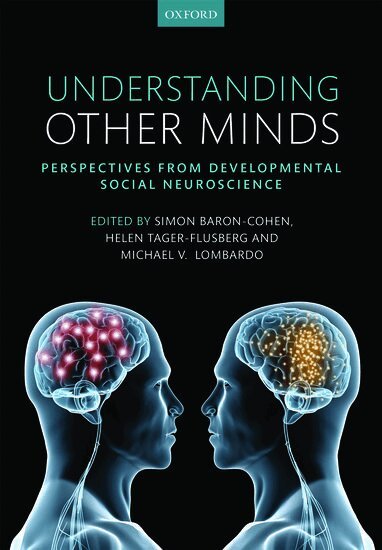
Understanding Other Minds
(häftad)Perspectives from Developmental Cognitive Neuroscience
av Simon Baron-Cohen
- Format:
- Häftad (paperback)
- Utgiven:
- 1999-12-01
- Språk:
- Engelska
(Oxford)
Passar bra ihop
|
De som köpt den här boken har ofta också köpt Nature Via Nurture (häftad) av Matt Ridley | |||
|
Pris för båda:
812:-Köp
|
Fler böcker av Simon Baron-Cohen
MindblindnessSimon Baron-Cohen (häftad) |
Teaching Children with Autism to Mind-readPatricia Howlin, Simon Baron-Cohen, Julie A Hadwin (häftad) |
Autism and Asperger SyndromeSimon Baron-Cohen (häftad) |
Essential DifferenceSimon Baron-Cohen (häftad) | |||
|
171:- Köp
|
322:- Köp
|
89:- Köp
|
142:- Köp
|
Kundrecensioner
Recensioner i media
"This is an important work in a rapidly changing field. The editors and contributors attempt to explain the always-elusive concept of self-awareness. The also attempt to explain that perhaps uniquely human quality of realizing that other, also, are self-aware, and how this ability is crucial in normal human development. Unlike may other books on this subject, the editors approach the concept from several different perspectives and succeed in offering an explanation using all these modalities. The book's usefulness is perhaps limited to researchers and child/development psychologists, but anyone interested in the subject will find it exciting reading."--Doody's<br> "Updated to integrate changes in theory, method, and data since the 1933 first edition, which was subtitled Perspectives from Autism, 21 studies cover the theory of mind from perspectives of normal development and autism, neurobiological aspects, clinical aspects, and anthropological and evolutionary issues. The range of topics is reflected in the disciplines from which the contributors hail. Among the specific concerns are developmental relationships between language and the theory of mind, the role of the frontal lobes and the amygdala, early diagnosis of autism, teaching the theory of mind to people with autism, whether chimpanzees use their gestures to instruct each other, and paleo-anthropological perspectives."--SciTech Book News<br> "Understanding Other Minds is a well thought-out text, with all the chapter authors achieving a very high standard of presentation. The book provides an excellent introduction for readers new to the area while also providing an important research synthesis for the more expert. Itcontains a wealth of material of obvious relevance and interest to psychiatrists, clinical psychologists and developmental psychologists, but will also be of interest to those working in other branches of psychology."--Psychological Medicine<br>
(Oxford)
Bloggat om Understanding Other Minds
Innehållsförteckning
Preface; SECTION 1: THEORY OF MIND IN NORMAL DEVELOPMENT AND AUTISM; 2. Developing understandings of mind; 3. Early theories of mind: what the theory can tell us about autism; 4. Autism: Deficits in folk psychology exist alongside superiority in folk physics; 5. Language and theory of mind: what are the developmental relationships?; 6. Language and understanding minds: connections in autism; 7. Theory of mind and executive function: is there a developmental relationship?; 8. Pretending, imagery and self-awareness in autism; 9. Parts and wholes, meaning and minds: central coherence and its relation to theory of mind; 10. Aspects of autism that theory of mind cannot easily explain; SECTION 2: THEORY OF MIND: NEUROBIOLOGICAL ASPECTS; 11. The role of the frontal lobes and the amygdala in theory of mind; 12. How can studies of the monkey brain help us understand theory of mind and autism in humans?; 13. Cerebral lateralization and theory of mind; 14. The physiological basis of theory of mind: functional neuroimaging studies; SECTION 3: THEORY OF MIND: CLINICAL ASPECTS; 15. Theory of mind in other clinical samples: is a selective theory of mind deficit exclusive to autism?; 16. Theory of mind and the early diagnosis of autism; 17. Teaching theory of mind to individuals with autism; SECTION 4: THEORY OF MIND: ANTHROPOLOGICAL AND EVOLUTIONARY ISSUES; 19. Palaeoanthropological perspectives on the theory of mind; 20. Culture and Understanding Other Minds; 21. Theory of mind in action
(Oxford)