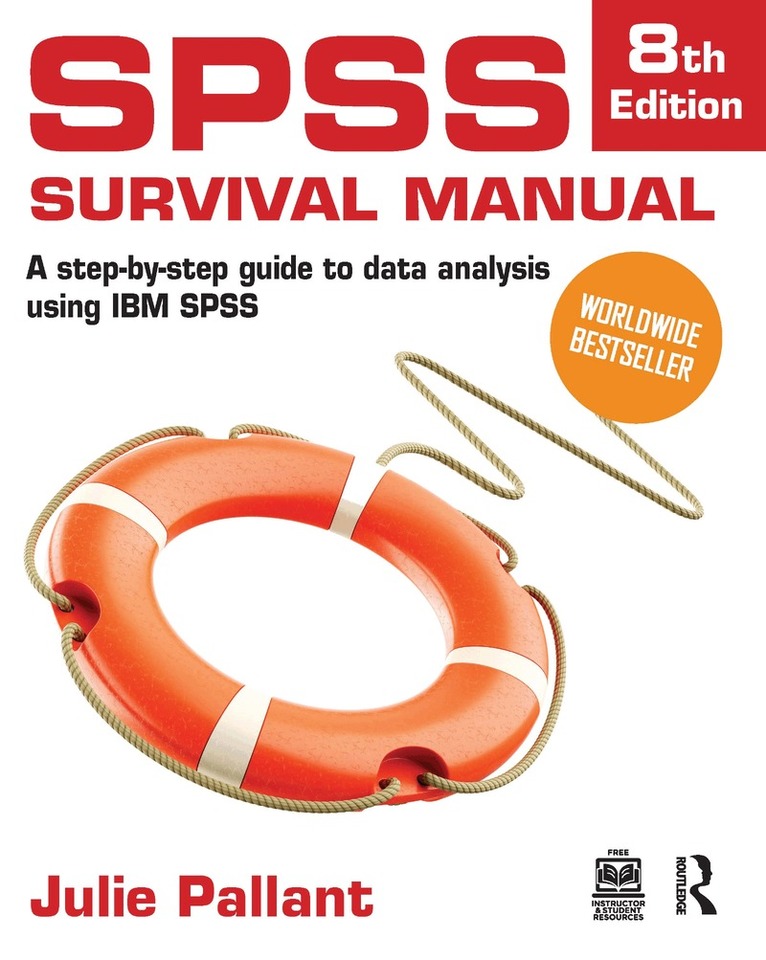
SPSS Survival Manual 4th Edition
A Step-by-step Guide to Data Analysis Using the SPSS Program
av J Pallant
- Format:
- Spiral bound
- Utgiven:
- 2010-11-15
- Språk:
- Engelska
In this thoroughly revised edition of her bestselling text, now covering up to version 18 of the SPSS software, Julie Pallant guides you through the entire research process, helping you choose the right data analysis technique for your project.
From the formulation of research questions, to the design of the study and analysis of data, to reporting the results, Julie discusses basic and advanced statistical techniques. She outlines each technique clearly, with easy to follow step-by-step procedures for performing the analysis, a detailed guide to interpreting data output and an example of how to present the results in a report. In this fourth edition all chapters have been updated to accommodate changes to SPSS procedures, screens and output. A number of additional techniques (McNemar's Test, Cochran's Q Test) have been included in the Non_parametric Statistics chapter. For both beginners and experienced users in psychology, sociology, health sciences, medicine, education, business and related disciplines, the SPSS Survival Manual is THE essential guide. Illustrated with screen grabs, examples of output and tips, it is supported by a website with sample data and guidelines on report writing.
(Computer Bookshops Limited)
Kundrecensioner
Bloggat om SPSS Survival Manual 4th Edition
Övrig information
Julie Pallant has spent many years helping students overcome 'statistics phobia'. She is Director of Research and Graduate Studies in the School of Rural Health at the University of Melbourne. She has worked as a counselling psychologist and has taught psychology, statistics and research methods at a number of universities.
(Computer Bookshops Limited)
Innehållsförteckning
Preface
Data files and website
Introduction and overview
Part One: Getting started
Designing a study
Preparing a codebook
Getting to know SPSS
Part Two: Preparing the data file
Creating a data file and entering data
Screening and cleaning the data
Part Three: Preliminary analyses
Descriptive statistics
Using graphs to describe and explore the data
Manipulating the data
Checking the reliability of a scale
Choosing the right statistic
Part Four: Statistical techniques to explore relationships among variables
Correlation
Partial correlation
Multiple regression
Logistic regression
Factor analysis
Part Five: Statistical techniques to compare groups
Non-parametric statistics
T-tests
One-way analysis of variance
Two-way between-groups ANOVA
Mixed between-within subjects analysis of variance
Multivariate analysis of variance
Analysis of covariance
Appendix: Details of data files
Recommended reading
References
Index
(Computer Bookshops Limited)