Beginning Linux Programming 4th Edition
(häftad)av Neil Matthew, Richard Stones
- Format:
- Häftad (paperback)
- Utgiven:
- 2007-11-01
- Språk:
- Engelska
(Computer Bookshops Limited)
Passar bra ihop
|
De som köpt den här boken har ofta också köpt Javascript: The Good Parts (häftad) av Douglas Crockford | |||
|
Pris för båda:
363:-Köp
|
Fler böcker av författarna
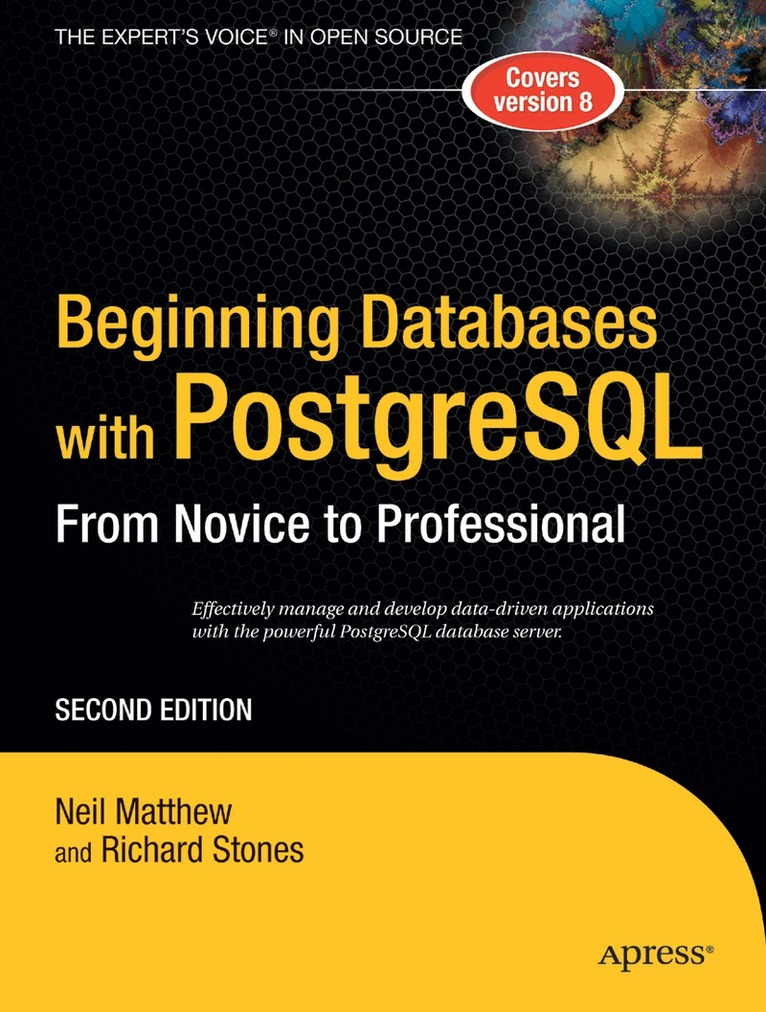
Beginning Databases with PostreSQL: From Expert to P...Richard Stones, Neil Matthew (häftad) |
Beginning Linux ProgrammingNeil Matthew (häftad) | |
|
368:- Köp
|
570:- Köp
|
Kundrecensioner
Bloggat om Beginning Linux Programming 4th Edition
Övrig information
Neil Matthew has been interested in and has programmed computers since 1974. A mathematics graduate from the University of Nottingham, Neil is just plain keen on programming languages and likes to explore new ways of solving computing problems. He's written systems to program in BCPL, FP (Functional Programming), Lisp, Prolog, and a structured BASIC. He even wrote a 6502 microprocessor emulator to run BBC microcomputer programs on UNIX systems. In terms of UNIX experience, Neil has used almost every flavor since the late 1970s, including BSD UNIX, AT&T System V, Sun Solaris, IBM AIX, many others, and of course Linux. He can claim to have been using Linux since August 1993 when he acquired a floppy disk distribution of Soft Landing (SLS) from Canada, with kernel version 0.99.11. He's used Linux-based computers for hacking C, C++, Icon, Prolog, Tcl, and Java at home and at work. All of Neil's "home" projects are developed using Linux. He says Linux is much easier because it supports quite a lot of features from other systems, so that both BSD- and System V-targeted programs will generally compile with little or no change. Neil is currently working as an Enterprise Architect specializing in IT strategy at Celesio AG. He has a background in technical consultancy, software development techniques, and quality assurance. Neil has also programmed in C and C++ for real-time embedded systems. Rick Stones started programming at school (more years ago than he cares to remember) on a 6502-powered BBC micro, which, with the help of a few spare parts, continued to function for the next 15 years. He graduated from Nottingham University with a degree in Electronic Engineering, but decided software was more fun. Over the years he has worked for a variety of companies, from the very small with just a dozen employees, to the very large, including the IT services giant EDS. Along the way he has worked on a range of projects, from real-time communications to accounting systems, to very large help desk systems. He is currently working as an IT architect, acting as a technical authority on various major projects for a large pan-European company. A bit of a programming linguist, he has programmed in various assemblers, a rather neat proprietary telecommunications language called SL-1, some FORTRAN, Pascal, Perl, SQL, and smidgeons of Python and C++, as well as C. (Under duress he even admits that he was once reasonably proficient in Visual Basic, but tries not to advertise this aberration.)
(Computer Bookshops Limited)
Innehållsförteckning
Acknowledgements.
Foreword.
Introduction.
Chapter 1: Getting Started.
Chapter 2: Shell Programming.
Chapter 3: Working with Files.
Chapter 4: The Linux Environment.
Chapter 5: Terminals.
Chapter 6: Managing Text-Based Screens with curses.
Chapter 7: Data Management.
Chapter 8: MySQL.
Chapter 9: Development Tools.
Chapter 10: Debugging.
Chapter 11: Processes and Signals.
Chapter 12: POSIX Threads.
Chapter 13: Inter-Process Communication: Pipes.
Chapter 14: Semaphores, Shared Memory, and Message Queues.
Chapter 15: Sockets.
Chapter 16: Programming GNOME Using GTK+.
Chapter 17: Programming KDE Using Qt.
Chapter 18: Standards for Linux.
Index.
(Computer Bookshops Limited)