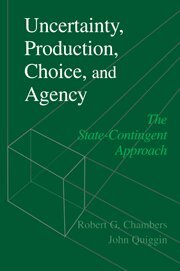
Uncertainty, Production, Choice, and Agency
The State-Contingent Approach
AvRobert G. Chambers,John Quiggin
Häftad, Engelska, 2000
633 kr
Beställningsvara. Skickas inom 7-10 vardagar. Fri frakt över 249 kr.
Fler format och utgåvor
Beskrivning
This book demonstrates that the state-contingent approach provides the best way to think about all problems in the economics of uncertainty, including problems of consumer choice, the theory of the firm, and principal agent relationships. The authors demonstrate that dual methods apply under uncertainty and that the dual representations can be developed for stochastic technologies. Moreover, proper exploitation of the properties of alternative primal and dual representations of preferences allows analysts to generalize and extend the results of the existing literature on preferences under uncertainty, thus making expected-utility theory largely superfluous for many decisions. These insights open the way for developments in the basic theory of production under uncertainty, the theory of hedging behavior, the analysis of agency problems and the theory of production insurance.