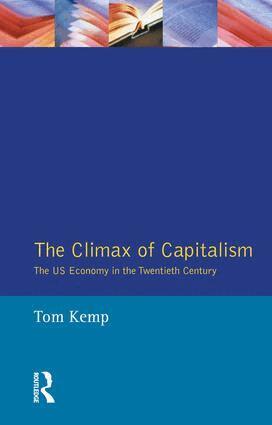
The Climax of Capitalism
(häftad)The U.S. Economy in the Twentieth Century
av T Kemp
- Format:
- Häftad (paperback)
- Utgiven:
- 1990-10-01
- Språk:
- Engelska
(Pearson)
Passar bra ihop
|
De som köpt den här boken har ofta också köpt An Economic History of Twentieth-Century Europe (häftad) av Ivan T Berend | |||
|
Pris för båda:
616:-Köp
|
Fler böcker av T Kemp
Historical Patterns of IndustrializationT Kemp (häftad) |
Industrialization in Nineteenth Century EuropeT Kemp (häftad) |
Industrialisation in the Non-Western WorldT Kemp (häftad) | ||
|
319:- Köp
|
360:- Köp
|
270:- Köp
|
Kundrecensioner
Bloggat om The Climax of Capitalism
Innehållsförteckning
Part 1 Sources of American power: from primary producer to industrial giant; the Civil War and its significance; the industrialization process; rise of the corporation; business management; Taylorism; industrial achievement; social mobility; the United States in the world. Part 2 Trends in the twenties: the United States - world power; the prosperity decade; the automotive revolution; consumer durables; a booming economy; underconsumption; limits of welfare capitalism; the weaknesses of the labour movement; the organization of business; anti-trust laws; combination and monopoly; corporate business; business ideology; small and medium sized firms; traditional forms of business; geographical distribution of industry; manufacturing industry - the power house; Taylorism and Fordism in the twenties; working class conditions; Taylorism and the labour process; Fordism and the assembly line; agriculture - the simmering crisis; ideological trends; the banking system - a weak link. Part 3 A decade or crisis - 1929-1939: Black Thursday; the greatest depression; the limits of orthodoxy; the monetarist view; extent of the decline; Hoover's response; Roosevelt takes over; the New Deal; the historial significance of the New Deal; other New Deal measures; labour; social security; the depression summed up. Part 4 The economic impact of the Second World War: war brings full employment; the arms build up; government intervention; war production at its peak; labour in the war; the cost of the war; demobilization and reconstruction; the war economy and the development of American capitalism. Part 5 The post-1945 economy - the fifties boom: the post-war boom; the influence of Keynes; American hegemony and the Bretton Woods system; the cold war; the Marshall plan; prosperity returns; anti union policy; the new American dream; new trends of the fifties; roots of expansion; living standards; military spending. Part 6 Affluence and the Vietnam War - the 1960s: the Kennedy-Johnson boom; Keynesianism triumphant; the Great Society and Vietnam; financing the war; the war on poverty; the dollar weakens; war and inflation; Keynesianism falters. Part 7 Structural changes in American capitalism since 1945: corporate strategy; management techniques - the US model; the affluent society; the regulated market economy; towards a welfare state; the military-industrial complex; agriculture - the regulation of market forces. Part 8 Into troubled waters - the economy in the 1970s: the enigma of stagflation; enter Richard Nixon; towards recession; whip inflation now; the first oil shock; the second oil shock; role of the fed; a new phase; symptoms of change; bail-outs; changes in industry; foreign competition; the MNCS; post-industrial society. (Part Contents)
(Pearson)