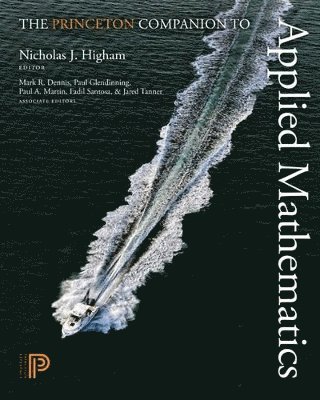
The Princeton Companion to Mathematics
av Timothy Gowers, June Barrow-Green, Imre Leader
(Bookdata)
Passar bra ihop
|
De som köpt den här boken har ofta också köpt What Is This Thing Called Science? Third Edition (häftad) av Chalmers | |||
|
Pris för båda:
853:-Köp
|
Fler böcker av författarna
Mathematics: A Very Short IntroductionTimothy Gowers (häftad) |
Poincare And The Discovery Of ChaosJune Barrow-Green (inbunden) |
MathematicsTimothy Gowers (e-bok) |
Princeton Companion to MathematicsTimothy Gowers, June Barrow-Green, Imre Leader (e-bok) | |||
|
93:- Köp
|
233:- Köp
|
97:- Visa
|
863:- Visa
|
Kundrecensioner
Recensioner i media
The Princeton Companion to Mathematics makes a heroic attempt to keep [abstract concepts] to a minimum ... and conveys the breadth, depth and diversity of mathematics. It is impressive and well written and it's good value for [the] money. -- Ian Stewart, The Times This is a panoramic view of modern mathematics. It is tough going in some places, but much of it is surprisingly accessible. A must for budding number-crunchers. -- "The Economist Although the editors' original goal of text that could be understood by anyone with a good background in high school mathematics provided short-lived, this wide-ranging account should reward undergraduate and graduate students and anyone curious about math as well as help research mathematicians understand the work of their colleagues in other specialties. The editors note some advantages a carefully organized printed reference may enjoy over a collection of Web pages, and this impressive volume supports their claim. -- "Science This impressive book represents an extremely ambitious and, I might add, highly successful attempt by Timothy Gowers and his coeditors, June Barrow-Green and Imre Leader, to give a current account of the subject of mathematics. It has something for nearly everyone, from beginning students of mathematics who would like to get some sense of what the subject is all about, all the way to professional mathematicians who would like to get a better idea of what their colleagues are doing... If I had to choose just one book in the world to give an interested reader some idea of the scope, goals and achievements of modern mathematics, without a doubt this would be the one. So try it. I guarantee you'll like it! -- "American Scientist Accessible, technically precise and thorough account of all math's major aspects. Students of math will find this book a helpful reference for understanding their classes; students of everything else will find helpful guides to understanding how math describes it all. -- Tom Siegfried, Science News Once in a while a book comes along that should be on every mathematician's bookshelf. This is such a book. Described as a 'companion', this 1000-page tome is an authoritative and informative reference work that is also highly pleasurable to dip into. Much of it can be read with benefit by undergraduate mathematicians, while there is a great deal to engage professional mathematicians of all persuasions. -- Robin Wilson, London Mathematical Society Imagine taking an overview of elementary and advanced mathematics, a history of mathematics and mathematicians, and a mathematical encyclopedia and combining them all into one comprehensive reference book. That is what Timothy Gowers, the 1998 Fields Medal laureate, has successfully accomplished in compiling and editing The Princeton Companion to Mathematics. At more than 1,000 pages and with nearly 200 entries written by some of the leading mathematicians of our time and specialists in their fields, this book is a one-of-a-kind reference for all things mathematics. -- "Mathematics Teacher Overall [The Princeton Companion to Mathematics] is an enormous achievement for which the authors deserve to be thanked. It contains a wealth of material, much of a kind one would not find elsewhere, and can be enjoyed by readers with man different backgrounds. -- Simon Donaldson, Notices of the American Mathematical Society This is an enormously ambitious book, full of beautiful things; I would wish to keep it on my bedside table, but that could only be possible relays, since of course it is far too large... To sum up, [The Princeton Companion to Mathematics] is really excellent. I know of no book that will give a young student a better idea of what mathematics is about. I am certain that this is the only single book that is likely to tell me what my colleagues are doing. -- Bryan Birch, Notices of the American Mathematical Society The book is so rich and yet it is well done. A rare achievement indeed!
(Bookdata)
Bloggat om The Princeton Companion to Mathematics
Övrig information
Timothy Gowers is the Rouse Ball Professor of Mathematics at the University of Cambridge. He received the Fields Medal in 1998, and is the author of "Mathematics: A Very Short Introduction". June Barrow-Green is lecturer in the history of mathematics at the Open University. Imre Leader is professor of pure mathematics at the University of Cambridge.
(Bookdata)
Innehållsförteckning
Preface ix Contributors xvii Part I Introduction I.1 What Is Mathematics About? 1 I.2 The Language and Grammar of Mathematics 8 I.3 Some Fundamental Mathematical Definitions 16 I.4 The General Goals of Mathematical Research 48 Part II The Origins of Modern Mathematics II.1 From Numbers to Number Systems 77 II.2 Geometry 83 II.3 The Development of Abstract Algebra 95 II.4 Algorithms 106 II.5 The Development of Rigor in Mathematical Analysis 117 II.6 The Development of the Idea of Proof 129 II.7 The Crisis in the Foundations of Mathematics 142 Part III Mathematical Concepts III.1 The Axiom of Choice 157 III.2 The Axiom of Determinacy 159 III.3 Bayesian Analysis 159 III.4 Braid Groups 160 III.5 Buildings 161 III.6 Calabi-Yau Manifolds 163 III.7 Cardinals 165 III.8 Categories 165 III.9 Compactness and Compactification 167 III.10 Computational Complexity Classes 169 III.11 Countable and Uncountable Sets 170 III.12 C*-Algebras 172 III.13 Curvature 172 III.14 Designs 172 III.15 Determinants 174 III.16 Differential Forms and Integration 175 III.17 Dimension 180 III.18 Distributions 184 III.19 Duality 187 III.20 Dynamical Systems and Chaos 190 III.21 Elliptic Curves 190 III.22 The Euclidean Algorithm and Continued Fractions 191 III.23 The Euler and Navier-Stokes Equations 193 III.24 Expanders 196 III.25 The Exponential and Logarithmic Functions 199 III.26 The Fast Fourier Transform 202 III.27 The Fourier Transform 204 III.28 Fuchsian Groups 208 III.29 Function Spaces 210 III.30 Galois Groups 213 III.31 The Gamma Function 213 III.32 Generating Functions 214 III.33 Genus 215 III.34 Graphs 215 III.35 Hamiltonians 215 III.36 The Heat Equation 216 III.37 Hilbert Spaces 219 III.38 Homology and Cohomology 221 III.39 Homotopy Groups 221 III.40 The Ideal Class Group 221 III.41 Irrational and Transcendental Numbers 222 III.42 The Ising Model 223 III.43 Jordan Normal Form 223 III.44 Knot Polynomials 225 III.45 K-Theory 227 III.46 The Leech Lattice 227 III.47 L-Functions 228 III.48 Lie Theory 229 III.49 Linear and Nonlinear Waves and Solitons 234 III.50 Linear Operators and Their Properties 239 III.51 Local and Global in Number Theory 241 III.52 The Mandelbrot Set 244 III.53 Manifolds 244 III.54 Matroids 244 III.55 Measures 246 III.56 Metric Spaces 247 III.57 Models of Set Theory 248 III.58 Modular Arithmetic 249 III.59 Modular Forms 250 III.60 Moduli Spaces 252 III.61 The Monster Group 252 III.62 Normed Spaces and Banach Spaces 252 III.63 Number Fields 254 III.64 Optimization and Lagrange Multipliers 255 III.65 Orbifolds 257 III.66 Ordinals 258 III.67 The Peano Axioms 258 III.68 Permutation Groups 259 III.69 Phase Transitions 261 III.70 p 261 III.71 Probability Distributions 263 III.72 Projective Space 267 III.73 Quadratic Forms 267 III.74 Quantum Computation 269 III.75 Quantum Groups 272 III.76 Quaternions, Octonions, and Normed Division Algebras 275 III.77 Representations 279 III.78 Ricci Flow 279 III.79 Riemann Surfaces 282 III.80 The Riemann Zeta Function 283 III.81 Rings, Ideals, and Modules 284 III.82 Schemes 285 III.83 The Schrodinger Equation 285 III.84 The Simplex Algorithm 288 III.85 Special Functions 290 III.86 The Spectrum 294 III.87 Spherical Harmonics 295 III.88 Symplectic Manifolds 297 III.89 Tensor Products 301 III.90 Topological Spaces 301 III.91 Transforms 303 III.92 Trigonometric Functions 307 III.93 Universal Covers 309 III.94 Variational Methods 310 III.95 Varieties 313 III.96 Vector Bundles 313 III.97 Von Neumann Algebras 313 III.98 Wavelets 313 III.99 The Zermelo-Fraenkel Axioms 314 Part IV Branches of Mathematics IV.1 Algebraic Numbers 315 IV.2 Analytic Number Theory 332 IV.3 Computational Number Theory 348 IV.4 Algebraic Geometry 363 IV.5 Arithmetic Geometry 372 IV.6 Algebraic Topology 383 IV.7 Differen
(Bookdata)