
Ahmed Seffah – författare
Visar alla böcker från författaren Ahmed Seffah. Handla med fri frakt och snabb leverans.
11 produkter
11 produkter

Häftad, Engelska, 2020
685 kr
Skickas inom 10-15 vardagar
There is an intrinsic conflict between creating secure systems and usable systems. But usability and security can be made synergistic by providing requirements and design tools with specific usable security principles earlier in the requirements and design phase. In certain situations, it is possible to increase usability and security by revisiting design decisions made in the past; in others, to align security and usability by changing the regulatory environment in which the computers operate. This book addresses creation of a usable security protocol for user authentication as a natural outcome of the requirements and design phase of the authentication method development life cycle.
Inbunden, Engelska, 2003
1 503 kr
Skickas inom 11-20 vardagar
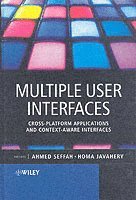
Multiple User Interfaces allow people using mobile phones, lap tops, desk tops, palm tops or PDAs to access and read information from their central server or the internet in a coherent and consistent way and to communicate effectively with other users who may be using different devices. MUIs provide multiple views of the information according to the device used and co-ordinate communication between the users. Multiple User Interfaces: Engineering and Applications Frameworks is the first work to describe user interface design for mobile and hand-held devices such as mobile phones. Given the proliferation of books on web site design in the late '90s, this promises to be the forerunner in a new wave of books dealing with the issues specific to small screens, limited memory and wireless transmission. It also deals with problems relating to multi-user functionality and sharing the same application over various platforms. Offers a comprehensive account of state-of-the-art researchCombines human and technical aspects including social interaction, workflow, HCI, & system architectures.Provides practical toolkits, guidelines and experience reportsIncludes contributions from leading experts at all the key institutions – Virginia Tech, Concordia University, Lancaster University, Ericsson & Intel With such a unique and cutting-edge approach researchers and developers working on user interface design in companies manufacturing handsets and other portable devices, university HCI groups and companies providing web-based information services for delivery to hand-held devices will find this indispensable.

Inbunden, Engelska, 2018
1 632 kr
Skickas inom 10-15 vardagar
There is an intrinsic conflict between creating secure systems and usable systems. But usability and security can be made synergistic by providing requirements and design tools with specific usable security principles earlier in the requirements and design phase. In certain situations, it is possible to increase usability and security by revisiting design decisions made in the past; in others, to align security and usability by changing the regulatory environment in which the computers operate. This book addresses creation of a usable security protocol for user authentication as a natural outcome of the requirements and design phase of the authentication method development life cycle.

Inbunden, Engelska, 2005
1 102 kr
Skickas inom 10-15 vardagar
Human-CenteredSoftwareEngineering: BridgingHCI,UsabilityandSoftwareEngineering From its beginning in the 1980’s, the ?eld of human-computer interaction (HCI) has beende?nedasamultidisciplinaryarena. BythisImeanthattherehas beenanexplicit recognition that distinct skills and perspectives are required to make the whole effort of designing usable computer systems work well. Thus people with backgrounds in Computer Science (CS) and Software Engineering (SE) joined with people with ba- grounds in various behavioral science disciplines (e. g. , cognitive and social psych- ogy, anthropology)inaneffortwhereallperspectiveswereseenasessentialtocreating usable systems. But while the ?eld of HCI brings individuals with many background disciplines together to discuss a common goal - the development of useful, usable, satisfying systems - the form of the collaboration remains unclear. Are we striving to coordinate the varied activities in system development, or are we seeking a richer collaborative framework? In coordination, Usability and SE skills can remain quite distinct and while the activities of each group might be critical to the success of a project, we need only insure that critical results are provided at appropriate points in the development cycle. Communication by one group to the other during an activity might be seen as only minimally necessary. In collaboration, there is a sense that each group can learn something about its own methods and processes through a close pa- nership with the other. Communication during the process of gathering information from target users of a system by usability professionals would not be seen as so- thing that gets in the way of the essential work of software engineering professionals.
Inbunden, Engelska, 2008
556 kr
Skickas inom 10-15 vardagar
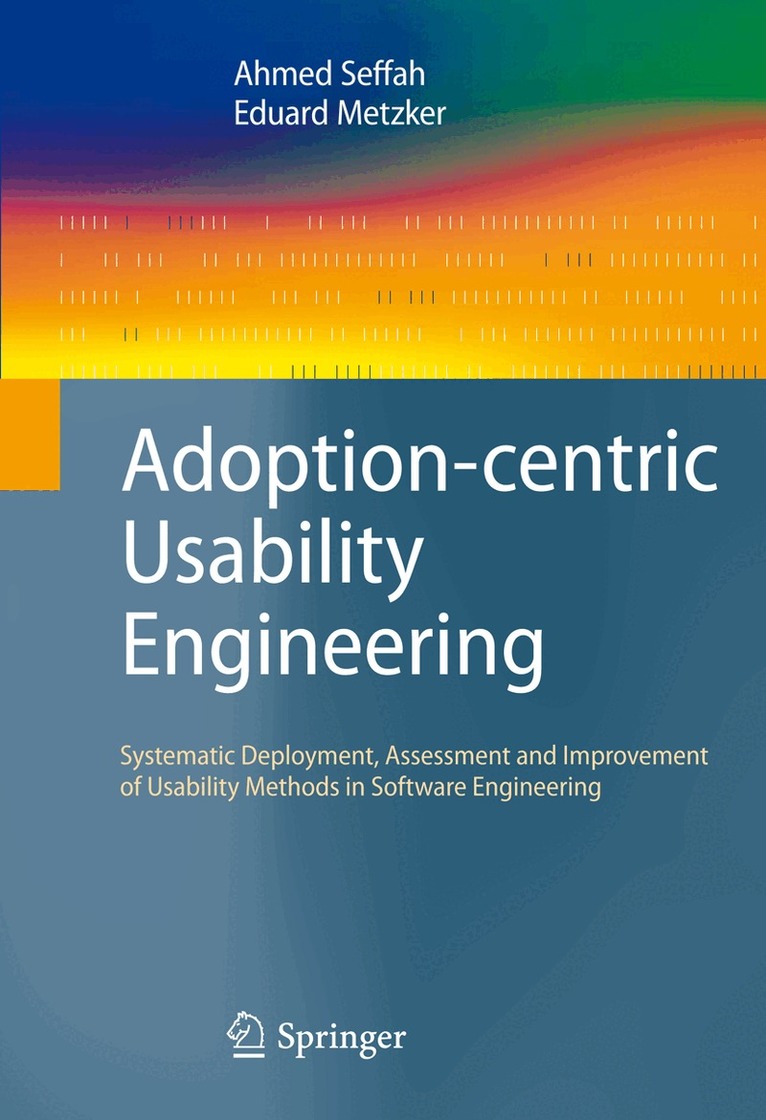
Developing software systems which are easy to use while simultaneously increasing the productivity, performance and satisfaction of users is still a major challenge in software engineering. Thus a large number of usability engineering methods have been proposed to systematically develop software with high usability. A large number of studies indicate that even basic usability engineering methods are not integrated in software development lifecycles practiced in industrial settings. Yet problems in the adoption of methods by project teams are rarely examined. This book provides a new perspective on the integration and adoption of usability engineering methods by software development teams. The adoption of methods by project teams – contrary to popular belief – is not assured just because it is mandated by the organization. This work argues that usability engineering methods can only be regarded as integrated in the software development process of an organization when these methods are practiced and accepted by development teams. So far no frameworks for examining the acceptance of methods by project teams and for exploiting such data for guiding project teams in method deployment are available. To address this problem, this book presents an approach which consists of a process meta-model for guiding project teams in the deployment of usability en- neering methods and a measurement framework for measuring the acceptance of the deployed methods. The approach is called Adoption-Centric Usability Engineering.

Inbunden, Engelska, 2009
1 650 kr
Skickas inom 10-15 vardagar
Activity theory is a way of describing and characterizing the structure of human - tivity of all kinds. First introduced by Russian psychologists Rubinshtein, Leontiev, and Vigotsky in the early part of the last century, activity theory has more recently gained increasing attention among interaction designers and others in the hum- computer interaction and usability communities (see, for example, Gay and H- brooke, 2004). Interest was given a signi?cant boost when Donald Norman suggested activity-theory and activity-centered design as antidotes to some of the putative ills of “human-centered design” (Norman, 2005). Norman, who has been credited with coining the phrase “user-centered design,” suggested that too much attention focused on human users may be harmful, that to design better tools designers need to focus not so much on users as on the activities in which users are engaged and the tasks they seek to perform within those activities. Although many researchers and practitioners claim to have used or been in?uenced by activity theory in their work (see, for example, Nardi, 1996), it is often dif?cult to trace precisely where or how the results have actually been shaped by activity theory. Inmanycases, evendetailedcasestudiesreportresultsthatseemonlydistantlyrelated, if at all, to the use of activity theory. Contributing to the lack of precise and traceable impact is that activity theory, - spite its name, is not truly a formal and proper theory.
Häftad, Engelska, 2010
556 kr
Skickas inom 10-15 vardagar
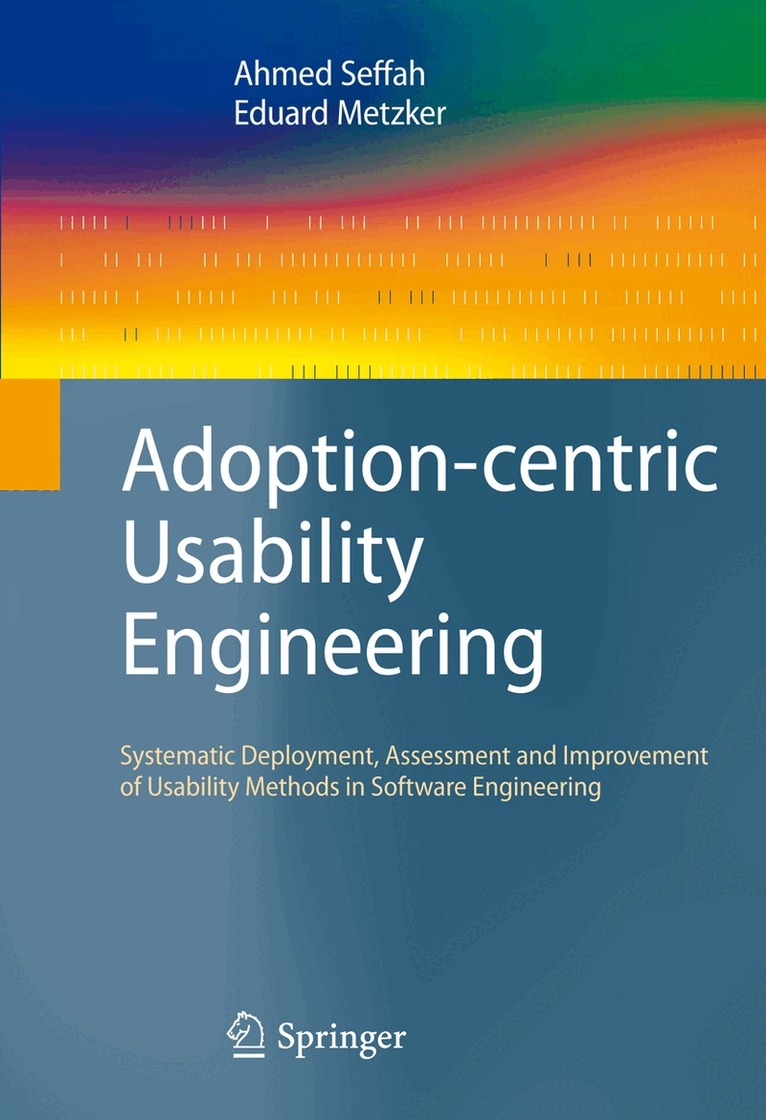
Developing software systems which are easy to use while simultaneously increasing the productivity, performance and satisfaction of users is still a major challenge in software engineering. Thus a large number of usability engineering methods have been proposed to systematically develop software with high usability. A large number of studies indicate that even basic usability engineering methods are not integrated in software development lifecycles practiced in industrial settings. Yet problems in the adoption of methods by project teams are rarely examined. This book provides a new perspective on the integration and adoption of usability engineering methods by software development teams. The adoption of methods by project teams – contrary to popular belief – is not assured just because it is mandated by the organization. This work argues that usability engineering methods can only be regarded as integrated in the software development process of an organization when these methods are practiced and accepted by development teams. So far no frameworks for examining the acceptance of methods by project teams and for exploiting such data for guiding project teams in method deployment are available. To address this problem, this book presents an approach which consists of a process meta-model for guiding project teams in the deployment of usability en- neering methods and a measurement framework for measuring the acceptance of the deployed methods. The approach is called Adoption-Centric Usability Engineering.

Häftad, Engelska, 2010
1 650 kr
Skickas inom 10-15 vardagar
Activity theory is a way of describing and characterizing the structure of human - tivity of all kinds. First introduced by Russian psychologists Rubinshtein, Leontiev, and Vigotsky in the early part of the last century, activity theory has more recently gained increasing attention among interaction designers and others in the hum- computer interaction and usability communities (see, for example, Gay and H- brooke, 2004). Interest was given a signi?cant boost when Donald Norman suggested activity-theory and activity-centered design as antidotes to some of the putative ills of “human-centered design” (Norman, 2005). Norman, who has been credited with coining the phrase “user-centered design,” suggested that too much attention focused on human users may be harmful, that to design better tools designers need to focus not so much on users as on the activities in which users are engaged and the tasks they seek to perform within those activities. Although many researchers and practitioners claim to have used or been in?uenced by activity theory in their work (see, for example, Nardi, 1996), it is often dif?cult to trace precisely where or how the results have actually been shaped by activity theory. Inmanycases, evendetailedcasestudiesreportresultsthatseemonlydistantlyrelated, if at all, to the use of activity theory. Contributing to the lack of precise and traceable impact is that activity theory, - spite its name, is not truly a formal and proper theory.
Inbunden, Engelska, 2015
1 102 kr
Skickas inom 10-15 vardagar
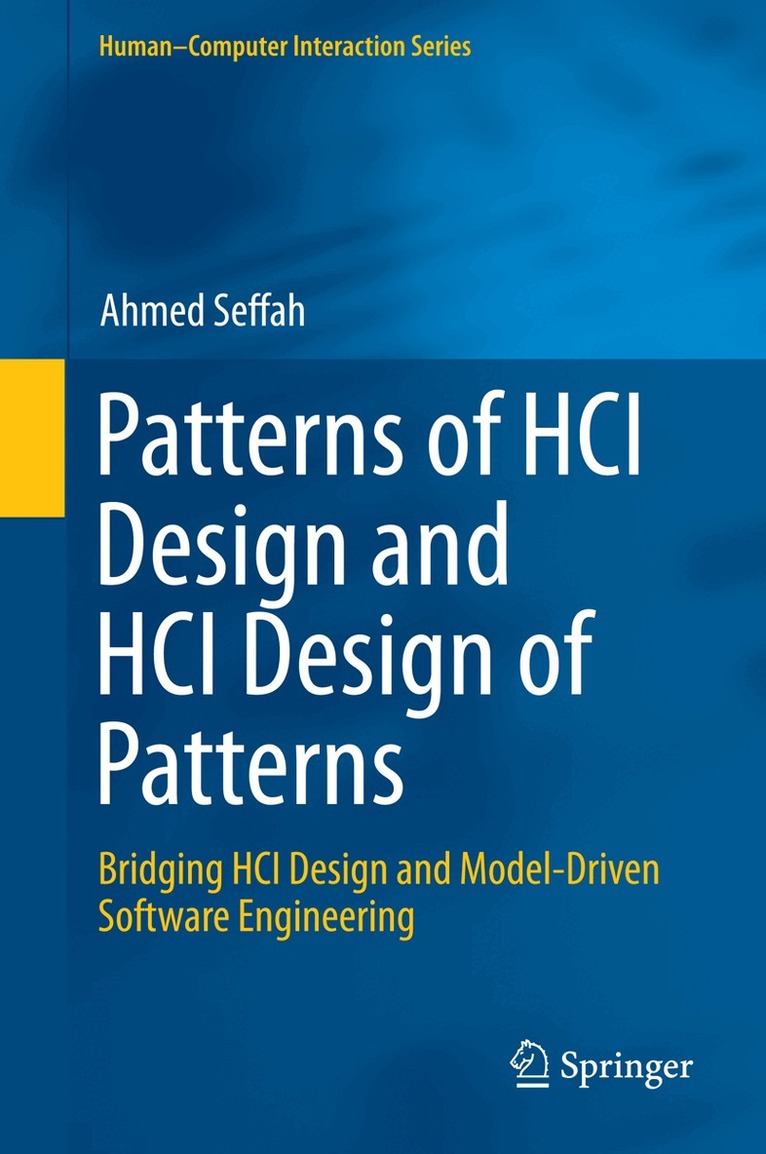
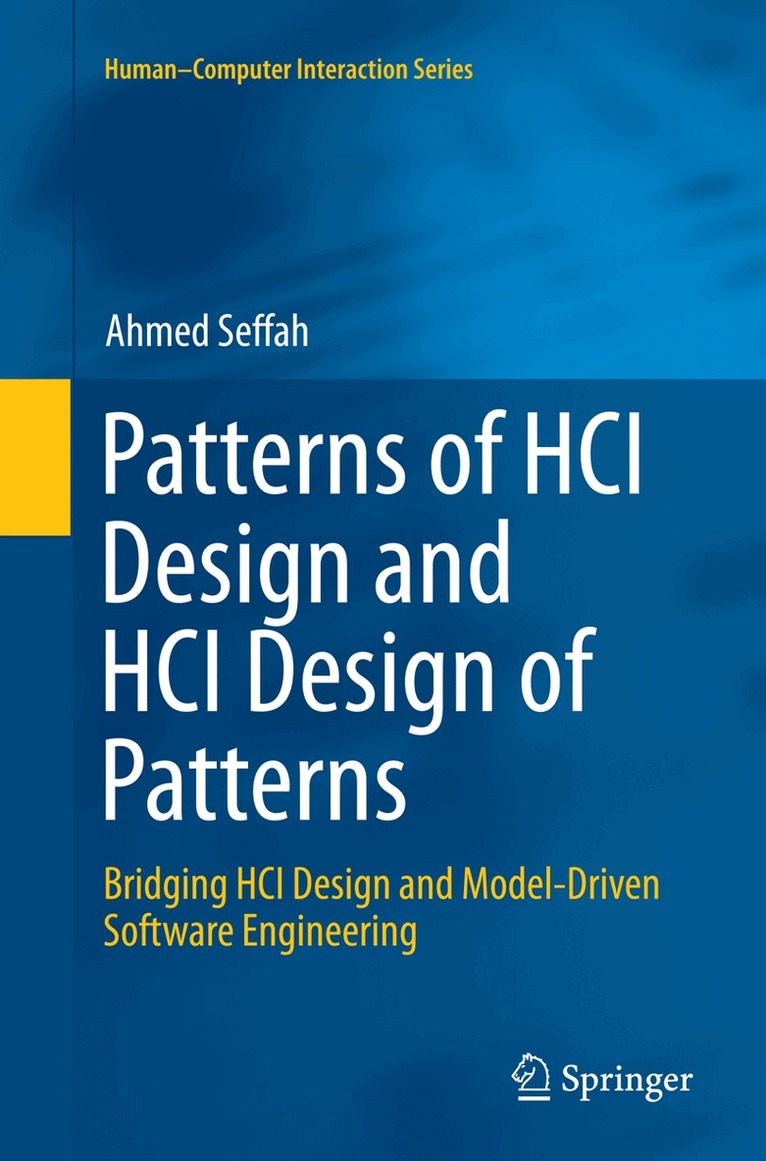
As interactive systems are quickly becoming integral to our everyday lives, this book investigates how we can make these systems, from desktop and mobile apps to more wearable and immersive applications, more usable and maintainable by using HCI design patterns. It also examines how we can facilitate the reuse of design practices in the development lifecycle of multi-devices, multi-platforms and multi-contexts user interfaces. Effective design tools are provided for combining HCI design patterns and User Interface (UI) driven engineering to enhance design whilst differentiating between UI and the underlying system features. Several examples are used to demonstrate how HCI design patterns can support this decoupling by providing an architectural framework for pattern-oriented and model-driven engineering of multi-platforms and multi-devices user interfaces. Patterns of HCI Design and HCI Design of Patterns is for students, academics and Industry specialists who are concerned with user interfaces and usability within the software development community.
Häftad, Engelska, 2016
1 102 kr
Skickas inom 10-15 vardagar
As interactive systems are quickly becoming integral to our everyday lives, this book investigates how we can make these systems, from desktop and mobile apps to more wearable and immersive applications, more usable and maintainable by using HCI design patterns. It also examines how we can facilitate the reuse of design practices in the development lifecycle of multi-devices, multi-platforms and multi-contexts user interfaces. Effective design tools are provided for combining HCI design patterns and User Interface (UI) driven engineering to enhance design whilst differentiating between UI and the underlying system features. Several examples are used to demonstrate how HCI design patterns can support this decoupling by providing an architectural framework for pattern-oriented and model-driven engineering of multi-platforms and multi-devices user interfaces. Patterns of HCI Design and HCI Design of Patterns is for students, academics and Industry specialists who are concerned with user interfaces and usability within the software development community.

Häftad, Engelska, 2011
1 102 kr
Skickas inom 10-15 vardagar
The fields of HCI and Software Engineering have evolved almost independently of each other until the last decade, when it became apparent that an integrated and combined perspective would benefit the development of interactive software applications. The chapters in this book are written by prominent researchers who bring to light the major integration issues and challenges, and offer a variety of solutions to bridging the HCI and SE gap, including: Extending software engineering artifacts for UI specification, such as annotating use cases with task descriptions, Enhancing object-oriented software engineering notations and models Possible extensions of HCI methods for requirements gathering through field observations and interviews, deriving a conceptual design model from scenario, task models and use cases and using personae as a way to understand and model end-users, New methodologies for interactive systems design, as well as approaches complementing existing methodologies.