
Jan Gulliksen – författare
Visar alla böcker från författaren Jan Gulliksen. Handla med fri frakt och snabb leverans.
11 produkter
11 produkter
Inbunden, Engelska, 2005
1 102 kr
Skickas inom 10-15 vardagar
Human-CenteredSoftwareEngineering: BridgingHCI,UsabilityandSoftwareEngineering From its beginning in the 1980’s, the ?eld of human-computer interaction (HCI) has beende?nedasamultidisciplinaryarena. BythisImeanthattherehas beenanexplicit recognition that distinct skills and perspectives are required to make the whole effort of designing usable computer systems work well. Thus people with backgrounds in Computer Science (CS) and Software Engineering (SE) joined with people with ba- grounds in various behavioral science disciplines (e. g. , cognitive and social psych- ogy, anthropology)inaneffortwhereallperspectiveswereseenasessentialtocreating usable systems. But while the ?eld of HCI brings individuals with many background disciplines together to discuss a common goal - the development of useful, usable, satisfying systems - the form of the collaboration remains unclear. Are we striving to coordinate the varied activities in system development, or are we seeking a richer collaborative framework? In coordination, Usability and SE skills can remain quite distinct and while the activities of each group might be critical to the success of a project, we need only insure that critical results are provided at appropriate points in the development cycle. Communication by one group to the other during an activity might be seen as only minimally necessary. In collaboration, there is a sense that each group can learn something about its own methods and processes through a close pa- nership with the other. Communication during the process of gathering information from target users of a system by usability professionals would not be seen as so- thing that gets in the way of the essential work of software engineering professionals.
Häftad, Engelska, 2005
1 650 kr
Skickas inom 10-15 vardagar
As a new medium for questionnaire delivery, the Internet has the potential to revolutionize the survey process. Online (Web-based) questionnaires provide several advantages over traditional survey methods in terms of cost, speed, appearance, flexibility, functionality, and usability [Bandilla et al. 2003; Dillman 2000; Kwak & Radler 2002]. Online-questionnaires can provide many capabilities not found in traditional paper-based questionnaires: they can include pop-up instructions and error messages; they can incorporate links; and it is possible to encode difficult skip patterns making such patterns virtually invisible to respondents. Despite this, and the emergence of numerous tools to support online-questionnaire creation, current electronic survey design typically replicates the look-and-feel of pap- based questionnaires, thus failing to harness the full power of the electronic survey medium. A recent environmental scan of online-questionnaire design tools found that little, if any, support is incorporated within these tools to guide questionnaire design according to best-practice [Lumsden & Morgan 2005]. This paper briefly introduces a comprehensive set of guidelines for the design of online-questionnaires. It then focuses on an informal observational study that has been conducted as an initial assessment of the value of the set of guidelines as a practical reference guide during online-questionnaire design. 2 Background Online-questionnaires are often criticized in terms of their vulnerability to the four standard survey error types: namely, coverage, non-response, sampling, and measurement errors.
Del 9856 - Lecture Notes in Computer Science
Human-Centered and Error-Resilient Systems Development
IFIP WG 13.2/13.5 Joint Working Conference, 6th International Conference on Human-Centered Software Engineering, HCSE 2016, and 8th International Conference on Human Error, Safety, and System Development, HESSD 2016, Stockholm, Sweden, August 29-31, 2016, Proceedings
Häftad, Engelska, 2016
556 kr
Skickas inom 10-15 vardagar
This book constitutes the refereed proceedings of the IFIP WG 13.2/13.5 Joint Working Conferences: 6th International Conference on Human-Centered Software Engineering, HCSE 2016, and 8th International Conference on Human Error, Safety, and System Development, HESSD 2016, held in Stockholm, Sweden, in August 2016.The 11 full papers and 14 short papers presented were carefully reviewed and selected from 32 submissions. The papers cover various topics such as integration of software engineering and user-centered design; HCI models and model-driven engineering; incorporating guidelines and principles for designing usable products in the development process; usability engineering; methods for user interface design; patterns in HCI and HCSE; software architectures for user interfaces; user interfaces for special environments; representations for design in the development process; working with iterative and agile process models in HCSE; social and organizational aspects in the software development lifecycle; human-centric software development tools; user profiles and mental models; user requirements and design constraints; and user experience and software design.
Häftad, Engelska, 2008
1 102 kr
Skickas inom 10-15 vardagar
Engineering Interactive Systems 2007 is an IFIP working conference that brings together researchers and practitioners interested in strengthening the scientific foun- tions of user interface design, examining the relationship between software engine- ing (SE) and human–computer interaction (HCI) and on how user-centerd design (UCD) could be strengthened as an essential part of the software engineering process. Engineering Interactive Systems 2007 was created by merging three conferences: • HCSE 2007 – Human-Centerd Software Engineering held for the first time. The HCSE Working Conference is a multidisciplinary conference entirely dedicated to advancing the basic science and theory of human-centerd software systems engineering. It is organized by IFIP WG 13.2 on Methodologies for User-Centerd Systems Design. • EHCI 2007 – Engineering Human Computer Interaction was held for the tenth time. EHCI aims to investigate the nature, concepts, and construction of user interfaces for software systems. It is organized by IFIP WG 13.4/2.7 on User Interface Engineering. • DSV-IS 2007 – Design, Specification and Verification of Interactive Systems was held for the 13th time. DSV-IS provides a forum where researchers wo- ing on model-based techniques and tools for the design and development of - teractive systems can come together with practitioners and with those working on HCI models and theories.
Häftad, Engelska, 2009
1 650 kr
Skickas inom 10-15 vardagar
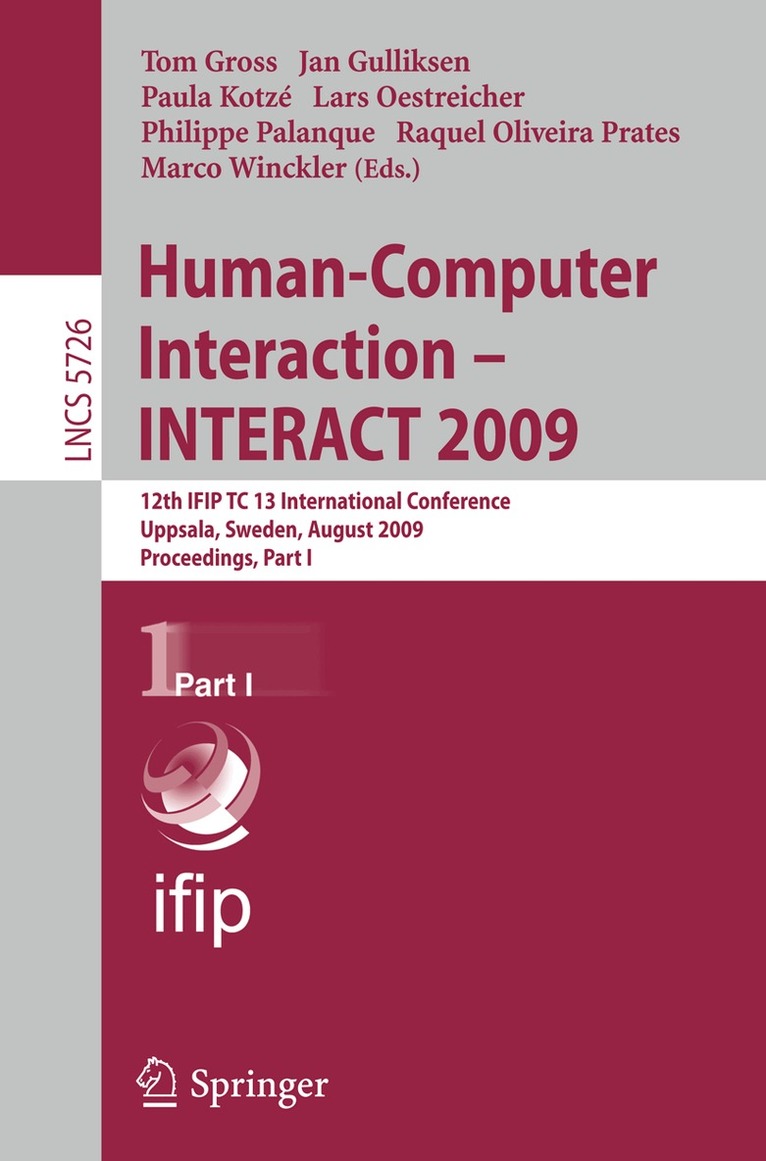
INTERACT 2009 was the 12th of a series of INTERACT international c- ferences supported by the IFIP Technical Committee 13 on Human–Computer Interaction. This year,INTERACT washeld in Uppsala (Sweden), organizedby the Swedish Interdisciplinary Interest Group for Human–Computer Interaction (STIMDI) in cooperation with the Department of Information Technology at Uppsala University. Like its predecessors, INTERACT 2009 highlighted, both to the academic and to the industrial world, the importance of the human–computer interaction (HCI) area and its most recent breakthroughs on current applications. Both - perienced HCI researchers and professionals, as well as newcomers to the HCI ?eld, interested in designing or evaluating interactive software, developing new interaction technologies, or investigating overarching theories of HCI, found in INTERACT 2009 a great forum for communication with people of similar int- ests, to encourage collaboration and to learn. INTERACT 2009 had Research and Practice as its special theme. The r- son we selected this theme is that the research within the ?eld has drifted away from the practicalapplicability of its results and that the HCI practice has come to disregard the knowledge and development within the academic community.
Häftad, Engelska, 2009
1 650 kr
Skickas inom 10-15 vardagar
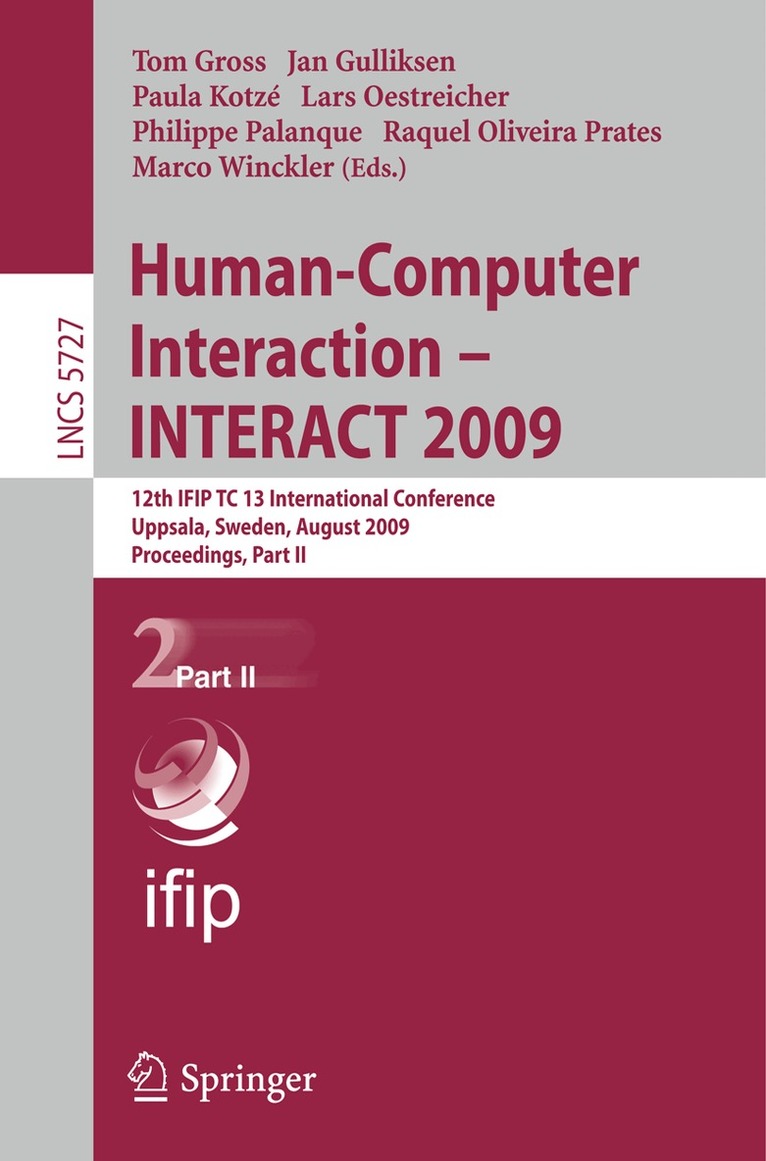
INTERACT 2009 was the 12th of a series of INTERACT international c- ferences supported by the IFIP Technical Committee 13 on Human–Computer Interaction. This year,INTERACT washeld in Uppsala (Sweden), organizedby the Swedish Interdisciplinary Interest Group for Human–Computer Interaction (STIMDI) in cooperation with the Department of Information Technology at Uppsala University. Like its predecessors, INTERACT 2009 highlighted, both to the academic and to the industrial world, the importance of the human–computer interaction (HCI) area and its most recent breakthroughs on current applications. Both - perienced HCI researchers and professionals, as well as newcomers to the HCI ?eld, interested in designing or evaluating interactive software, developing new interaction technologies, or investigating overarching theories of HCI, found in INTERACT 2009 a great forum for communication with people of similar int- ests, to encourage collaboration and to learn. INTERACT 2009 had Research and Practice as its special theme. The r- son we selected this theme is that the research within the ?eld has drifted away from the practicalapplicability of its results and that the HCI practice has come to disregard the knowledge and development within the academic community.

Häftad, Engelska, 2010
556 kr
Skickas inom 10-15 vardagar
The conference series HCSE (Human-Centred Software Engineering) was established four years ago in Salamanca. HCSE 2010 is the third working conference of IFIP Working Group 13.2, Methodologies for User-Centered Systems Design. The goal of HCSE is to bring together researchers and practitioners interested in strengthening the scientific foundations of user interface design, examining the re- tionship between software engineering and human-computer interaction and focusing on how to strengthen user-centered design as an essential part of software engineering processes. As a working conference, substantial time was devoted to the open and lively discussion of papers. The interest in the conference was positive in terms of submissions and partici- tion. We received 42 contributions that resulted in 10 long papers, 5 short papers and 3 poster papers. The selection was carried out carefully by the International Program Committee. The result is a set of interesting and stimulating papers that address such important issues as contextual design, user-aware systems, ubiquitous environments and usability evaluation. The final program of the conference included a keynote by Liam Bannon with the title “Approaches to Software Engineering: A Human-Centred Perspective.” This talk raised a lot of interesting questions for IFIP WG 13.2 and might have had some - pact for participants to become a member of the working group. We hope that participants considered HCSE 2010 as successful as its two p- desessors in terms of interesting discussions and new ideas for scientific co-operation.
Häftad, Engelska, 2011
1 102 kr
Skickas inom 10-15 vardagar
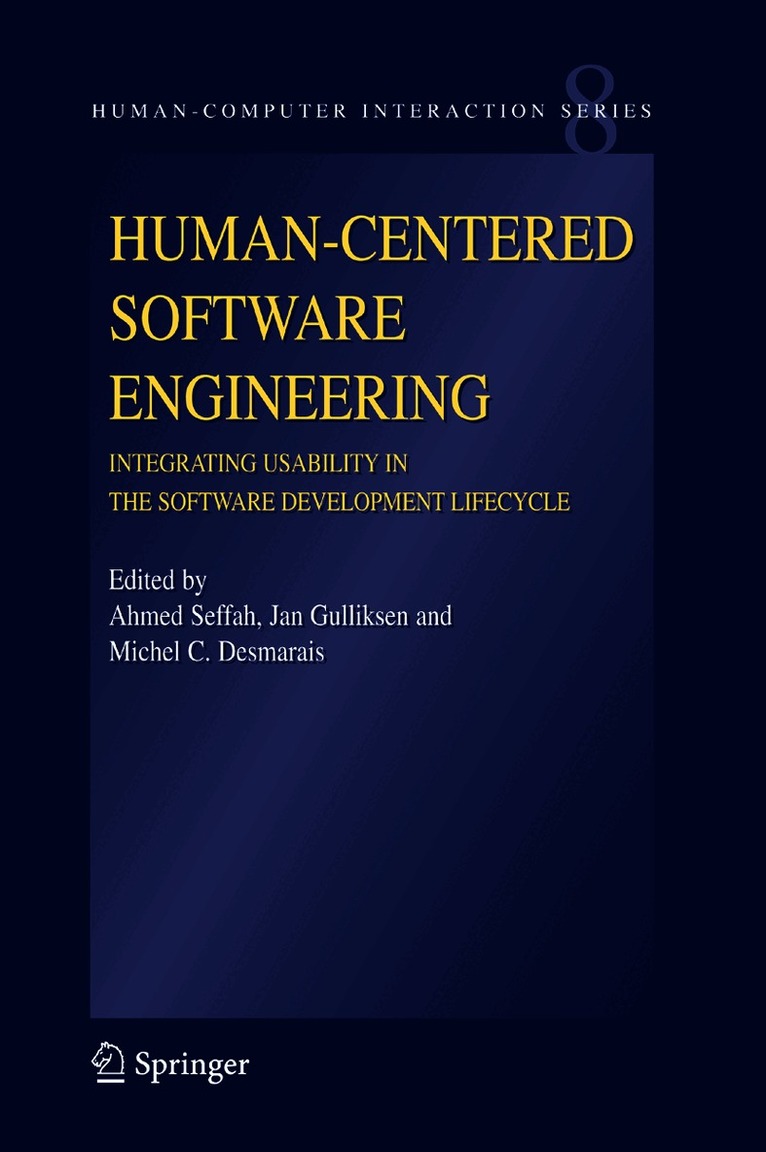
The fields of HCI and Software Engineering have evolved almost independently of each other until the last decade, when it became apparent that an integrated and combined perspective would benefit the development of interactive software applications. The chapters in this book are written by prominent researchers who bring to light the major integration issues and challenges, and offer a variety of solutions to bridging the HCI and SE gap, including: Extending software engineering artifacts for UI specification, such as annotating use cases with task descriptions, Enhancing object-oriented software engineering notations and models Possible extensions of HCI methods for requirements gathering through field observations and interviews, deriving a conceptual design model from scenario, task models and use cases and using personae as a way to understand and model end-users, New methodologies for interactive systems design, as well as approaches complementing existing methodologies.
Häftad, Svenska, 2002
459 kr
Skickas
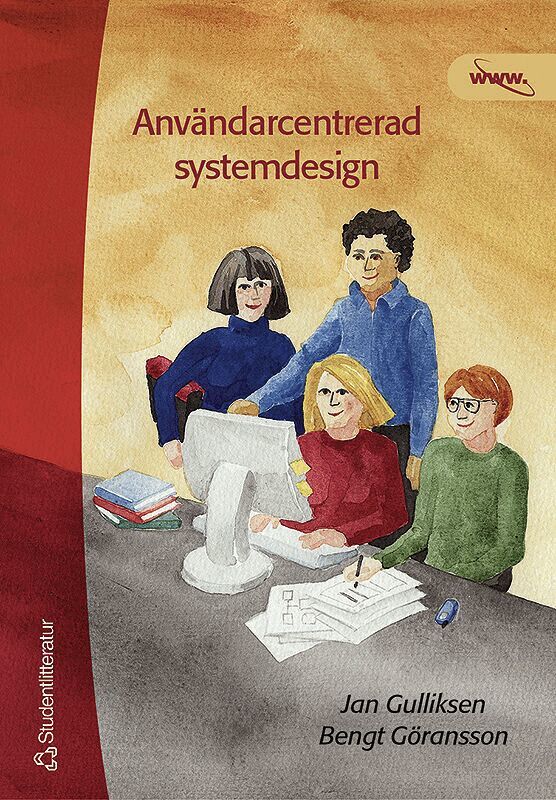
Denna bok ger god insikt i vad ett användbart IT-system är och beskriver hur man praktiskt kan bedriva utvecklingsarbetet på ett användarcentrerat sätt. Fokus ligger på den användarcentrerade utvecklingsprocessen. Författarna presenterar ett antal nyckelprinciper som är grunden för all användarcentrerad systemdesign. Boken riktar sig till alla intressenter i ett systemutvecklingsprojekt. Den riktar sig också till studenter som vill ha djupare kunskap och praktisk vägledning i hur man kan bedriva användarcentrerad systemdesign.
Häftad, Svenska, 2018
444 kr
Skickas
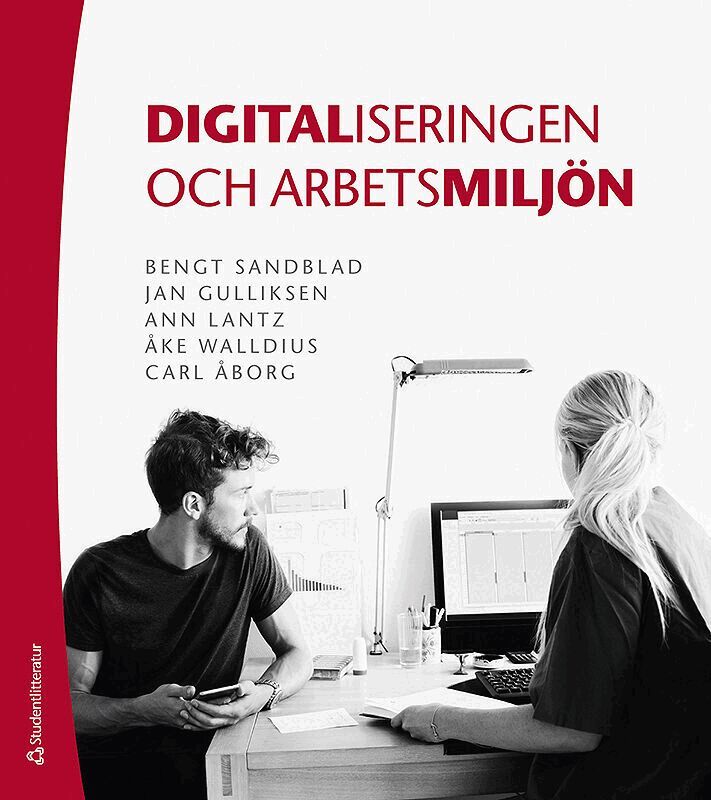
Vad är en god digital arbetsmiljö? Hur går man till väga för att skapa en sådan? Trots att det i dag finns mycket kunskap om detta, ser vi fortfarande it-projekt som havererar och missnöjda användare. Det är uppenbarligen svårt att lyckas i praktiken. Teorier måste omsättas i praktisk handling.När användningen och betydelsen av de digitala stödsystemen i arbetslivet ökar handlar det i allt större utsträckning om en digital arbetsmiljö. Om alla ska kunna utföra sina arbetsuppgifter på ett effektivt och säkert sätt, med hög kvalitet och utan onödiga belastningar, måste man ställa höga krav på de digitala systemens utformning och införande. Erfarenheterna i dag är tudelade: dels bidrar it-systemen till förnyelse och verksamhetsnytta, dels uppvisar de alltför ofta stora brister vilket medför påtagliga arbetsmiljöproblem. Många användare är frustrerade över att deras it-verktyg inte stödjer dem eller fungerar som de borde.Den här boken ger en grundläggande beskrivning av kunskapsläget om digitalisering och digitala arbetsmiljöproblem, samt en omfattande vägledning i hur man kan utnyttja digitaliseringens möjligheter och samtidigt försäkra sig om en god och hållbar digital arbetsmiljö.

Häftad, Svenska, 2021
438 kr
Skickas
Introduktion till medieteknik är boken för dig som vill få en introduktion till ämnet medieteknik. Vi vänder oss till dig som är intresserad av hur teknologier och dess användning möts − från ett fokus på mediekonsumtion, till hur medier formar vårt moderna samhälle. Boken ger en introduktion till medieteknikens olika former, kanaler, och uttryckssätt, och vi ger även en inblick i hur medieteknik skapas. Med en utgångspunkt i design, programmering och medieteknikens visuella och audiella uttryck ges en vidare introduktion till medieteknikens tillämpningsområden − från speldesign till interaktiva medier. Boken berör också angreppssätt för att arbeta användarcentrerat med digital medieutveckling och design, samt berör projektledning för utveckling av digital medieteknik. Med denna introduktion till medieteknik som ämne visar boken på ett antal framväxande områden för vidare forskning inom medieteknik.Introduktion till medieteknik är sammansatt så att den med fördel kan användas som kurslitteratur i utbildning inom områden som medieteknik, medie- produktion, design för digitala medier eller motsvarande. Boken kan läsas som en helhet, alternativt som fristående kapitel.