
Jared Diamond – författare
Visar alla böcker från författaren Jared Diamond. Handla med fri frakt och snabb leverans.
29 produkter
29 produkter

Häftad, Engelska, 2017
119 kr
Skickas inom 5-8 vardagar
Why did Eurasians conquer, displace, or decimate Native Americans, Australians, and Africans, instead of the reverse? In this “artful, informative, and delightful” (William H. McNeill, New York Review of Books) book, a classic of our time, evolutionary biologist Jared Diamond dismantles racist theories of human history by revealing the environmental factors actually responsible for its broadest patterns.The story begins 13,000 years ago, when Stone Age hunter-gatherers constituted the entire human population. Around that time, the developmental paths of human societies on different continents began to diverge greatly. Early domestication of wild plants and animals in the Fertile Crescent, China, Mesoamerica, the Andes, and other areas gave peoples of those regions a head start at a new way of life. But the localized origins of farming and herding proved to be only part of the explanation for their differing fates. The unequal rates at which food production spread from those initial centers were influenced by other features of climate and geography, including the disparate sizes, locations, and even shapes of the continents. Only societies that moved away from the hunter-gatherer stage went on to develop writing, technology, government, and organized religions as well as deadly germs and potent weapons of war. It was those societies, adventuring on sea and land, that invaded others, decimating native inhabitants through slaughter and the spread of disease.A major landmark in our understanding of human societies, Guns, Germs, and Steel chronicles the way in which the modern world, and its inequalities, came to be.

Häftad, Engelska, 1998
141 kr
Skickas
**WINNER OF THE PULITZER PRIZE**'A book of big questions, and big answers' Yuval Noah Harari, bestselling author of SapiensWhy has human history unfolded so differently across the globe? And what can it teach us about our current crisis?Jared Diamond puts the case that geography and biogeography, not race, moulded the contrasting fates of Europeans, Asians, Native Americans, sub-Saharan Africans, and aboriginal Australians.An ambitious synthesis of history, biology, ecology and linguistics, Guns, Germs and Steel is a ground-breaking and humane work of popular science that can provide expert insight into our modern world.'The most absorbing account on offer of the emergence of a world divided between have and have-nots... Never before put together so coherently, with such a combination of expertise, charm and compassion' The Times

Häftad, Engelska, 2020
160 kr
Skickas
'A riveting and illuminating tour of how nations deal with crises - which might hopefully help humanity as a whole deal with our present global crisis' YUVAL NOAH HARARI, author of SAPIENS ** NEW YORK TIMES BESTSELLER** Author of the landmark international bestsellers Guns, Germs and Steel and Collapse, Jared Diamond has transformed our understanding of what makes civilizations rise and fall. Now, at a time when crises are erupting around the world, he explores what makes certain nations resilient, and reveals the factors that influence how nations and individuals can respond to enormous challenges. In a riveting journey into the recent past, he traces how six distinctive modern nations - Finland, Chile, Indonesia, Japan, Germany and Australia - have survived defining catastrophes, and identifies patterns in their recovery. Looking ahead, he investigates the risk that the United States and other countries, faced by grave threat, are set on a course towards catastrophe. Adding a rich psychological dimension to the in-depth history, geography, biology and anthropology that underpin all of Diamond's writing, Upheaval is epic in scope, but also his most personal book yet.'Fascinating ... I finished the book even more optimistic about our ability to solve problems than I started' BILL GATES'Jared Diamond does it again: another rich, original and fascinating chapter in the human saga - with vital lessons for our difficult times' STEVEN PINKER

Häftad, Engelska, 2021
61 kr
Skickas
In twenty short books, Penguin brings you the classics of the environmental movement.This is Jared Diamond's haunting account of visiting the mysterious stone statues of Easter Island, showing how a remote civilization destroyed itself by exploiting its own natural resources - and why we must heed this warning.Over the past 75 years, a new canon has emerged. As life on Earth has become irrevocably altered by humans, visionary thinkers around the world have raised their voices to defend the planet, and affirm our place at the heart of its restoration. Their words have endured through the decades, becoming the classics of a movement. Together, these books show the richness of environmental thought, and point the way to a fairer, saner, greener world.
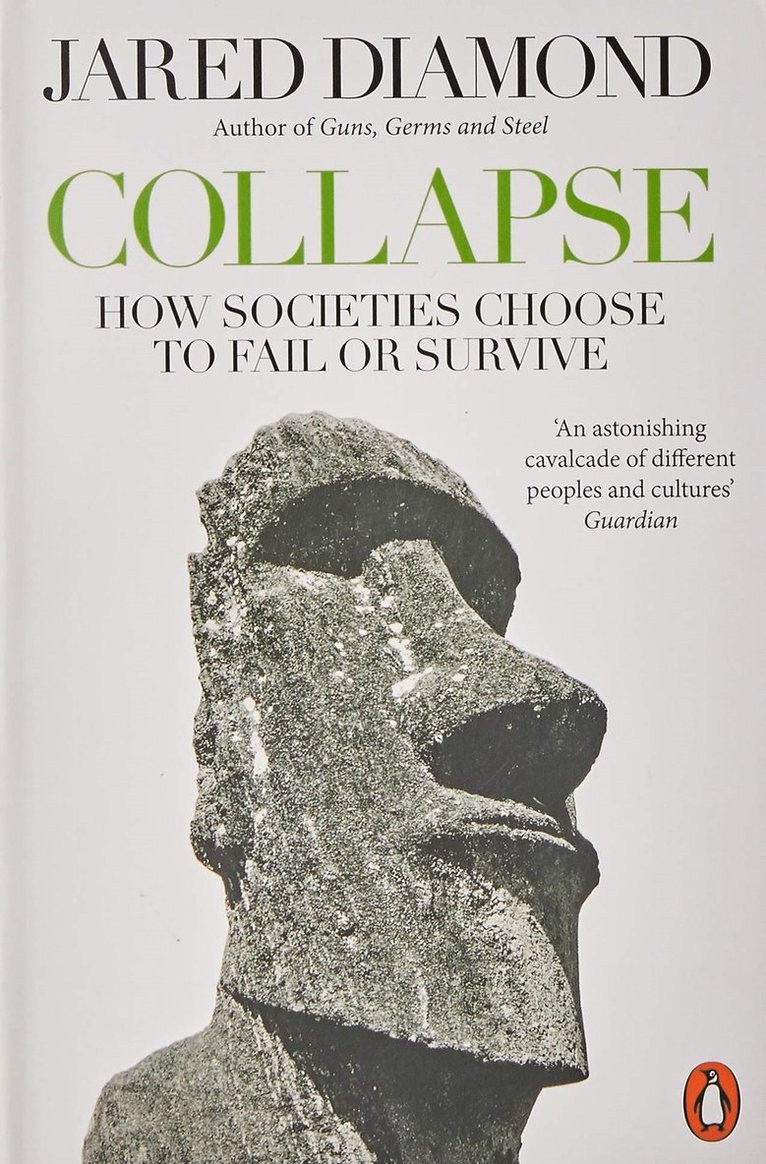
Häftad, Engelska, 2011
198 kr
Skickas
From the author of Guns, Germs and Steel, Jared Diamond's Collapse: How Societies Choose to Fail or Survive is a visionary study of the mysterious downfall of past civilizations.Now in a revised edition with a new afterword, Jared Diamond's Collapse uncovers the secret behind why some societies flourish, while others founder - and what this means for our future.What happened to the people who made the forlorn long-abandoned statues of Easter Island?What happened to the architects of the crumbling Maya pyramids?Will we go the same way, our skyscrapers one day standing derelict and overgrown like the temples at Angkor Wat?Bringing together new evidence from a startling range of sources and piecing together the myriad influences, from climate to culture, that make societies self-destruct, Jared Diamond's Collapse also shows how - unlike our ancestors - we can benefit from our knowledge of the past and learn to be survivors.'A grand sweep from a master storyteller of the human race' - Daily Mail'Riveting, superb, terrifying' - Observer'Gripping ... the book fulfils its huge ambition, and Diamond is the only man who could have written it' - Economis'This book shines like all Diamond's work' - Sunday Times

Häftad, Engelska, 2021
177 kr
Skickas inom 5-8 vardagar

Inbunden, Engelska, 2026
344 kr
Kommande

Häftad, Engelska, 2026
377 kr
Kommande
Häftad, Engelska, 1992
146 kr
Skickas
From the Pulitzer Prize winning author of Guns, Germs and SteelMore than 98 % of human genes are shared with two species of chimpanzee. The 'third' chimpanzee is man. Jared Diamond surveys our life-cycle, culture, sexuality and destructive urges both towards ourselves and the planet to explore the ways in which we are uniquely human yet still influenced by our animal origins.

Häftad, Engelska, 2013
175 kr
Skickas
The no. 1 bestselling author of Collapse and Guns, Germs and Steel explores the profound lessons that traditional societies offer us todayOver the past 500 years, the West achieved global dominance, but do Westerners necessarily have better ideas about how to raise children, care for the elderly, or simply live well? In this epic journey into our past, Jared Diamond reveals that traditional societies around the world offer an extraordinary window into how our ancestors lived for the majority of human history - until virtually yesterday, in evolutionary terms. Drawing on decades of his own fieldwork, Diamond explores how tribal people approach essential human problems, from health and diet to conflict resolution and language, and discovers they have much to teach us.Jared Diamond is the Pulitzer Prize-winning author of the seminal million-copy-bestseller Guns, Germs, and Steel, which was named one of TIME's best non-fiction books of all time, and Collapse, a #1 international bestseller. A professor of geography at UCLA and noted polymath, Diamond's work has been influential in the fields of anthropology, biology, ornithology, ecology and history, among others.
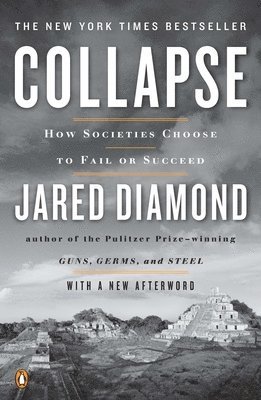
Häftad, Engelska, 2011
253 kr
Skickas

Häftad, Engelska, 2013
161 kr
Skickas inom 3-6 vardagar
The bestselling author of Collapse and Guns, Germs and Steel surveys the history of human societies to answer the question: What can we learn from traditional societies that can make the world a better place for all of us?“As he did in his Pulitzer Prize-winning Guns, Germs, and Steel, Jared Diamond continues to make us think with his mesmerizing and absorbing new book." BookpageMost of us take for granted the features of our modern society, from air travel and telecommunications to literacy and obesity. Yet for nearly all of its six million years of existence, human society had none of these things. While the gulf that divides us from our primitive ancestors may seem unbridgeably wide, we can glimpse much of our former lifestyle in those largely traditional societies still or recently in existence. Societies like those of the New Guinea Highlanders remind us that it was only yesterday—in evolutionary time—when everything changed and that we moderns still possess bodies and social practices often better adapted to traditional than to modern conditions.The World Until Yesterday provides a mesmerizing firsthand picture of the human past as it had been for millions of years—a past that has mostly vanished—and considers what the differences between that past and our present mean for our lives today.This is Jared Diamond’s most personal book to date, as he draws extensively from his decades of field work in the Pacific islands, as well as evidence from Inuit, Amazonian Indians, Kalahari San people, and others. Diamond doesn’t romanticize traditional societies—after all, we are shocked by some of their practices—but he finds that their solutions to universal human problems such as child rearing, elder care, dispute resolution, risk, and physical fitness have much to teach us. Provocative, enlightening, and entertaining, The World Until Yesterday is an essential and fascinating read.
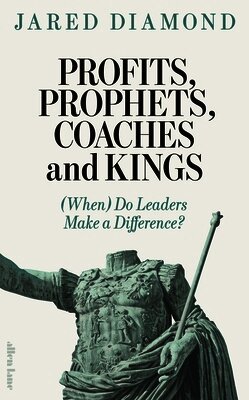
Inbunden, Engelska, 2026
254 kr
Kommande
Can one political leader change the course of history? Should CEOs be given big bonuses when a company performs well? Will firing a coach actually change the fortunes of the team? What does a religion’s success owe to a charismatic founder? In a fresh take on the interplay of power, character and success, world-renowned historian and bestselling author Jared Diamond argues that great leaders are so much more than either heroic exceptions or products of circumstance. Looking at natural experiments in four different spheres – history, business, sport and religion – Diamond asks under which conditions is a leader most likely to make a difference and why.Drawing on examples of iconic leaders – from Botswana president Seretse Khama to environmentalist Rachel Carson to legendary UCLA football coach John Wooden – Diamond shows us how effectiveness is determined by a range of complex interrelated factors, from resources to geography, culture to technology. Profits, Prophets, Coaches and Kings is a thought-provoking assessment of when leaders can bring about effective change, when they don’t, and perhaps whether we need them at all.

Häftad, Engelska, 2020
259 kr

Inbunden, Engelska, 2005
349 kr
Skickas inom 3-6 vardagar
Winner of the Pulitzer Prize, Guns, Germs, and Steel is a brilliant work answering the question of why the peoples of certain continents succeeded in invading other continents and conquering or displacing their peoples. This edition includes a new chapter on Japan and all-new illustrations drawn from the television series. Until around 11,000 BC, all peoples were still Stone Age hunter/gatherers. At that point, a great divide occurred in the rates that human societies evolved. In Eurasia, parts of the Americas, and Africa, farming became the prevailing mode of existence when indigenous wild plants and animals were domesticated by prehistoric planters and herders. As Jared Diamond vividly reveals, the very people who gained a head start in producing food would collide with preliterate cultures, shaping the modern world through conquest, displacement, and genocide.The paths that lead from scattered centers of food to broad bands of settlement had a great deal to do with climate and geography. But how did differences in societies arise? Why weren't native Australians, Americans, or Africans the ones to colonize Europe? Diamond dismantles pernicious racial theories tracing societal differences to biological differences. He assembles convincing evidence linking germs to domestication of animals, germs that Eurasians then spread in epidemic proportions in their voyages of discovery. In its sweep, Guns, Germs and Steel encompasses the rise of agriculture, technology, writing, government, and religion, providing a unifying theory of human history as intriguing as the histories of dinosaurs and glaciers.

Häftad, Engelska, 2011
222 kr
Skickas inom 5-8 vardagar
Some central questions in the natural and social sciences can't be answered by controlled laboratory experiments, often considered to be the hallmark of the scientific method. This impossibility holds for any science concerned with the past. In addition, many manipulative experiments, while possible, would be considered immoral or illegal. One has to devise other methods of observing, describing, and explaining the world.In the historical disciplines, a fruitful approach has been to use natural experiments or the comparative method. This book consists of eight comparative studies drawn from history, archeology, economics, economic history, geography, and political science. The studies cover a spectrum of approaches, ranging from a non-quantitative narrative style in the early chapters to quantitative statistical analyses in the later chapters. The studies range from a simple two-way comparison of Haiti and the Dominican Republic, which share the island of Hispaniola, to comparisons of 81 Pacific islands and 233 areas of India. The societies discussed are contemporary ones, literate societies of recent centuries, and non-literate past societies. Geographically, they include the United States, Mexico, Brazil, western Europe, tropical Africa, India, Siberia, Australia, New Zealand, and other Pacific islands.In an Afterword, the editors discuss how to cope with methodological problems common to these and other natural experiments of history.

Inbunden, Engelska, 1975
1 252 kr
Skickas inom 5-8 vardagar
In recent times, the science of ecology has been rejuvenated and has moved to a central position in biology. This volume contains eighteen original, major contributions by leaders in the field, all associates of the late Robert MacArthur, whose work has stimulated many of the recent developments in ecology. The intellectual ferment of the field is reflected in these papers, which offer new models for ecological processes, new applications of theoretical and quantitative techniques, and new methods for analyzing and interpreting a wide variety of empirical data.The first five chapters explore the evolution of species abundance and diversity (R. Levins, E. Leigh, J. MacArthur, R. May, and M. Rosenzweig). The theory of loop analysis is newly applied to understanding stability of species communities under both mendelian and group selection. Species abundance relations, population fluctuations, and continental patterns of species diversity are illustrated and interpreted theoretically. The next section examines the competitive strategies of optimal resource allocation variously employed in plant life histories (W. Schaffer and M. Gadgil), bird diets and foraging techniques (H. Hespenheide), butterfly seasonal flights (A. Shapiro), and forest succession examined by the theory of Markov processes (H. Horn).The seven chapters of the third section study the structure of species communities, by comparing different natural communities in similar habitats (M. Cody, J. Karr and F. James, E. Pianka, J. Brown, J. Diamond), or by manipulating field situations experimentally (R. Patrick, J. Connell). The analyses are of communities of species as diverse as freshwater stream organisms, desert lizards and rodents, birds, invertebrates, and plants. These studies yield insights into the assembly of continental and insular communities, convergent evolution of morphology and of ecological structure, and the relative roles of predation, competition, and harsh physical conditions in limiting species ranges.Finally, the two remaining chapters illustrate how ecological advances depend on interaction of theory with field and laboratory observations (G. E. Hutchinson), and how ecological studies such as those of this volume may find practical application to conservation problems posed by man's accelerating modification of the natural world (E. Wilson and E. Willis).

Häftad, Engelska, 2015
139 kr
Skickas inom 5-8 vardagar
A fascinating insight into how human sexuality came to be the way it is now - Jared Diamond explains why we are different from the animal kingdom.Why are humans one of the few species to have sex in private? Why do humans have sex any day of the month or year, including when the female is pregnant, beyond her reproductive years, or between her fertile cycles? Why are human females one of the few mammals to go through menopause?Human sexuality seems normal to us but it is bizarre by the standards of other animals. Jared Diamond argues that our strange sex lives were as crucial to our rise to human status as were our large brains. He also describes the battle of the sexes in the human and animal world over parental care, and why sex differences in the genetic value of parental care provide a biological basis for the all-too-familiar different attitudes of men and women towards extramarital sex.
Häftad, Engelska, 2015, 9-12 år
152 kr
Skickas
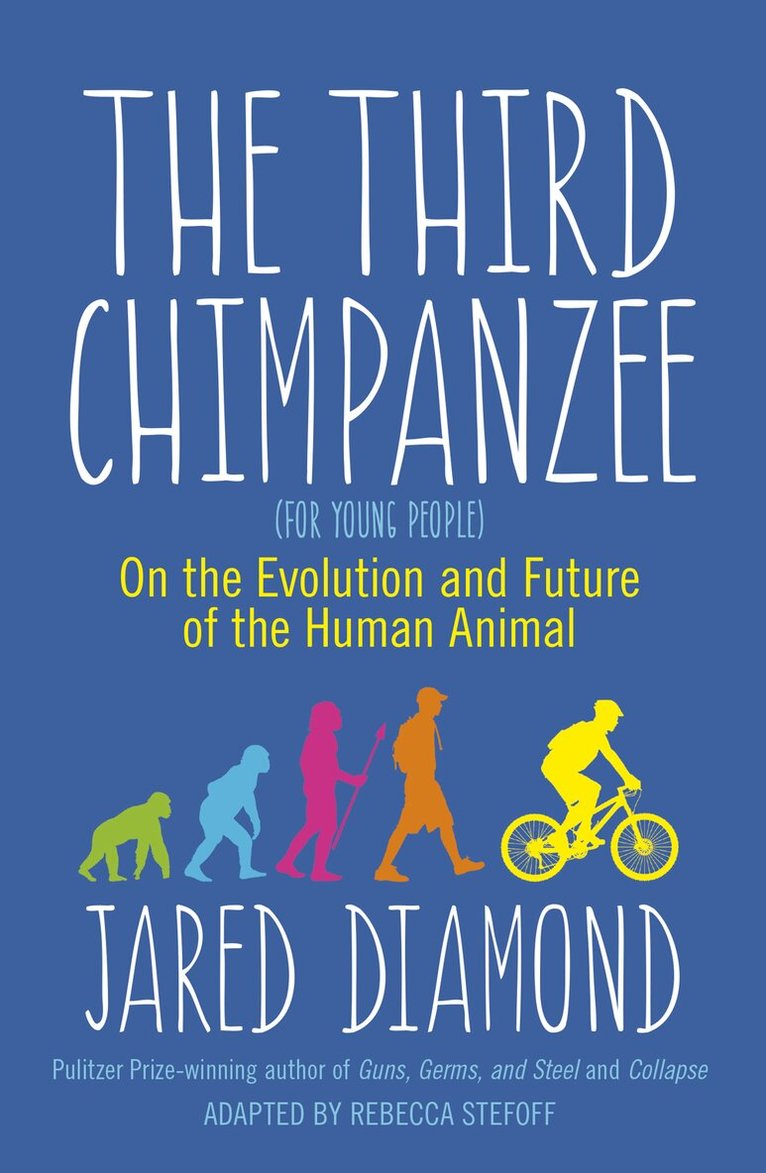
The Third Chimpanzee was first published in 1991 and has been in print ever since. This new, illustrated edition is aimed at a young readership. In it, Jared Diamond explores what makes us human and poses fascinating questions.If we share more than 98% of our DNA with chimpanzees, how is it that we can write, read, talk, build telescopes and bombs, while we put our speechless and bomb-less close relatives in cages and zoos?What can woodpeckers teach us about spacecraft?Is genocide a human invention?Why does extinction matter?Why are we destroying the natural resources on which we depend for survival?What hope is there for future generations?Not only is The Third Chimpanzee a mind-boggling survey of how we came to be, but it is also a plea to the next generation to "make better decisions than their parents and get us out of the mess we're in."

Häftad, Engelska, 2019
141 kr
Skickas
Read this specially designed new edition of Jared Diamond’s Pulitzer-prize winning exploration of what makes us human. Why has human history unfolded so differently across the globe? In this Pulitzer Prize-winning book, Jared Diamond puts the case that geography and biogeography, not race, moulded the contrasting fates of Europeans, Asians, Native Americans, sub-Saharan Africans, and aboriginal Australians. An ambitious synthesis of history, biology, ecology and linguistics, Guns, Germs and Steel remains a groundbreaking and humane work of popular science.PATTERNS OF LIFE: SPECIAL EDITIONS OF GROUNDBREAKING SCIENCE BOOKS

Inbunden, Tyska, 2019
283 kr
Skickas inom 3-6 vardagar

Häftad, Tyska, 2006
260 kr
Skickas inom 3-6 vardagar

Häftad, Tyska, 2006
297 kr
Skickas inom 3-6 vardagar

Häftad, Tyska, 2013
149 kr
Skickas inom 3-6 vardagar

Häftad, Tyska, 2011
177 kr
Skickas inom 3-6 vardagar

Häftad, Tyska, 2011
260 kr
Skickas inom 3-6 vardagar

Häftad, Spanska, 2016
236 kr
Skickas inom 3-6 vardagar

Häftad, Spanska, 2025
207 kr
Skickas inom 3-6 vardagar

Häftad, Koreanska, 2005
467 kr
Skickas inom 5-8 vardagar
"Guns, Germs, and Steel: The Fates of Human Societies" av Jared Diamond är en banbrytande utforskning av de faktorer som formade mänsklig historia. Från geografi till biologi avslöjar Diamond krafterna bakom samhällsutveckling och erbjuder en tankeväckande analys av vårt gemensamma förflutna.