
Visar resultat för..."Analytic Press,U.S."
3 produkter
3 produkter
Häftad, Engelska, 2005
243 kr
Skickas inom 5-8 vardagar
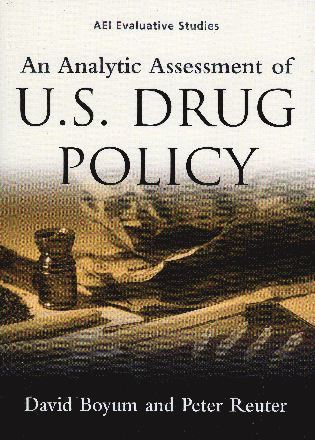
In its efforts to control the use of cocaine, heroin, marijuana, and other illegal drugs, the United States spends about $35 billion per year in public funds. Almost half a million dealers and users are under incarceration. In this book, David Boyum and Peter Reuter provide an assessment of how well this massive investment of tax dollars and government authority is working. Boyum and Reuter show that America's drug problem is mainly a legacy of the epidemics of heroin, cocaine, and crack use during the 1970s and 1980s, which left us with aging cohorts of criminally active and increasingly sick users. Newer drugs, such as Ecstasy and methamphetamine, perennially threaten to become comparable problems, but so far have not. Using a market framework, the book discusses the nature and effectiveness of efforts to tackle the nation's drug problems. Drug policy has become increasingly punitive, with the number of drug offenders in jail and prison growing tenfold between 1980 and 2003. Nevertheless, there is strikingly little evidence that tougher law enforcement can materially reduce drug use.By contrast, drug treatment services remain in short supply, even though research indicates that treatment expenditures easily pay for themselves in terms of reduced crime and improved productivity. Boyum and Reuter conclude that America's drug policy should be reoriented in several ways to be more effective. Enforcement should focus on reducing drug-related problems, such as violence associated with drug markets, rather than on locking up large numbers of low-level dealers. Treatment services for heavy users, particularly methadone and other opiate maintenance therapies, need more money and fewer regulations. And programs that coerce convicted drug addicts to enter treatment and maintain abstinence as a condition of continued freedom should be expanded. The AEI Evaluative Studies series aims to promote greater understanding and continuing review of major activities of the federal government. Each study focuses on a gov

Häftad, Engelska, 2015
477 kr
Tillfälligt slut
Since the early 1960s, the U.S. strategic nuclear posture has been composed of a triad of nuclear-certified long-range bombers, intercontinental ballistic missiles, and submarine-launched ballistic missiles. Since the early 1970s, U.S. nuclear forces have been subject to strategic arms control agreements. The large numbers and diversified nature of the U.S. nonstrategic (tactical) nuclear forces, which cannot be ignored as part of the overall nuclear deterrent, have decreased substantially since the Cold War. While there is domestic consensus today on the need to maintain an effective deterrent, there is no consensus on precisely what that requires, especially in a changing geopolitical environment and with continued reductions in nuclear arms. This places a premium on having the best possible analytic tools, methods, and approaches for understanding how nuclear deterrence and assurance work, how they might fail, and how failure can be averted by U.S. nuclear forces. U.S.Air Force Strategic Deterrence Analytic Capabilities identifies the broad analytic issues and factors that must be considered in seeking nuclear deterrence of adversaries and assurance of allies in the 21st century. This report describes and assesses tools, methods - including behavioral science-based methods - and approaches for improving the understanding of how nuclear deterrence and assurance work or may fail in the 21st century and the extent to which such failures might be averted or mitigated by the proper choice of nuclear systems, technological capabilities, postures, and concepts of operation of American nuclear forces. The report recommends criteria and a framework for validating the tools, methods, and approaches and for identifying those most promising for Air Force usage.

Häftad, Engelska, 1999
598 kr
Skickas inom 5-8 vardagar
A Philosopher’s Story is the autobiography of a prominent philosopher whose interactions with other leading thinkers and experiences at major institutions of higher learning over a period of time of more than fifty years make this an informative introduction to the intellectual life of late twentieth century America. During his academic career, Morton White has been involved in a number of controversies that have raised profound issues. One concerned the role of religion at Harvard in the 1950s; another was precipitated by the student rebellion at Harvard in the 1960s; and a third surrounded the question of academic governance at the Institute of Advanced Study during the 1970s. Throughout his academic career he has been an intellectual bridge-builder who has tried to avoid the pitfalls off wooliness and obscurity while uniting his widely spread interests. This is a professor’s story with many distinguishing features. Like other examples of the author’s writing, it reflects many different aspects of American thought and society during the twentieth century.
Letar du efter digitala böcker?
E-böcker och ljudböcker handlar du än så länge på vår tidigare sajt.