
Visar resultat för..."Trust Media Distribution"
Sökningen "Trust Media Distribution (formerly STL)" gav inga träffar.5 produkter
5 produkter
Häftad, Engelska, 2000
664 kr
Skickas inom 10-15 vardagar
This issue represents a broad synopsis of the past, present, and future of electronic publishing. The contributors explore the opportunities and challenges related to this new distribution channel, and the effect of this change on publishers, authors/editors, distributors, and consumers. Standing with the key to the "new world," publishers will be faced with new opportunities and nagging issues related to new competition, content control, and protection of revenue streams requiring strategies that stress rationalization of distribution systems, cross-promotion, strategic pricing, and leveraging to new revenue sources. In addition, this issue also highlights the objections of consumers to these types of change, the benefits of the new technology for consumers, and the adaptation of the publishing industry as a whole.
Häftad, Engelska, 2021
337 kr
Skickas inom 10-15 vardagar
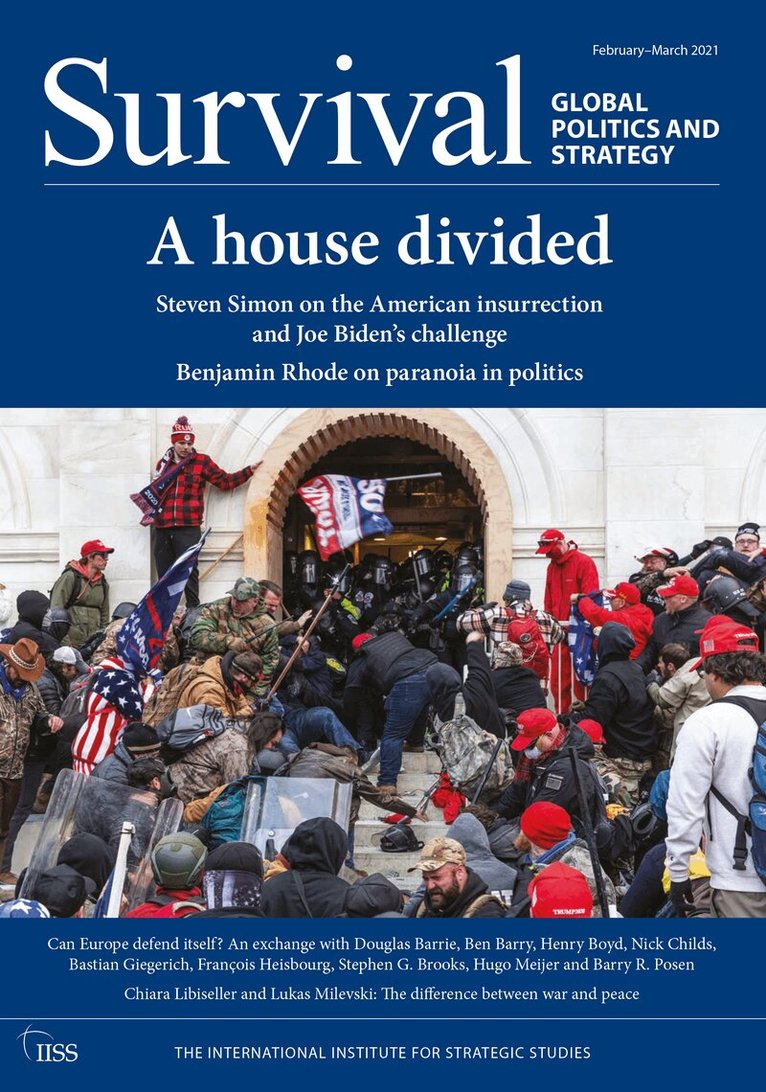
Survival, the IISS’s bimonthly journal, challenges conventional wisdom and brings fresh, often controversial, perspectives on strategic issues of the moment.In this issue: Steven Simon argues that despite the violent storming of the US Capitol, Republicans are inclined to commit to minority rule In a special forum, IISS researchers and three other experts consider whether NATO’s European members can defend themselves without US support Hanns W. Maull contends that the coronavirus pandemic has revealed deficiencies of global governance, and analyses their implications for the future of international order Christopher W. Hughes, Alessio Patalano and Robert Ward examine Japan’s grand strategy and Abe Shinzo’s legacyAnd seven more thought-provoking pieces, as well as our regular Book Reviews and Noteworthy column.Editor: Dr Dana AllinManaging Editor: Jonathan StevensonAssociate Editor: Carolyn WestAssistant Editor: Jessica Watson
Inbunden, Engelska, 2023
800 kr
Skickas inom 10-15 vardagar
The Cybersecurity landscape is a daunting one today. It is nothing like it was 10 years ago. Now, it has become very complex, covert, dynamic, and stealthy. It has literally become a cat and mouse game, in which the Cyberattacker is still one step ahead. This is despite all of the technology that is available to us a society, which includes Artificial Intelligence (AI) and Machine Learning.Part of the other problem is that human beings are resistant to change. For example, the password is still the favored way of authenticating and authorizing an individual, but it too has shown its grave limitations. Despite the use of Password Managers, which can create long and complex passwords, people still resort to their old fashioned ways of doing things.So what is needed now is an extreme change, in which, unfortunately, people have no choice in whether or not they will participate. It is called the Zero Trust Framework, and in this methodology, absolutely nobody can be trusted in either the internal or the external environments. The mantra here is to keep verifying everybody, all the time. The Zero Trust Framework also involves the concept of segmentation, in which the IT and Network Infrastructure of a business is broken down into smaller components, much like a Subnet. Each component will have its own layer of security, and every individual must be authenticated via the use of Multifactor Authentication (MFA).In this book, we review both the concepts and mechanics behind the Zero Trust Framework. We also introduce advanced technologies into it, including the use of Biometrics, the Public Key Infrastructure, and Quantum Mechanics/Quantum Cryptography.
Häftad, Engelska, 2024
290 kr
Skickas inom 10-15 vardagar
The Cybersecurity landscape is a daunting one today. It is nothing like it was 10 years ago. Now, it has become very complex, covert, dynamic, and stealthy. It has literally become a cat and mouse game, in which the Cyberattacker is still one step ahead. This is despite all of the technology that is available to us a society, which includes Artificial Intelligence (AI) and Machine Learning.Part of the other problem is that human beings are resistant to change. For example, the password is still the favored way of authenticating and authorizing an individual, but it too has shown its grave limitations. Despite the use of Password Managers, which can create long and complex passwords, people still resort to their old fashioned ways of doing things.So what is needed now is an extreme change, in which, unfortunately, people have no choice in whether or not they will participate. It is called the Zero Trust Framework, and in this methodology, absolutely nobody can be trusted in either the internal or the external environments. The mantra here is to keep verifying everybody, all the time. The Zero Trust Framework also involves the concept of segmentation, in which the IT and Network Infrastructure of a business is broken down into smaller components, much like a Subnet. Each component will have its own layer of security, and every individual must be authenticated via the use of Multifactor Authentication (MFA).In this book, we review both the concepts and mechanics behind the Zero Trust Framework. We also introduce advanced technologies into it, including the use of Biometrics, the Public Key Infrastructure, and Quantum Mechanics/Quantum Cryptography.
Häftad, Engelska, 2015
680 kr
Skickas inom 10-15 vardagar
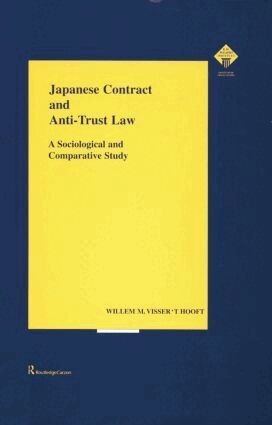
Little has been written on Japanese contract law and anti-trust law in Western languages. This book describes the role of this law in protecting the distributor against unilateral terminations of distribution agreements. There have been significant pressures both to lower prices and restructure distribution channels in Japan which have strained many distribution agreements. This volume, based primarily on Japanese language legal material, not only involves a study of applicable black-letter law, but also a sociological study of its application in practice. Detailed analysis has been made in particular of famous legal termination cases during the 1990s in the Japanese luxury cosmetics distribution system which generated influential decisions by the higher courts and the Fair Trade Commission, providing new insights into whether or not there are distinct Japanese attitudes towards contracts.
Letar du efter digitala böcker?
E-böcker och ljudböcker handlar du än så länge på vår tidigare sajt.