
P. Engel – författare
Visar alla böcker från författaren P. Engel. Handla med fri frakt och snabb leverans.
4 produkter
4 produkter
Del 83 - Philosophical Studies Series
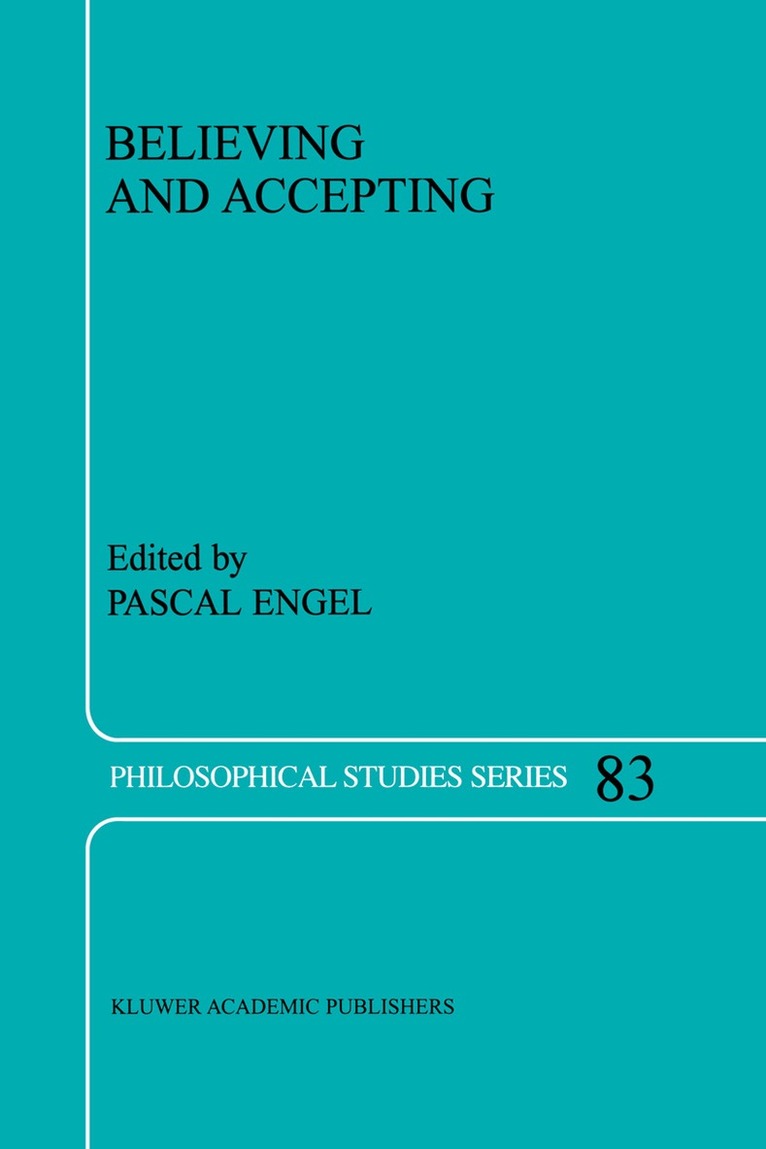
Believing and Accepting
Inbunden, Engelska, 2000
1 070 kr
Skickas inom 10-15 vardagar
The notion of belief figures prominently in contemporary philosophy of language and mind and in cognitive science. These essays address a range of issues concerning the complexity of our belief attitudes, their contents, and the influence of motivational factors on beliefs. The text is aimed at philosophers, psychologists, cognitive scientists and social theorists interested in the problem of representation, metarepresentation and the contents of propositional attitudes.
Inbunden, Engelska, 1986
1 070 kr
Skickas inom 10-15 vardagar
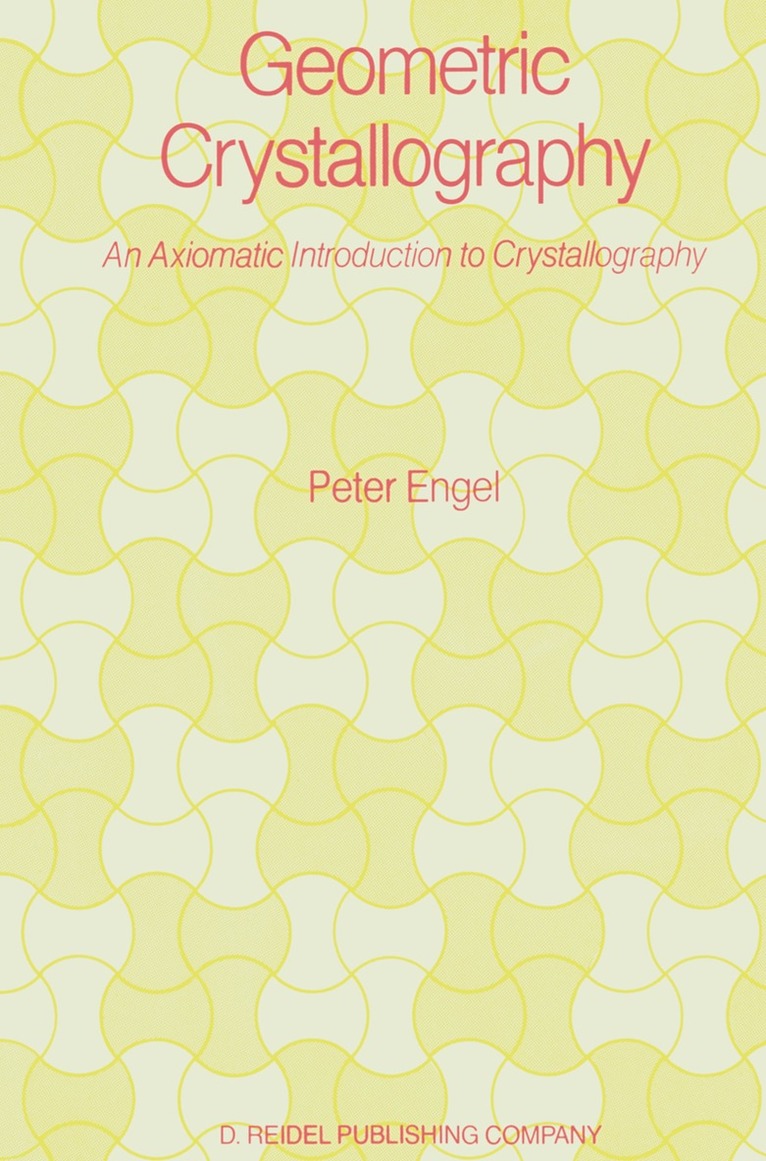
In the last decade mathematical crystallography has found increasing interest. Siginificant results have been obtained by algebraic, geometric, and group theoretic methods. Also classical crystallography in three-dimen sional Euclidean space has been extended to higher dimen sions in order to understand better the dimension independent crystallographic properties. The aim of this note is to introduce the reader to the fascinating and rich world of geometric crystallography. The prerequisites for reading it are elementary geometry and topological notations, and basic knowledge of group theory and linear algebra. Crystallography is geometric by its nature. In many cases, geometric arguments are the most appropriate and can thus best be understood. Thus the geometric point of view is emphasized here. The approach is axiomatic start ing from discrete point sets in Euclidean space. Symmetry comes in very soon and plays a central role. Each chapter starts with the necessary definitions and then the subject is treated in two- and three-dimensional space. Subsequent sections give an extension to higher dimensions. Short historical remarks added at the end of the chapters will show the development of the theory. The chapters are main ly self-contained. Frequent cross references, as well as an extended subject index, will help the reader who is only interested in a particular subject.
Häftad, Engelska, 1986
1 070 kr
Skickas inom 10-15 vardagar
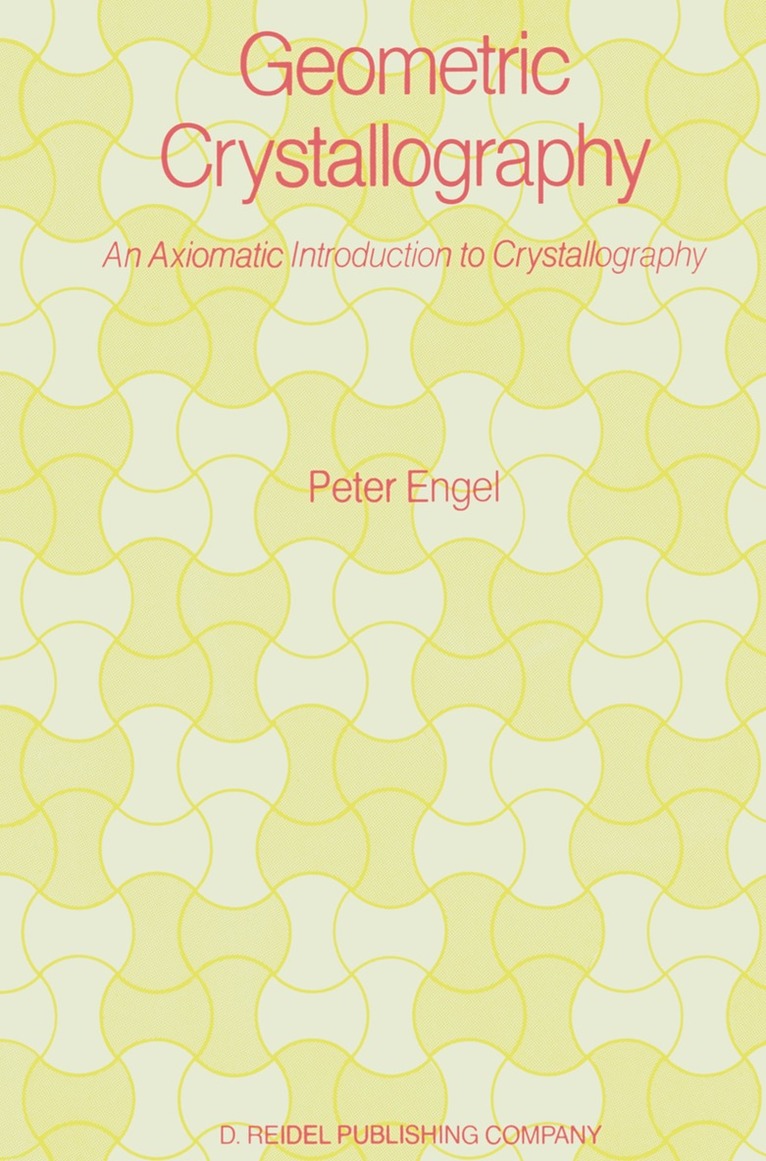
In the last decade mathematical crystallography has found increasing interest. Siginificant results have been obtained by algebraic, geometric, and group theoretic methods. Also classical crystallography in three-dimen sional Euclidean space has been extended to higher dimen sions in order to understand better the dimension independent crystallographic properties. The aim of this note is to introduce the reader to the fascinating and rich world of geometric crystallography. The prerequisites for reading it are elementary geometry and topological notations, and basic knowledge of group theory and linear algebra. Crystallography is geometric by its nature. In many cases, geometric arguments are the most appropriate and can thus best be understood. Thus the geometric point of view is emphasized here. The approach is axiomatic start ing from discrete point sets in Euclidean space. Symmetry comes in very soon and plays a central role. Each chapter starts with the necessary definitions and then the subject is treated in two- and three-dimensional space. Subsequent sections give an extension to higher dimensions. Short historical remarks added at the end of the chapters will show the development of the theory. The chapters are main ly self-contained. Frequent cross references, as well as an extended subject index, will help the reader who is only interested in a particular subject.
Del 83 - Philosophical Studies Series
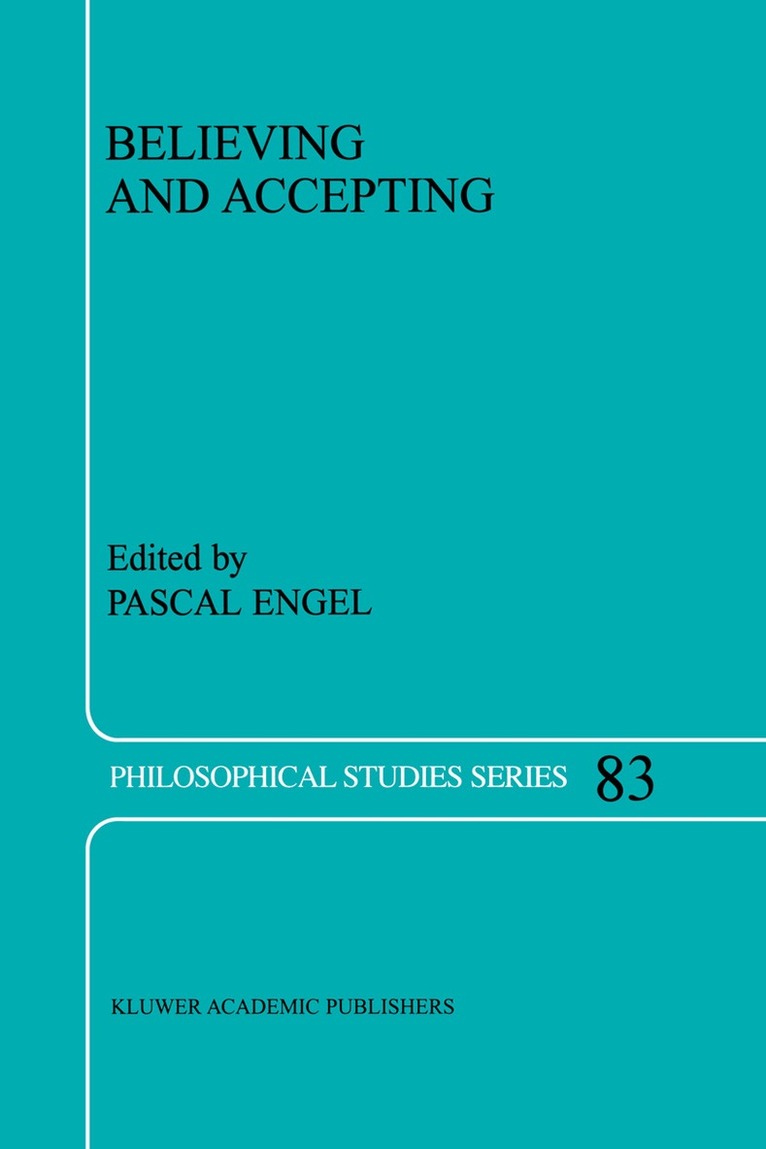
Believing and Accepting
Häftad, Engelska, 2012
1 070 kr
Skickas inom 10-15 vardagar
(1) Beliefs are involuntary, and not nonnally subject to direct voluntary control. For instance I cannot believe at will that my trousers are on fire, or that the Dalai Lama is a living God, even if you pay me a large amount of money for believing such things. (2) Beliefs are nonnally shaped by evidence for what is believed, unless they are, in some sense, irrational. In general a belief is rational if it is proportioned to the degree of evidence that one has for its truth. In this sense, one often says that "beliefs aim at truth" . This is why it is, on the face of it, irrational to believe against the evidence that one has. A subject whose beliefs are not shaped by a concern for their truth, but by what she wants to be the case, is more or less a wishful thinker or a self-deceiver. (3) Beliefs are context independent, in the sense that at one time a subject believes something or does not believe it; she does not believe it relative to one context and not relative to another. For instance if I believe that Paris is a polluted city, I cannot believe that on Monday and not on Tuesday; that would be a change of belief, or a change of mind, but not a case of believing one thing in one context and another thing in another context. If I believe something, the belief is more or 4 less pennanent across various contexts.