
Tshepo Chris Nokeri – författare
Visar alla böcker från författaren Tshepo Chris Nokeri. Handla med fri frakt och snabb leverans.
6 produkter
6 produkter
Häftad, Engelska, 2021
550 kr
Skickas inom 3-6 vardagar
Get insight into data science techniques such as data engineering and visualization, statistical modeling, machine learning, and deep learning. This book teaches you how to select variables, optimize hyper parameters, develop pipelines, and train, test, and validate machine and deep learning models. Each chapter includes a set of examples allowing you to understand the concepts, assumptions, and procedures behind each model.The book covers parametric methods or linear models that combat under- or over-fitting using techniques such as Lasso and Ridge. It includes complex regression analysis with time series smoothing, decomposition, and forecasting. It takes a fresh look at non-parametric models for binary classification (logistic regression analysis) and ensemble methods such as decision trees, support vector machines, and naive Bayes. It covers the most popular non-parametric method for time-event data (the Kaplan-Meier estimator). It also covers ways of solving classification problems using artificial neural networks such as restricted Boltzmann machines, multi-layer perceptrons, and deep belief networks. The book discusses unsupervised learning clustering techniques such as the K-means method, agglomerative and Dbscan approaches, and dimension reduction techniques such as Feature Importance, Principal Component Analysis, and Linear Discriminant Analysis. And it introduces driverless artificial intelligence using H2O.After reading this book, you will be able to develop, test, validate, and optimize statistical machine learning and deep learning models, and engineer, visualize, and interpret sets of data.What You Will LearnDesign, develop, train, and validate machine learning and deep learning modelsFind optimal hyper parameters for superior model performanceImprove model performance using techniques such as dimension reduction and regularizationExtract meaningful insights for decision making using data visualizationWho This Book Is ForBeginning and intermediate level data scientists and machine learning engineers
Häftad, Engelska, 2021
551 kr
Skickas inom 3-6 vardagar
Bring together machine learning (ML) and deep learning (DL) in financial trading, with an emphasis on investment management. This book explains systematic approaches to investment portfolio management, risk analysis, and performance analysis, including predictive analytics using data science procedures.The book introduces pattern recognition and future price forecasting that exerts effects on time series analysis models, such as the Autoregressive Integrated Moving Average (ARIMA) model, Seasonal ARIMA (SARIMA) model, and Additive model, and it covers the Least Squares model and the Long Short-Term Memory (LSTM) model. It presents hidden pattern recognition and market regime prediction applying the Gaussian Hidden Markov Model. The book covers the practical application of the K-Means model in stock clustering. It establishes the practical application of the Variance-Covariance method and Simulation method (using Monte Carlo Simulation) for value at risk estimation. It also includes market direction classification using both the Logistic classifier and the Multilayer Perceptron classifier. Finally, the book presents performance and risk analysis for investment portfolios.By the end of this book, you should be able to explain how algorithmic trading works and its practical application in the real world, and know how to apply supervised and unsupervised ML and DL models to bolster investment decision making and implement and optimize investment strategies and systems.What You Will LearnUnderstand the fundamentals of the financial market and algorithmic trading, as well as supervised and unsupervised learning models that are appropriate for systematic investment portfolio managementKnow the concepts of feature engineering, data visualization, and hyperparameter optimizationDesign, build, and test supervised and unsupervised ML and DL modelsDiscover seasonality, trends, and market regimes, simulating a change in the market and investment strategy problems and predicting market direction and pricesStructure and optimize an investment portfolio with preeminent asset classes and measure the underlying riskWho This Book Is ForBeginning and intermediate data scientists, machine learning engineers, business executives, and finance professionals (such as investment analysts and traders)
Häftad, Engelska, 2021
348 kr
Skickas inom 10-15 vardagar
Get up to speed on the application of machine learning approaches in macroeconomic research. This book brings together economics and data science.Author Tshepo Chris Nokeri begins by introducing you to covariance analysis, correlation analysis, cross-validation, hyperparameter optimization, regression analysis, and residual analysis. In addition, he presents an approach to contend with multi-collinearity. He then debunks a time series model recognized as the additive model. He reveals a technique for binarizing an economic feature to perform classification analysis using logistic regression. He brings in the Hidden Markov Model, used to discover hidden patterns and growth in the world economy. The author demonstrates unsupervised machine learning techniques such as principal component analysis and cluster analysis. Key deep learning concepts and ways of structuring artificial neural networks are explored along with training them and assessing their performance. The Monte Carlo simulation technique is applied to stimulate the purchasing power of money in an economy. Lastly, the Structural Equation Model (SEM) is considered to integrate correlation analysis, factor analysis, multivariate analysis, causal analysis, and path analysis.After reading this book, you should be able to recognize the connection between econometrics and data science. You will know how to apply a machine learning approach to modeling complex economic problems and others beyond this book. You will know how to circumvent and enhance model performance, together with the practical implications of a machine learning approach in econometrics, and you will be able to deal with pressing economic problems. What You Will LearnExamine complex, multivariate, linear-causal structures through the path and structural analysis technique, including non-linearity and hidden statesBe familiar with practical applications of machine learning and deep learning in econometricsUnderstand theoretical framework and hypothesis development, and techniques for selecting appropriate modelsDevelop, test, validate, and improve key supervised (i.e., regression and classification) and unsupervised (i.e., dimension reduction and cluster analysis) machine learning models, alongside neural networks, Markov, and SEM modelsRepresent and interpret data and models Who This Book Is ForBeginning and intermediate data scientists, economists, machine learning engineers, statisticians, and business executives
Häftad, Engelska, 2021
348 kr
Skickas inom 10-15 vardagar
Apply supervised and unsupervised learning to solve practical and real-world big data problems. This book teaches you how to engineer features, optimize hyperparameters, train and test models, develop pipelines, and automate the machine learning (ML) process. The book covers an in-memory, distributed cluster computing framework known as PySpark, machine learning framework platforms known as scikit-learn, PySpark MLlib, H2O, and XGBoost, and a deep learning (DL) framework known as Keras.The book starts off presenting supervised and unsupervised ML and DL models, and then it examines big data frameworks along with ML and DL frameworks. Author Tshepo Chris Nokeri considers a parametric model known as the Generalized Linear Model and a survival regression model known as the Cox Proportional Hazards model along with Accelerated Failure Time (AFT). Also presented is a binary classification model (logistic regression) and an ensemble model (Gradient Boosted Trees). The book introduces DL and an artificial neural network known as the Multilayer Perceptron (MLP) classifier. A way of performing cluster analysis using the K-Means model is covered. Dimension reduction techniques such as Principal Components Analysis and Linear Discriminant Analysis are explored. And automated machine learning is unpacked.This book is for intermediate-level data scientists and machine learning engineers who want to learn how to apply key big data frameworks and ML and DL frameworks. You will need prior knowledge of the basics of statistics, Python programming, probability theories, and predictive analytics. What You Will LearnUnderstand widespread supervised and unsupervised learning, including key dimension reduction techniquesKnow the big data analytics layers such as data visualization, advanced statistics, predictive analytics, machine learning, and deep learningIntegrate big data frameworks with a hybrid of machine learning frameworks and deep learning frameworksDesign, build, test, and validate skilled machine models and deep learning modelsOptimize model performance using data transformation, regularization, outlier remedying, hyperparameter optimization, and data split ratio alteration Who This Book Is ForData scientists and machine learning engineers with basic knowledge and understanding of Python programming, probability theories, and predictive analytics
Häftad, Engelska, 2021
550 kr
Skickas inom 3-6 vardagar
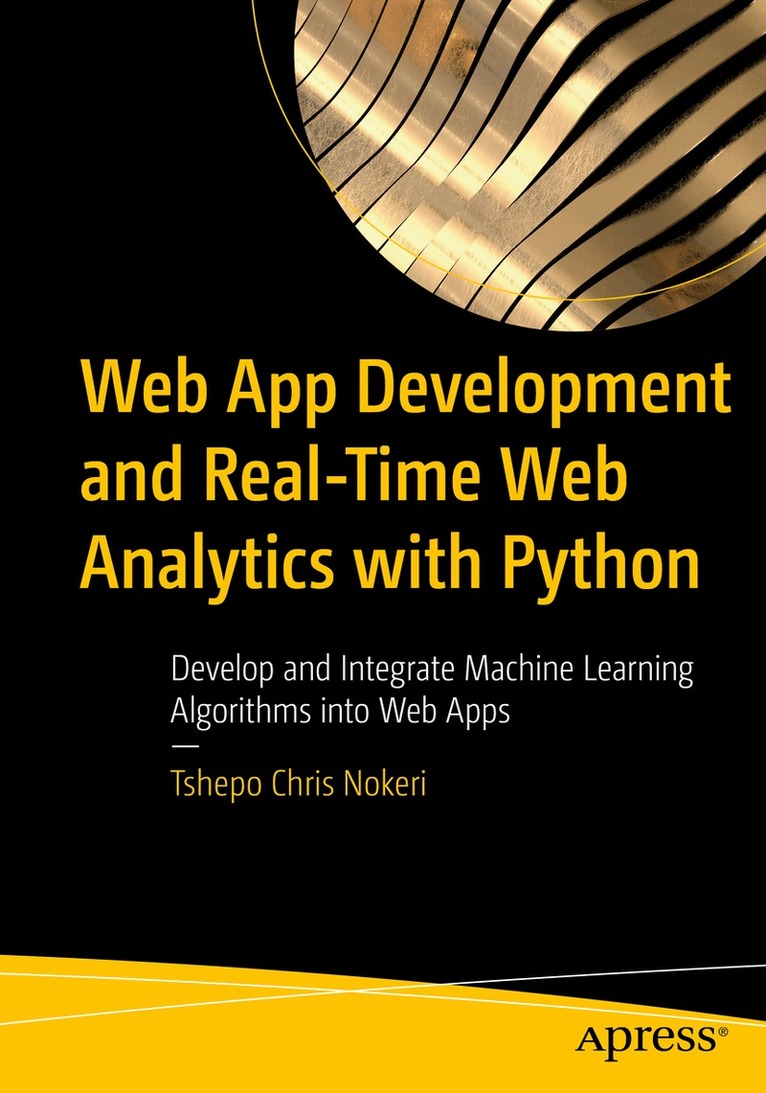
Learn to develop and deploy dashboards as web apps using the Python programming language, and how to integrate algorithms into web apps.Author Tshepo Chris Nokeri begins by introducing you to the basics of constructing and styling static and interactive charts and tables before exploring the basics of HTML, CSS, and Bootstrap, including an approach to building web pages with HTML. From there, he’ll show you the key Python web frameworks and techniques for building web apps with them. You’ll then see how to style web apps and incorporate themes, including interactive charts and tables to build dashboards, followed by a walkthrough of creating URL routes and securing web apps. You’ll then progress to more advanced topics, like building machine learning algorithms and integrating them into a web app. The book concludes with a demonstration of how to deploy web apps in prevalent cloud platforms.Web App Development and Real-Time Web Analytics with Python isideal for intermediate data scientists, machine learning engineers, and web developers, who have little or no knowledge about building web apps that implement bootstrap technologies. After completing this book, you will have the knowledge necessary to create added value for your organization, as you will understand how to link front-end and back-end development, including machine learning.What You Will LearnCreate interactive graphs and render static graphs into interactive onesUnderstand the essentials of HTML, CSS, and BootstrapGain insight into the key Python web frameworks, and how to develop web applications using themDevelop machine learning algorithms and integrate them into web apps Secure web apps and deploy them to cloud platformsWho This Book Is ForIntermediate data scientists, machine learning engineers, and web developers.
Häftad, Engelska, 2022
550 kr
Skickas inom 3-6 vardagar
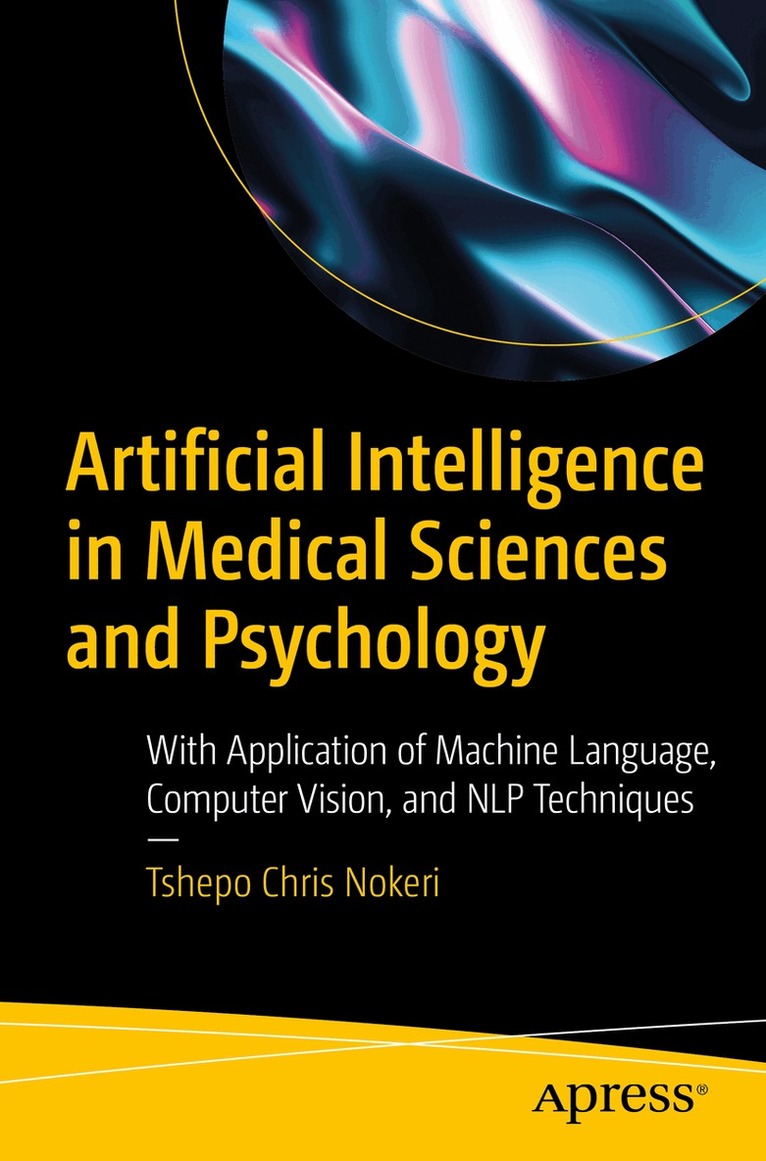
Get started with artificial intelligence for medical sciences and psychology. This book will help healthcare professionals and technologists solve problems using machine learning methods, computer vision, and natural language processing (NLP) techniques. The book covers ways to use neural networks to classify patients with diseases. You will know how to apply computer vision techniques and convolutional neural networks (CNNs) to segment diseases such as cancer (e.g., skin, breast, and brain cancer) and pneumonia. The hidden Markov decision making process is presented to help you identify hidden states of time-dependent data. In addition, it shows how NLP techniques are used in medical records classification. This book is suitable for experienced practitioners in varying medical specialties (neurology, virology, radiology, oncology, and more) who want to learn Python programming to help them work efficiently. It is also intended for data scientists, machine learning engineers, medical students, and researchers.What You Will LearnApply artificial neural networks when modelling medical dataKnow the standard method for Markov decision making and medical data simulationUnderstand survival analysis methods for investigating data from a clinical trialUnderstand medical record categorizationMeasure personality differences using psychological modelsWho This Book Is ForMachine learning engineers and software engineers working on healthcare-related projects involving AI, including healthcare professionals interested in knowing how AI can improve their work setting