Basic and Clinical Aspects of Neuroscience - Böcker
Visar alla böcker i serien Basic and Clinical Aspects of Neuroscience. Handla med fri frakt och snabb leverans.
5 produkter
5 produkter
Del 2 - Basic and Clinical Aspects of Neuroscience
Transmitter Molecules in the Brain
Part I: Biochemistry of Transmitter Molecules Part II: Function and Dysfunction
Häftad, Engelska, 1987
550 kr
Skickas inom 10-15 vardagar
This second volume of Basic and Clinical Aspects of Neuroscience is devoted to the various transmitter systems of the brain (classical and neuropeptides). In Part I the basic aspects are given, including a critical appraisal of the methods used yesterday and today to describe such neurotransmitter systems. Part II concentrates on the functioning in the body of these transmitter systems under physiologic and pathologic conditions. It goes on to show how neuroendocrine investigations may give insights into the functioning of neurotransmitter sys tems at least in the hypothalamus, to end with a chapter which assesses very critically the errors and deficiencies of the concepts and techniques used in the attempt to understand the functioning of the brain and the mind. The editors have been fortunate to have the eight chapters written by a team of investigators working under the direction of Professor G. Fink in the MRC Brain Metabolic Unit at Edinburgh University. We are grateful to him and his colleagues for their work in writing these chapters and for the fine result they achieved. I am grateful for the editorial work done by Professor E. E. Muller (Milan) and Professor M. O. Thorner (Charlottesville), which made this volume possible. Basle, May 1987 E. Fluckiger Managing Editor Table of Contents Part I: Biochemistry of Transmitter Molecules Introduction: Role of Chemical Neurotransmission in Brain Function G.FINK References 4 Classical Transmitters and Neuromodulators 1. K. MCQUEEN Process of Synaptic Transmission. 7 Classification of Synaptic Messengers 7 Dale's Principle ...... .
1 062 kr
Skickas inom 10-15 vardagar
As in other volumes in the series, this newest volume conveys up-to-date knowledge in a clear and straightforward manner. It begins with a survey of the neurobiological functions of the brain, with the emphasis on Parkinson's disease. This is followed by a presentation of the role of dopamine in the regulation of human anterior pituitary function. The final two chapters concentrate on the dopamine receptors: first, the binding sites are characterized and the biochemical and physiological consequences of dopamine-receptor stimulation are discussed and, finally, there is a report on the topology of a dopamine-receptor model that can account comprehensively for agonists and antagonists.
1 062 kr
Skickas inom 10-15 vardagar
One of the phylogenetically oldest hormones, somatostatin is a regulatory peptide with remarkable characteristics. It is a nonclassical neurotransmitter discovered less than 20 years ago both in the central nervous system and in the gastroenteropancreatic system. It regulates the secretion of both pituitary and digestive hormones, it ensures nutrient homeostasis and it has therapeutic uses. This volume deals withall these aspects.
550 kr
Skickas inom 10-15 vardagar
Cell transplantation to the brain and spinal cord is a well-established research tool for studies on cellular and molecular mechanisms, but can it be developed into a useful therapeutic approach in human neurological disorders? Clinical trials in patients with Parkinson's disease have provided encouraging evidence; however, no treatment based on transplantation is yet available. An overview of current research is given in this book. It summarizes the status of grafting in humans and discusses scientific problems that have to be solved before intracerebral transplantation can become a useful routine approach to treatment.
1 094 kr
Skickas inom 10-15 vardagar
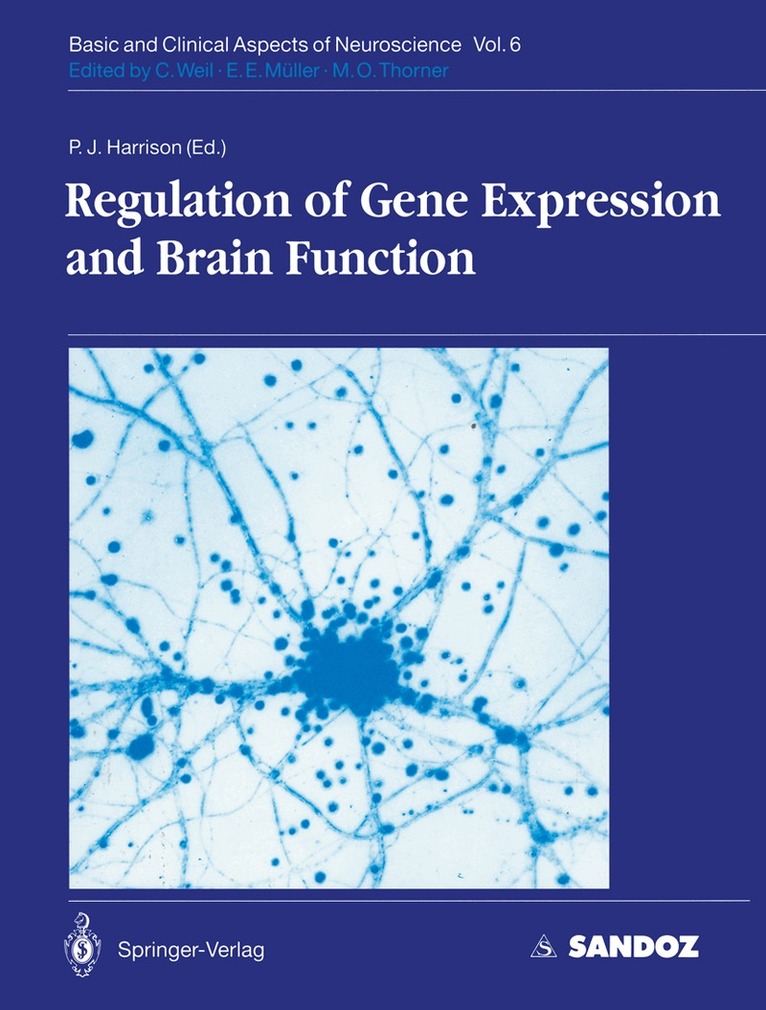
Gene expression converts the information coded by our genes into proteins. These determine the structure and function of an organ such as the brain. It is therefore an essential process, linking molecular genetics with neurochemistry and behavioural neuroscience. This volume presents a didactic approach to the understanding of the basic processes of gene expression and their involvement in certain brain diseases, such as Alzheimer's disease and schizophrenia. Generously illustrated, the contributions provide a valuable outline of this key aspect of molecular neurobiology and clinical neuroscience.