Developments in Electromagnetic Theory and Applications - Böcker
Visar alla böcker i serien Developments in Electromagnetic Theory and Applications. Handla med fri frakt och snabb leverans.
12 produkter
12 produkter
2 953 kr
Skickas inom 10-15 vardagar
In this book, the author draws on his broad experience to describe both the theory and the applications of wave propagations. The contents are presented in four parts and the sequence of these parts reflect the development of ionospheric and propagational research in areas such as space research geophysics and communications. The first part of the book presents an outline of the theory of electromagnetic waves propagating in a cold electron plasma. For reference, vector analysis, dyadics and eigenvalues introduced in this part are presented in the appendices. Practical aspects of radio wave propagation are the subject of the second part. The typical conditions in different frequency ranges are discussed and the irregular features of the ionospheric structure such as sound and gravity waves are also considered. Warm plasma and the effects of ions are considered in the third part, which includes a discussion of sound-like waves in electron and ion plasmas. Nonlinear effects and instabilities are described in the fourth part.
1 059 kr
Skickas inom 10-15 vardagar
to Electromagnetic Inverse Scattering by K. I. Hopcraft Department of Theoretical Mechanics, University of Nottingham, Nottingham, U. K. and P. R. Smith Department of Electronic and Electrical Engineering, University of Technology, Loughborough, U. K. Springer-Science+Business Media, B. V. Library of Congress Cataloging-in-Publication Data Hopcraft, K. I. An lntroductlon to electromagnetic inverse scattering I by K. I. Hopcraft and P. R. Smith. p. cm. -- (Developments in electromagnetic theory and application; 7) Includes blbliographical references and index. ISBN 978*90*481*4070*1 1. Electromagnetic waves--Scattering. 2. Inverse scattering transform. I. Smith, P. R. , Ph. D. II. Title. III. Series: DevelopNents in electromagnetic theory and applications; 7. OC665. S3H67 1992 539. 2--dc20 92-23966 ISBN 978-90-481-4070-1 ISBN 978-94-015-8014-4 (eBook) DOI 10.1007/978-94-015-8014-4 AH Rights Reserved (c) 1992 Springer Science+Business Media Dordrecht OriginaHy published by Kluwer Academic Publishers in 1992 Softcover reprint of the hardcover Ist edition 1992 No part ofthe material protected by this copyright notice may be reproduced or utilized in any form or by any means, electronic or mechanical, including photocopying, recording or by any information storage and retrieval system, without written permission from the copyright owner. Contents (;Iossary ...*. . *. **...*...*. . *. ***. *...****...**...* ix I'reface *************. . ****. **. *. ************************************************ xi 1 Introduction...1 1. 1 What is inverse scattering? ...1 1. 2 Why study inverse scattering? ...2 1. 3 An historical sketch ...3 1. 4 How to solve inverse problems ...*...6 Definitions and terminology ...6 Electromagnetic wave equations ...
Del 10 - Developments in Electromagnetic Theory and Applications
Microwave NDT
Inbunden, Engelska, 1992
2 111 kr
Skickas inom 10-15 vardagar
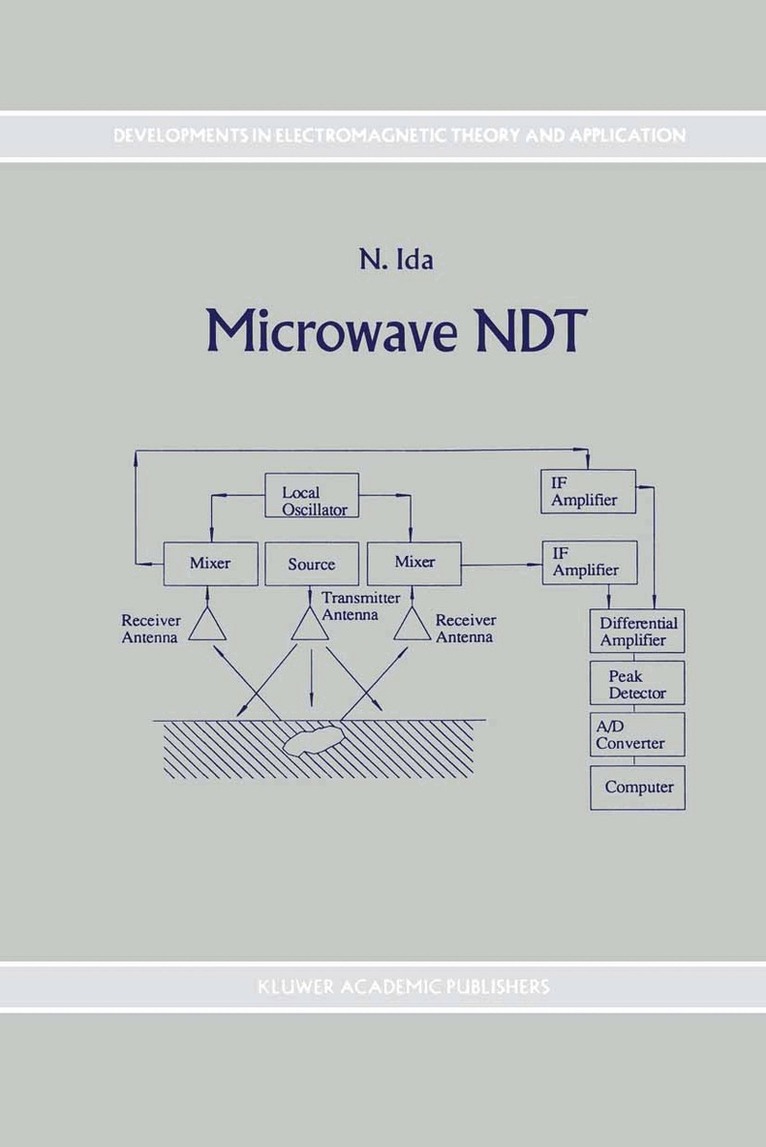
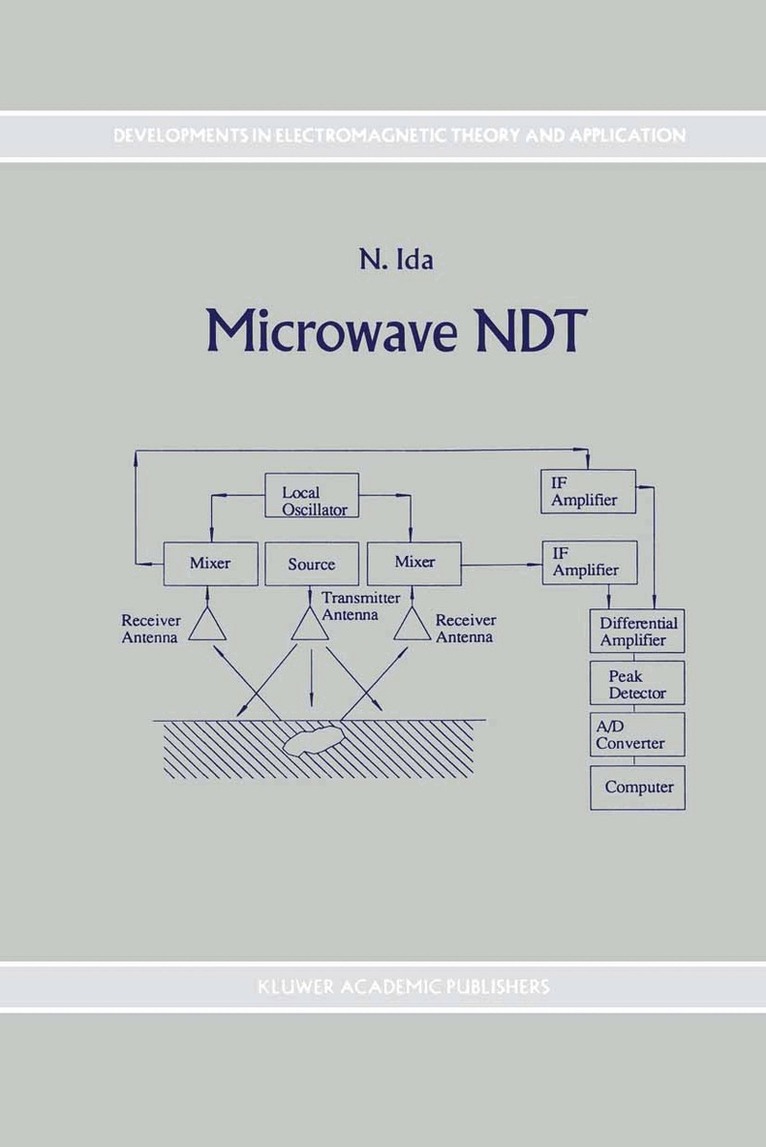
Microwave testing has been paid only scant attention in the literature as a method for nondestructive testing of materials, yet it offers some attractive features, especially for the testing of composite and other non-metalic materials. Microwave techniques have been used in a large number of applications that can be classified as nondestructive testing applications, ranging from large scale remote sensing to detection of tumours in the body. This volume describes a unified approach to microwave nondestructive testing by presenting the three essential components of testing: theory, practice and modelling. While recognizing that each of these subjects is wide enough to justify a volume of its own, the presentation of the three topics together shows that these are interrelated and should be practiced together. While few will argue against a good theoretical backgound, modelling and simulation of the testing environment is seldom part of the NDT training in any method, but particularly so in microwave testing. The text is divided into four parts. The first part presents the field theory background necessary for understanding the microwave domain.The second part treats microwave measurements as well as devices and sources and the third part discusses practical tests applicable to a variety of materials and geometries. The fourth part discusses modelling of microwave testing. Each chapter contains a bibliography intended to expand on the material given and, in particular, to point to subjects which could not be covered either as not appropriate or for lack of space. This work should be of interest to engineers, applied physicists and materials scientists.
1 059 kr
Skickas inom 10-15 vardagar
The book aims to present current knowledge concerning the propagation of electro magnetic waves in a homogeneous magnetoplasma for which temperature effects are unimportant. It places roughly equal emphasis on the radio and the . hydromagnetic parts of the electromagnetic spectrum. The dispersion properties of a magnetoplasma are treated as a function both of wave frequency (assumed real) and of ionization density. However, there is little discussion of propagation in a stratified medium, for of collisions is included only which reference may be made to Budden [1] . The effect in so far as this can be done with simplicity. The book describes how pulses are radiated from both small and large antennas embedded in a homogeneous magneto plasma. The power density radiated from a type of dipole antenna is studied as a function of direction of radiation in all bands of wave frequency. Input reactance is not treated, but the dependence of radiation resistance on wave frequency is described for the entire electromagnetic spectrum. Also described is the relation between beaming and guidance for Alfven waves.
1 585 kr
Skickas inom 10-15 vardagar
2 The linearized ideal MHO equations. . . . . . . . . . . . 204 3 Spectral problems corresponding to evolutionary problems . . 211 4 Stability of equilibrium configurations and the Energy Principle 215 5 Alternative forms of the plasma potential energy 220 6 Minimization of the potential energy with respect to a parallel displacement . . . . . . . . . . . . . 222 7 Classification of ideal MHO instabilities . 224 8 The linearized non-ideal MHO equations . 226 Chapter 6. Homogeneous and discretely structured plasma oscillations 229 I Introduction . . . . . . . . . . . . . . . 229 2 Alfven waves in an incompressible ideal plasma 230 3 Cold ideal plasma oscillations. . . . 233 4 Compressible hot plasma oscillations 236 5 Finite resistivity effects . . . . . . . 239 6 Propagation of waves generated by a local source 240 7 Stratified plasma oscillations . . . . . . . . . 247 8 Oscillations of a plasma slab . . . . . . . . . 254 9 Instabilities of an ideal stratified gravitating plasma 256 10 Instabilities of a resistive stratified gravitating plasma. 262 Chapter 7. MHO oscillations of a gravitating plasma slab 265 I Introduction . . . . . . . . . . . . . . . 265 2 Gravitating slab equilibrium . . . . . . . . 266 3 Oscillations of a hot compressible plasma slab 267 4 Investigation of the slab stability via the Energy Principle 270 5 On the discrete spectrum of the operator Kk . . . . . . 274 6 On the essential spectrum of the operator Kk . . . . . . 279 7 On the discrete spectrum embedded in the essential spectrum 282 8 The eigenfunction expansion formula . . . . . . . . . . 285 9 Excitation of plasma oscillations by an external power source . 288 10 The linearized equations governing resistive gravitating plasma slab oscillations . . . . . . . . . . . . . . . . . . . . . 290II Heuristic investigation of resistive instabilities. . . . . . . . . .
2 953 kr
Skickas inom 10-15 vardagar
In this book, the author draws on his broad experience to describe both the theory and the applications of wave propagations. The contents are presented in four parts and the sequence of these parts reflect the development of ionospheric and propagational research in areas such as space research geophysics and communications. The first part of the book presents an outline of the theory of electromagnetic waves propagating in a cold electron plasma. For reference, vector analysis, dyadics and eigenvalues introduced in this part are presented in the appendices. Practical aspects of radio wave propagation are the subject of the second part. The typical conditions in different frequency ranges are discussed and the irregular features of the ionospheric structure such as sound and gravity waves are also considered. Warm plasma and the effects of ions are considered in the third part, which includes a discussion of sound-like waves in electron and ion plasmas. Nonlinear effects and instabilities are described in the fourth part.
1 059 kr
Skickas inom 10-15 vardagar
to Electromagnetic Inverse Scattering by K. I. Hopcraft Department of Theoretical Mechanics, University of Nottingham, Nottingham, U. K. and P. R. Smith Department of Electronic and Electrical Engineering, University of Technology, Loughborough, U. K. Springer-Science+Business Media, B. V. Library of Congress Cataloging-in-Publication Data Hopcraft, K. I. An lntroductlon to electromagnetic inverse scattering I by K. I. Hopcraft and P. R. Smith. p. cm. -- (Developments in electromagnetic theory and application; 7) Includes blbliographical references and index. ISBN 978*90*481*4070*1 1. Electromagnetic waves--Scattering. 2. Inverse scattering transform. I. Smith, P. R. , Ph. D. II. Title. III. Series: DevelopNents in electromagnetic theory and applications; 7. OC665. S3H67 1992 539. 2--dc20 92-23966 ISBN 978-90-481-4070-1 ISBN 978-94-015-8014-4 (eBook) DOI 10.1007/978-94-015-8014-4 AH Rights Reserved (c) 1992 Springer Science+Business Media Dordrecht OriginaHy published by Kluwer Academic Publishers in 1992 Softcover reprint of the hardcover Ist edition 1992 No part ofthe material protected by this copyright notice may be reproduced or utilized in any form or by any means, electronic or mechanical, including photocopying, recording or by any information storage and retrieval system, without written permission from the copyright owner. Contents (;Iossary ...*. . *. **...*...*. . *. ***. *...****...**...* ix I'reface *************. . ****. **. *. ************************************************ xi 1 Introduction...1 1. 1 What is inverse scattering? ...1 1. 2 Why study inverse scattering? ...2 1. 3 An historical sketch ...3 1. 4 How to solve inverse problems ...*...6 Definitions and terminology ...6 Electromagnetic wave equations ...
Del 3 - Developments in Electromagnetic Theory and Applications
Theory of Reflection of Electromagnetic and Particle Waves
Häftad, Engelska, 2010
1 285 kr
Skickas inom 10-15 vardagar
This book is written for scientists and engineers whose work involves wave reflec tion or transmission. Most of the book is written in the language of electromagnetic theory, but, as the title suggests, many of the results can be applied to particle waves, specifically to those satisfying the Schr6dinger equation. The mathematical connection between electromagnetic s (or TE) waves and quantum particle waves is established in Chapter 1. The main results for s waves are translated into quantum mechanical language in the Appendix. There is also a close analogy between acoustic waves and electromagnetic p (or TM) waves, as shown in Section 1-4. Thus the book, though primarily intended for those working in optics, microwaves and radio, will be of use to physicists, chemists and electrical engineers studying reflection and transmission of particles at potential barriers. The tech niques developed here can also be used by those working in acoustics, ocean ography and seismology. Chapter 1 is recommended for all readers: it introduces reflection phenomena, defines the notation, and previews (in Section 1-6) the contents of the rest of the book. This preview will not be duplicated here. We note only that applied topics do appear: two examples are the important phenomenon of attenuated total reflection in Chapter 8, and the reflectivity of multilayer dielectric mirrors in Chapter 12. The subject matter is restricted to linear classical electrodynamics in non-magnetic media, and the corresponding particle analogues.
1 059 kr
Skickas inom 10-15 vardagar
The book aims to present current knowledge concerning the propagation of electro magnetic waves in a homogeneous magnetoplasma for which temperature effects are unimportant. It places roughly equal emphasis on the radio and the . hydromagnetic parts of the electromagnetic spectrum. The dispersion properties of a magnetoplasma are treated as a function both of wave frequency (assumed real) and of ionization density. However, there is little discussion of propagation in a stratified medium, for of collisions is included only which reference may be made to Budden [1] . The effect in so far as this can be done with simplicity. The book describes how pulses are radiated from both small and large antennas embedded in a homogeneous magneto plasma. The power density radiated from a type of dipole antenna is studied as a function of direction of radiation in all bands of wave frequency. Input reactance is not treated, but the dependence of radiation resistance on wave frequency is described for the entire electromagnetic spectrum. Also described is the relation between beaming and guidance for Alfven waves.
533 kr
Skickas inom 10-15 vardagar
During the past few years the rapid development of computer tech nology has made high power computing facilities more readily accessible to a greater proportion of our industrial and academic community. This development coupled with the recent upsurge in mathematical modelling and computer simulation has led to signif icant developments in electromagnetic field theory and its applic ations to industry. In view of such developments and the present high interest to both academics and industry the theme chosen for the Polymodel 6 Conference held at Newcastle upon Tyne in May 1983 was Industrial Electromagnetics Modelling. To date the North East Polytechnics Mathematical Modelling and Computer Simulation Group has organised five successful Polymodel. conferences each with a different theme. The objectives of the Polymodel group include the promotion of collaborative research between Newcastle, Sunderland and Teesside Polytechnics and industry in the areas of mathematical modelling and computer simulation. The aim of the Polymodel 6 Conference was to call on and use the modelling and computer.simulation expertise of eminent academics and industrialists who are deeply involved in the area of electro magnetics. These proceedings have a twofold purpose in that they contain current analytical and numerical techniques relevant to electromagnetic field problems and useful ideas on the modelling and simulation techniques which are most appropriate. It was also felt important to include implications. of. computer developments (both hardware and software) on such work.
2 111 kr
Skickas inom 10-15 vardagar
Microwave testing has been paid only scant attention in the literature as a method for nondestructive testing of materials, yet it offers some attractive features, especially for the testing of composite and other non-metallic materials. Microwave techniques have been used in a large number of applications that can be classified as nondestructive testing applications, ranging from large scale remote sensing to detection of tumors in the body. This volume describes a unified approach to microwave nondestructive testing by presenting the three essential components of testing: theory, practice, and modelling. While recognizing that each of these subjects is wide enough to justify a volume of its own, the presentation of the three topics together shows that these are interrelated and should be practiced together. While few will argue against a good theoretical background, modelling and simulation of the testing environment is seldom part of the NDT training in any method, but particularly so in microwave testing. The text is devided in four parts. The first part presents the field theory background necessary for understanding the microwave domain. The second part treats microwave measurements as well as devices and sources and the third part discusses practical tests applicable to a variety of materials and geometries. The fourth part discusses modelling of microwave testing. Each chapter contains a bibliography intended to expand on the material given and, in particular, to point to subjects which could not be covered either as not appropriate or for lack of space. For engineers, applied physicsts, material scientists.
1 585 kr
Skickas inom 10-15 vardagar
2 The linearized ideal MHO equations. . . . . . . . . . . . 204 3 Spectral problems corresponding to evolutionary problems . . 211 4 Stability of equilibrium configurations and the Energy Principle 215 5 Alternative forms of the plasma potential energy 220 6 Minimization of the potential energy with respect to a parallel displacement . . . . . . . . . . . . . 222 7 Classification of ideal MHO instabilities . 224 8 The linearized non-ideal MHO equations . 226 Chapter 6. Homogeneous and discretely structured plasma oscillations 229 I Introduction . . . . . . . . . . . . . . . 229 2 Alfven waves in an incompressible ideal plasma 230 3 Cold ideal plasma oscillations. . . . 233 4 Compressible hot plasma oscillations 236 5 Finite resistivity effects . . . . . . . 239 6 Propagation of waves generated by a local source 240 7 Stratified plasma oscillations . . . . . . . . . 247 8 Oscillations of a plasma slab . . . . . . . . . 254 9 Instabilities of an ideal stratified gravitating plasma 256 10 Instabilities of a resistive stratified gravitating plasma. 262 Chapter 7. MHO oscillations of a gravitating plasma slab 265 I Introduction . . . . . . . . . . . . . . . 265 2 Gravitating slab equilibrium . . . . . . . . 266 3 Oscillations of a hot compressible plasma slab 267 4 Investigation of the slab stability via the Energy Principle 270 5 On the discrete spectrum of the operator Kk . . . . . . 274 6 On the essential spectrum of the operator Kk . . . . . . 279 7 On the discrete spectrum embedded in the essential spectrum 282 8 The eigenfunction expansion formula . . . . . . . . . . 285 9 Excitation of plasma oscillations by an external power source . 288 10 The linearized equations governing resistive gravitating plasma slab oscillations . . . . . . . . . . . . . . . . . . . . . 290II Heuristic investigation of resistive instabilities. . . . . . . . . .