Hellenistica Groningana – serie
Visar alla böcker i serien Hellenistica Groningana. Handla med fri frakt och snabb leverans.
6 produkter
6 produkter
Del 26 - Hellenistica Groningana
Women and Power in Hellenistic Poetry
Häftad, Engelska, 2021
1 532 kr
Skickas inom 3-6 vardagar
It is a well-known and striking fact that Hellenistic Poetry is full of powerful and powerfully present women, ranging from Ptolemaic and other queens, to female (semi-) divinities and epic heroines. But the Hellenistic era is likewise remarkable for being relatively rich in female authors, specifically in the domain of epigrammatic poetry. This volume sets out to broach not only the question who the powerful women of Hellenistic poetry were, and what their power consisted of, but also, quite emphatically, in what ways they differ from or resemble previous literary representations of women in, for example, Homeric epic, archaic lyric and Athenian tragedy, and why.
Del 6 - Hellenistica Groningana
Hellenistic Epigrams
Häftad, Engelska, 2002
1 069 kr
Tillfälligt slut
This volume contains the papers of the 'Groningen Workshop on Hellenistic Poetry 5: Hellenistic Epigrams' (Groningen 30 August - 1 September 2000). During the workshop a first draft of the papers was discussed and commented on by an international group of specialists in the field of Hellenistic poetry.The volume contains a wide range of articles and thus provides a survey of current developments in research on one of the important genres of Hellenistic poetry. Several articles deal with generic aspects of the Hellenistic epigram, including the transition of inscriptions on stone to purely literary texts, others explore the function of the epigram in its social and cultural context or focus on specific groups of epigrams.The volume is the fifth of a series. Every two years a Workshop on Hellenistic Poetry takes place at the University of Groningen, the papers of which are published in the series "Hellenistica Groningana".
Del 9 - Hellenistica Groningana
Kinder und junge Helden
Innovative Aspekte des Umgangs mit der literarischen Tradition bei Kallimachos
Häftad, Tyska, 2005
1 005 kr
Tillfälligt slut
Die vorliegende Untersuchung zum Motiv des Kindes und des jungen Helden bei Kallimachos thematisiert zentrale Aspekte der Kallimacheischen Dichtung: ihre intertextuelle Dimension, die sich in der Bezugnahme sowohl auf die literarische Tradition als auch auf zeitgenössische Texte manifestiert, ihre narratologischen Strategien und ihr poetologisches Potential. Die 'Verjüngung' der 'alten' Gestalten des Götter- und Heroenmythos lässt sich als aitiologische Strategie erklären, die der alexandrinische Dichter in innovativer Weise zur Erneuerung der literarischen Tradition einsetzt. Ein repräsentativer Querschnitt durch das Gesamtwerk des Kallimachos macht anhand der jugendlichen Figuren thematische Parallelen und Kontraste zwischen jeweils korrespondierenden Texten sichtbar: Theseus in der «Hekale» steht Herakles in der «Victoria Berenices» gegenüber, Teiresias im fünften «Hymnos» kontrastiert mit Erysichthon im sechsten «Hymnos», und die göttlichen Kinder der übrigen «Hymnen» treten miteinander in Konkurrenz. Abschliessend wird am Beispiel der fiktiven Selbstdarstellung des Erzählers als Kind und als Jüngling im «Aitien-Prolog» und im «Somnium» aufgezeigt, wie Kallimachos mittels vergleichbarer aitiologischer Strategien seine eigene Position innerhalb der griechischen Literaturgeschichte definiert.
Del 10 - Hellenistica Groningana
Hidden Presences
Monuments, Gravesites, and Corpses in Greek Funerary Epigram
Häftad, Engelska, 2005
866 kr
Tillfälligt slut
«Hidden Presences» explores the inheritances of Hellenistic literary epigram from the sepulchral sub-genre of inscribed epigram. Divorced from the stone and the burial site, the literary form enjoys a new freedom, but exhibits this independence in a deliberate but creative use of out-of-date themes (notably roadside placement of the monument), subversive use of the inscribed epigrams' attempt to betray the "hidden presence" of the deceased, and exploitation of sepulchral conceits surrounding cenotaph. Indeed, this study shows not only that the fourth- and third-century poets at the headwaters of the literary tradition were interested in inscriptional precedents, but also that this interest was exercised down to the time of the epigrammatist Meleager. The poets within the variative community of literary epigram therefore carry on a literary conversation not simply between themselves, but between themselves and the inscribed tradition, and among themselves about the inscribed tradition.
Del 15 - Hellenistica Groningana
Nature and Science in Hellenistic Poetry
Häftad, Engelska, 2009
1 093 kr
Tillfälligt slut
This volume contains the papers of the 'Groningen Workshop on Hellenistic Poetry 8: Nature and Science' (Groningen 2006). During the workshop a first draft of the papers was commented on by an international group of specialists in the field of Hellenistic poetry. This volume deals with the interaction between 'nature and science' and Hellenistic poetry, particularly the ways in which poets were inspired and stimulated by the results of science and incorporated them into their work. In the Hellenistic period the fields of nature and science on the one hand and scholarship and poetry on the other hand touch and overlap to a large extent and the boundaries between science and poetry were not as straight and clear as they are today. The articles in this volume refine the general picture somewhat further. They focus on various authors and topics, e.g. Aratus, Nicander and Callimachus, medicine, astronomy, and geography. The volume is part of a series. Every two years a 'Workshop on Hellenistic Poetry' takes place at the University of Groningen, the papers of which are published in the series 'Hellenistica Groningana'.
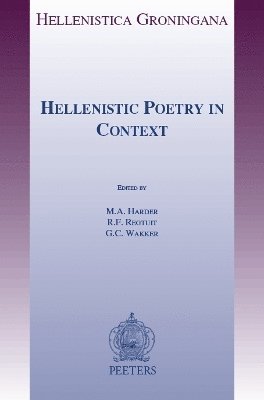
Del 20 - Hellenistica Groningana
Hellenistic Poetry in Context
Häftad, Engelska, 2014
1 333 kr
Tillfälligt slut
This volume is devoted to Hellenistic poetry in the context of the contemporary world of third century Alexandria and beyond. This topic fits in with the increasing interest in the role of literature in ancient society in recent research, which has already been applied successfully to various aspects of Hellenistic poetry. The subject also has an added interest because for a long time there has been a tendency to regard this kind of poetry as art for art’s sake, a kind of autonomous poetry and display of virtuosity among scholar-poets, who indulged in being as sophisticated as possible without being in touch with the real world. This view has been rightly challenged in recent years and the articles in this volume reflect this new approach, as the authors investigate the ways in which Hellenistic poetry, played a part in its social and cultural context.