Practical and Technical Guides for Laboratory-based Chemists - Böcker
Visar alla böcker i serien Practical and Technical Guides for Laboratory-based Chemists. Handla med fri frakt och snabb leverans.
3 produkter
3 produkter
618 kr
Skickas inom 5-8 vardagar
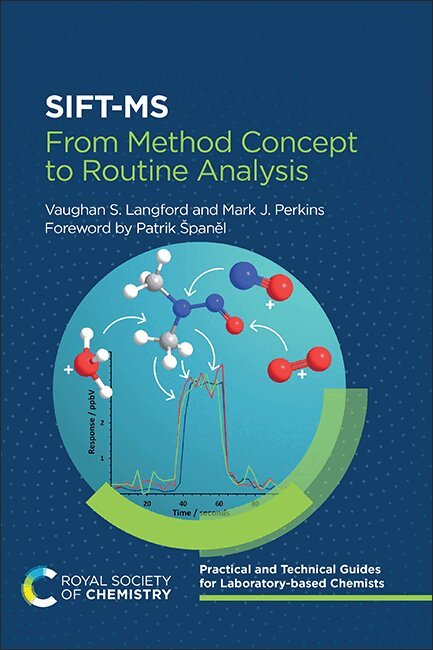
Selected ion flow tube mass spectrometry (SIFT-MS) is a chromatography-free, direct-analysis technique that is ideally suited to real-time, quantitative analysis of volatile compounds in air at trace concentrations. SIFT-MS utilises highly controlled, soft chemical ionisation – in the form of gas-phase ion–molecule reactions – coupled with mass spectrometry detection to provide both broad-spectrum and specific analysis of volatiles with diverse functionalities.This book provides readers with a broad understanding of the principles of the SIFT-MS technique and how it differs from conventional chromatographic approaches that are used for analysis of volatiles. It will also aid users to identify existing and new methods where adoption of SIFT-MS would be advantageous, e.g. through reduction in sample preparation or higher throughput, and provides the knowledge and insight required to develop best-practice methods and effectively evaluate the data that they generate and approaches to optimising, validating, and transferring methods to routine analysis and other applications.This book addresses two needs for SIFT-MS users:As a reference work, it gathers the fundamental principles from the literature and laboratory experience to provide a practical textbook for those using SIFT-MS in routine laboratories, research organisations and academia.It utilises a procedure-based approach to apply principles to routine analysis, simplifying implementation in routine analysis laboratories, while also accelerating effective application in other specialisations.The audience for this book is method developers and laboratory technicians engaged in routine analysis and research laboratories, but it is also well suited to graduate students, reducing the mentoring load for academics and research fellows.
618 kr
Skickas inom 5-8 vardagar
Struggling to get to grips with a new technique? Need some guidance on how to analyse metallic elements? Pitfalls, common errors and useful hints and tips are all discovered in this new book.Atomic spectrometry techniques are used to determine the metallic elements, as well as metalloids and non-metals. Providing methods of sample collection, sample preparation and analytical methodology, the book explores several techniques including flame and electrothermal atomic absorption spectrometry (FAAS and ETAAS), inductively coupled plasma–optical emission spectrometry (ICP–OES), inductively coupled plasma–mass spectrometry (ICP–MS), and more. In addition to these, the sections on sample collection and sample preparation methods are valuable for those practising or revising techniques. It provides a precious source of theoretical and practical information for those who are new to the techniques or working in laboratories with little access to in-house expertise. Unlike some books that are suitable for undergraduate students, this text provides hints, tips and methodology for users of the techniques. It is an accessible reference which can be read in parts or as a whole and is written to appeal to researchers, industrial scientists and technicians working in this field.
509 kr
Skickas
Have you been given a sample of unknown matter and don’t know where to start with working out what that sample might be? Knowing where to start when presented with a new chemical measurement problem can be daunting, but this book guides you through the reasonable steps to take to ascertain what a sample might be. From planning and developing appropriate analytical measurement methods to method validation, it fills a gap in the literature where there are few, to no, general guides on what to consider when developing chemical measurement methods. Starting with managing the various complexities of sample matrices, discussion on how to select techniques for the identification and quantification of analytes and, finally, details on assessment of the data to streamline the method development process are provided. Approaches range from sourcing and using established methods to adaptation and innovation in method development. Consideration is also given to what is appropriate to solve the analytical measurement problem whilst minimizing cost and optimizing use of time.Written for the novice, this book is also appropriate for established analytical chemists looking for new ideas. It will remove the worry of starting a new project or identifying that elusive sample.