World Crops: Production, Utilization and Description – serie
Visar alla böcker i serien World Crops: Production, Utilization and Description. Handla med fri frakt och snabb leverans.
15 produkter
15 produkter
Inbunden, Engelska, 1979
3 197 kr
Skickas inom 10-15 vardagar
A Seminar in the EEC Programme of Coordination of Research on Plant Protein Improvement
Inbunden, Engelska, 1980
2 134 kr
Skickas inom 10-15 vardagar
Inbunden, Engelska, 1983
2 134 kr
Skickas inom 10-15 vardagar
Del 9 - World Crops: Production, Utilization and Description
Ascochyta Blight and Winter Sowing of Chickpeas
Inbunden, Engelska, 1984
2 134 kr
Skickas inom 10-15 vardagar
Proceedings of the Workshop in Ascochyta Blight and Winter Sowing of Chickpeas, held in Aleppo, Syria, May 4-7, 1981
2 134 kr
Skickas inom 10-15 vardagar
This is the fourth major publication on Vicia faba reporting proceedings of seminars organised through the Commission of the European Communities in the context of the E.E.C. Common Research Programme on Plant Protein Improvement. The previous three volumes report proceedings from the seminar in Sari in 1978 (Some current research on Vicia faba in Western Europe), and from Cambridge in 1979 (Vicia faba : Feeding value, processing and viruses) and in Wageningen in 1980 (Vicia faba : Physiology and Breeding). The theme of this seminar, held at the University of Nottingham from 14th to 16th September 1983 was selected to examine current research on agronomy, physiology, plant breeding and nutrition. 84 delegates from 15 European countries attended. Throughout the seminar there was a spirit of friendliness and co-operation. Everyone seemed dedicated to doing real justice to the faba bean crop. The organisation of this seminar would not have been possible without the help of my secretary, Mrs. Jeanne Rodwell who undertook most of the administrative and secretarial work. P.D. Hebblethwaite COMPONENTS OF THE YIELD AND YIELD OF VICIA FABA Ph. Plancquaert, J.L. Raphalen Institut Technique des Cereales et des Fourrages 8 Avenue du President Wilson, 75116 Paris, France. ABSTRACT Preliminary experiments have indicated the main factors affecting the yield of winter (6 trials) and spring faba beans (5 trials) : information is presented on the development of pods and flowers, yield and yield components and grain protein content at different locations in France.
Inbunden, Engelska, 1985
2 134 kr
Skickas inom 10-15 vardagar
Proceedings of a Seminar in the CEC Programme of Research on Plant Protein Improvement, held in Copenhagen 11th-13th September 1984
Inbunden, Engelska, 1987
1 070 kr
Skickas inom 10-15 vardagar
This publication contains proceedings of a Seminar on GLUCOSINOLATES IN RAPESEEDS - Analytical Aspects, held in Gembloux (Belgium) from 1 to 3 October 1986. The meeting was organized by request of the Commission of the European Communities in the context of the CEC Programme of Research on Plant Productivity. The main aim of the Seminar was to contribute to the elaboration of reliable quantitative methods for glucosinolate determination in rapeseeds. Fourty Experts from thirteen countries participated in this Seminar. Original contributions which were considered of special importance for the subject covered by the Seminar were presented and discussed. Thanks are due to the Chairmen, Dr. Heaney R., Dr. Biston R., Dr. Ri- baillier D., Prof. Dr. Robbelen G., authors and participants in the meeting for their contributions, friendliness and cooperation. Special thanks go to Dr. Mc Gregor (Canada) and Dr. Uppstrom B. (Swe- den) who gave Members the benefit of their knowledge. Finally, I would also like to thank those who have helped in organizing this Seminar Director Lecomte R. (Centre de Recherches Agronomiques de l'Etat, Gembloux), Rector Ledent A.(Faculte des Sciences Agronomiques de l'Etat, Gembloux), Prof. Severin M., Dr. Biston R., Mrs Bock and all my colleagues.
2 134 kr
Skickas inom 10-15 vardagar
This is the fourth major publication on Vicia faba reporting proceedings of seminars organised through the Commission of the European Communities in the context of the E.E.C. Common Research Programme on Plant Protein Improvement. The previous three volumes report proceedings from the seminar in Sari in 1978 (Some current research on Vicia faba in Western Europe), and from Cambridge in 1979 (Vicia faba : Feeding value, processing and viruses) and in Wageningen in 1980 (Vicia faba : Physiology and Breeding). The theme of this seminar, held at the University of Nottingham from 14th to 16th September 1983 was selected to examine current research on agronomy, physiology, plant breeding and nutrition. 84 delegates from 15 European countries attended. Throughout the seminar there was a spirit of friendliness and co-operation. Everyone seemed dedicated to doing real justice to the faba bean crop. The organisation of this seminar would not have been possible without the help of my secretary, Mrs. Jeanne Rodwell who undertook most of the administrative and secretarial work. P.D. Hebblethwaite COMPONENTS OF THE YIELD AND YIELD OF VICIA FABA Ph. Plancquaert, J.L. Raphalen Institut Technique des Cereales et des Fourrages 8 Avenue du President Wilson, 75116 Paris, France. ABSTRACT Preliminary experiments have indicated the main factors affecting the yield of winter (6 trials) and spring faba beans (5 trials) : information is presented on the development of pods and flowers, yield and yield components and grain protein content at different locations in France.
Häftad, Engelska, 2011
539 kr
Skickas inom 10-15 vardagar
Faba beans, formerly known as broad beans, are among the oldest crops in the world. It has in fact been claimed with some justification that the Pyramids were built on faba beans! They are today a major crop in many countries such as China, Egypt and the Sudan; and are widely grown for human food throughout the Me~iterranean region, in Ethiopia and in parts of Latin America. In recent years there has been a growing interest in faba bean production as a protein source for stock feed in parts of Europe, North America and Aus· tralia. The publication served by this preface arose from the first International Faba Bean Con ference, held in Cairo, Egypt, on March 7-11, 1981 which provided a suitable forum for the review of many scientifically important aspects of the improvement of the crop. Leading faba bean specialists from four continents who participated were able not only to contri· bute from their personal expertise in relevant subjects, but in return to gain from their ex perience of Nile Valley conditions and from close contact with so many of the world's faba bean scientists. The conference was supported in the main by the ICARDAjIFAD Nile Valley Faba Bean Project. Additional support was received from a number of other organisations and institutions whose help is gladly acknowledged. These included the Agricultural Research Council (ARC) of the Egyptian Ministry of Agriculture; G.T.Z. of Germany; IDRC of Canada; the National Research Center of Egypt; and Cairo University.
Del 7 - World Crops: Production, Utilization and Description
Aromatic Plants
Basic and Applied Aspects
Häftad, Engelska, 2011
539 kr
Skickas inom 10-15 vardagar
The use of aromatic plants has been practised since ancient times as is evidenced by records of Chinese, Egyptian, Mesopotamian, Greek and Roman origin; recent findings in Pakistan prove that it goes as far back as 5000 years. Accordingly, the importance and value ascribed to them were always high. Either as a medicine, a foodstuff, a seasoning, a cosmetic or an element of religious rituals the aromatic plant was indispensable. It is not to be forgotten that desire tor the riches of India - spices among which - and the struggle to monopolize the trade of the latter con tributed to the opening of new sea routes, discovering of continents and altering the picture of the known world. With the advent of modern civilization, characterized by scientific and technological development which dIverted estimation and consumption towards artificial products, aromatic plants experienced a temporary de cline of use retaining, however, theIr importance In sectors such as the culinary art and cosmetics industry.
539 kr
Skickas inom 10-15 vardagar
This is the third major publication on Viaia faba reporting proceedings of seminars organised through the Commission of the European Communities in the context of the EEC Common Research Programme on Plant Protein Improvement. The previous two volumes report proceedings from the seminars in Bari in 1978 (Some current research on Vida faba in Western Europe) and in Cambridge in 1979 (Vicia faba: Feeding value, processing and viruses) • The theme of this seminar, held in Wageningen on 24th - 26th June, was selected to examine various aspects of plant physiology, especially in relation to their potential contribu tion to plant breeding. Areas identified for discussion included those to elucidate particular responses of the plant to the environment and, in the broader concept, an examination of the combined responses of ideotypes required to exploit fully the range of environments in which Viaia faba is grown. Increased pea breeding in Europe in recent years justified an assessment of the projected progress of the crop for dry seed production and two papers were invited on this topic. Participants visited Cebeco at Lelystad where, after hearing of the involvement in field beans and peas, the advanced selections in field plots were examined and discussed. On the same day visits were also made to the SVP experimental farm and to the CABO experimental farm at de Eest, to discuss the plant breeding/physiology experiments on field beans and peas. The seminar was organised by Dr. G. Dantuma and Ir. R.J.
1 070 kr
Skickas inom 10-15 vardagar
This publication contains the proceedings of a seminar on 'Production and Utilization of Protein in Oilsead Crops', held at Braunschweig from 8 to 10 July, 1980. The meeting was held under the auspices of the Commission of the European Communities, as part of the EEC Common Research Programme on Plant Protein Improvement. Methods for the intensive production of meat and milk have been adopted to an increasing extent in EEC coun±ries over the past two decades, their success is based on animal diets of high quality, balanced for energy and protein contents. The substantial improvements in cereal yields in EEC over this period has kept pace with the increasing demand for dietary energy in concentrated animal foodstuffs, but provision of the necessary protein supplementation has required ever-increasing imports of soybean products. Grain legumes and oilseed meals are the two main sources of concentrated protein for the animal feeds industry, and there is an urgent need for increased EEC production of both. Seminars on grain legumes have been held at regular intervals since 1976; the meeting at Braunschweig, now reported, was the first to consider in detail the potential contribution from oilseed crops suitable for EEC conditions. Local arrangements for the seminar were made by Professor Dr. M. Dambroth, Dr. C. Sommer, and their colleagues at the Institut fUr Pflanzenbau und Pflanzenzuchtung, Braunschweig - Volkenr6de.
Häftad, Engelska, 2011
539 kr
Skickas inom 10-15 vardagar
Häftad, Engelska, 2011
1 070 kr
Skickas inom 10-15 vardagar
This publication contains proceedings of a Seminar on GLUCOSINOLATES IN RAPESEEDS - Analytical Aspects, held in Gembloux (Belgium) from 1 to 3 October 1986. The meeting was organized by request of the Commission of the European Communities in the context of the CEC Programme of Research on Plant Productivity. The main aim of the Seminar was to contribute to the elaboration of reliable quantitative methods for glucosinolate determination in rapeseeds. Fourty Experts from thirteen countries participated in this Seminar. Original contributions which were considered of special importance for the subject covered by the Seminar were presented and discussed. Thanks are due to the Chairmen, Dr. Heaney R., Dr. Biston R., Dr. Ri- baillier D., Prof. Dr. Robbelen G., authors and participants in the meeting for their contributions, friendliness and cooperation. Special thanks go to Dr. Mc Gregor (Canada) and Dr. Uppstrom B. (Swe- den) who gave Members the benefit of their knowledge. Finally, I would also like to thank those who have helped in organizing this Seminar Director Lecomte R. (Centre de Recherches Agronomiques de l'Etat, Gembloux), Rector Ledent A.(Faculte des Sciences Agronomiques de l'Etat, Gembloux), Prof. Severin M., Dr. Biston R., Mrs Bock and all my colleagues.
Häftad, Engelska, 2011
539 kr
Skickas inom 10-15 vardagar
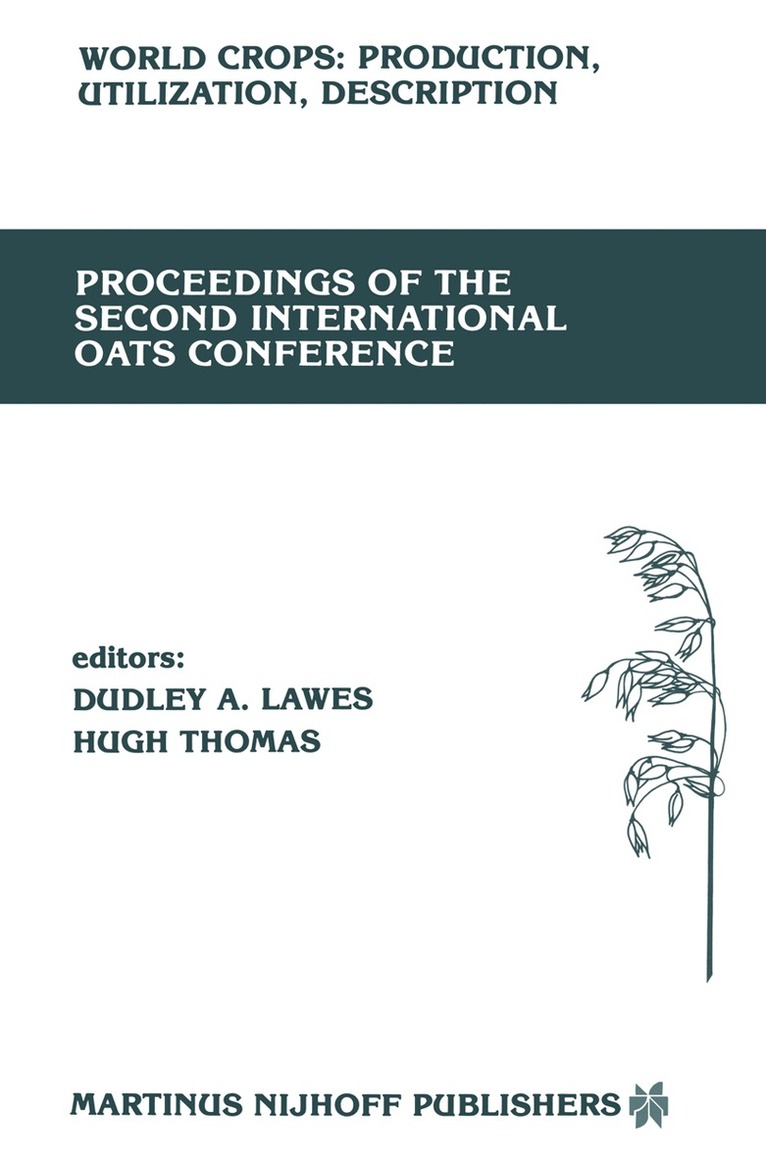
The Second International Oat Conference. of which these are the proceedings.was heldat Aberystwyth. 15-18 July.1985. In thebusiness meeting heldatthecloseof theFirstInternational Oat Workshop that was held at PennsylvaniaStateUniversity in 1982. an Internat i ona1 Organsi i ng Committee under the chairmanship of Or KJ Frey was electedto organisethe next conference.and Aberystwyth was proposed and agreed as the venue. The final date of the Second Conferenceand the out 1i ne of the programme. inc1udi ng selection of the rnain speakers. was agreed by the Internat i ona1 Committee but 1oca1 arrangements and finalisation of the programme were delegatedto a local sub-committee centredat the Welsh Plant Breeding Station. We wish to record our appreciationof the work done bythis localcommittee in assuming various organisational responsibilities. From the outsettherewas a firm committmentto makethe Conferenceas international as possible and every effortwas made both to provide a programme thatwouldattract participants from allpartsof the worldand to keep costs to a minimum so as to increasethe chances of potential delegatesbeing ableto attend.Alistof participantsis includedbut it is worthyof notethattwenty-three countr ies were represented. The Conferencewas organisedintoseven half-daysessions. Six of these covered differenttopics relevantto the improvement of oats and the seventhwas a visit to the Welsh PlantBreedingStationwhere laboratory and fieldwork ontheoatcrop was demonstrated.