• Fri frakt över 249 kr
  • •
  • Snabba leveranser
  • •
  • Billiga böcker
Kundservice

Du är på sajten för privatpersoner.

Företag, bibliotek eller offentlig verksamhet?

Du handlar på classic.bokus.com, där alla dina funktioner finns intakta.
Till classic.bokus.com
Bokus logotyp. Gå till startsidan.
  • Erbjudanden
  • Student
  • Topplistor
  • Barn & ungdom
  • Bokus Play
  • E-böcker
  • Ljudböcker
  • Pocketböcker
  • Spel och pussel

5% studentrabatt – använd koden KURSBOK27 →

Sidfot

Mina sidor

    Hjälp

    • Kundservice
    • Vanliga frågor och svar
    • Frakt och leverans
    • Retur vid ångerrätt
    • Reklamera vara
    • Betalning
    • Köpvillkor
    • Allmänna villkor
    • Information om webbplatsens tillgänglighet

    Om Bokus

    • Om oss
    • Pressrum
    • För studenter
    • För företag
    • För bibliotek och offentlig verksamhet
    • För leverantörer
    • Hållbarhet

    Populärt

    • Aktuella erbjudanden
    • Presentkort
    • Studentlitteratur
    • Nya böcker
    • Topplistor
    • Signerade böcker
    • Engelska böcker

    Inspiration

    • Boktips
    • BookTok
    • Barnbokskaraktärer
    • Populära författare
    Logotyp för Bokus
    Följ oss på Facebook (extern länk)Följ oss på Instagram (extern länk)Följ oss på YouTube (extern länk)Följ oss på TikTok (extern länk)
    bokus @ CookiesAnpassa cookiesIntegritetspolicyKöpvillkor
    Till Citymail hemsida (extern länk)Till Budbee hemsida (extern länk)Till Postnord hemsida (extern länk)Till Schenker hemsida (extern länk)Till Early Bird hemsida (extern länk)Till Walleys hemsida (extern länk)
    1. Naturvetenskap och teknik
    2. Matematik och naturvetenskap
    3. Matematik
    4. Beräkning och matematisk analys

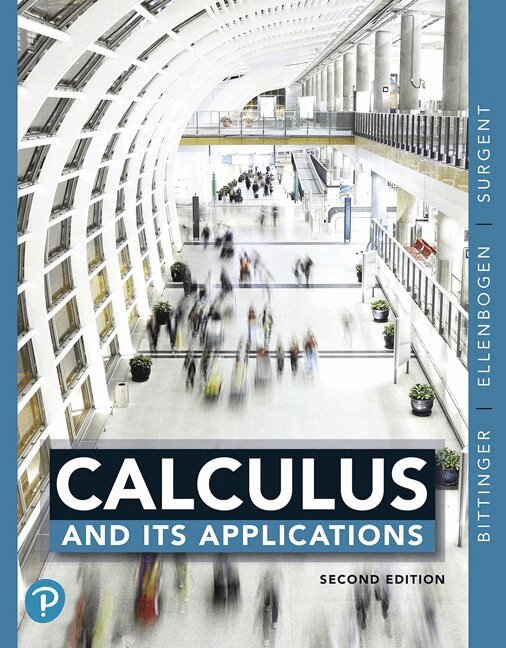
    Calculus and Its Applications

    AvMarvin Bittinger,David Ellenbogen

    Inbunden, Engelska, 2019

    3 296 kr

    Beställningsvara. Skickas inom 7-10 vardagar. Fri frakt över 249 kr.

    Beskrivning

    For two-semester courses in Applied Calculus. 


    Anticipating and meeting student needs

    Calculus and Its Applications remains a best-selling text because of its intuitive approach that anticipates student needs, and a writing style that pairs clear explanations with carefully crafted figures to help students visualize concepts. Key enhancements in the 2nd Edition include the earlier introduction of logarithmic and exponential functions to help students master these important functions and their applications. 


    The text’s accompanying MyLab™ Math course also has been revised substantially, as new co-author Gene Kramer (University of Cincinnati, Blue Ash) revisited every homework question and learning aid to improve  content clarity and accuracy. These and all other aspects of the new edition are designed to motivate and help students more readily understand and apply principles of calculus.


    The title of this text was formerly Calculus and Its Applications, Expanded Version.


    Also available with MyLab Math

    MyLab™ Math is the teaching and learning platform that empowers you to reach every student. By combining trusted author content with digital tools and a flexible platform, MyLab Math personalizes the learning experience and improves results for each student.


    Note: You are purchasing a standalone product; MyLab Math does not come packaged with this content. Students, if interested in purchasing this title with MyLab Math, ask your instructor to confirm the correct package ISBN and Course ID. Instructors, contact your Pearson representative for more information.


    If you would like to purchase both the physical text and MyLab Math, search for:


    013530802X / 9780135308028 Calculus and Its Applications plus MyLab Math with Pearson eText - Title-Specific Access Card Package

    Package consists of:

    • 0135091683 / 9780135091685 Calculus and Its Applications
    • 0135218233 / 9780135218235 MyLab Math with Pearson eText - Standalone Access Card - for Calculus and Its Applications

    Produktinformation

    • Utgivningsdatum:2019-01-08
    • Mått:217 x 277 x 40 mm
    • Vikt:2 074 g
    • Format:Inbunden
    • Språk:Engelska
    • Antal sidor:960
    • Upplaga:2
    • Förlag:Pearson Education
    • ISBN:9780135091685

    Utforska kategorier

    • Beräkning och matematisk analys inom Naturvetenskap och teknik

    Mer om författaren

    About our authors Marvin Bittinger has been teaching math at the university level for more than 38 years. Since 1968, he has been employed at Indiana University - Purdue University Indianapolis, and is now professor emeritus of mathematics education. Professor Bittinger has authored over 250 publications on topics ranging from basic mathematics to algebra and trigonometry to applied calculus. He received his BA in mathematics from Manchester College and his PhD in mathematics education from Purdue University. Special honors include Distinguished Visiting Professor at the United States Air Force Academy and his election to the Manchester College Board of Trustees from 1992 to 1999. His hobbies include hiking in Utah, baseball, golf, and bowling. Professor Bittinger has also had the privilege of speaking at many mathematics conventions, most recently giving a lecture entitled "Baseball and Mathematics." In addition, he also has an interest in philosophy and theology, in particular, apologetics. Professor Bittinger currently lives in Carmel, Indiana with his wife Elaine. He has 2 grown and married sons, Lowell and Chris, and 4 granddaughters.David Ellenbogen has taught math at the college level for over 30 years, spending most of that time in the Massachusetts and Vermont community college systems, where he has served on both curriculum and developmental math committees. He has also taught at St. Michael's College and the University of Vermont. Professor Ellenbogen has been active in the American Mathematical Association of Two Year Colleges since 1985, having served on its Developmental Mathematics Committee and as a Vermont state delegate. He has been a member of the Mathematical Association of America since 1979, has authored dozens of publications on topics ranging from prealgebra to calculus, and has delivered lectures at numerous conferences on the use of language in mathematics. Professor Ellenbogen received his BA in mathematics from Bates College and his MA in community college mathematics education from the University of Massachusetts at Amherst, and a certificate of graduate study in Ecological Economics from the University of Vermont. Professor Ellenbogen has a deep love for the environment and the outdoors, and serves on the boards of 3 nonprofit organizations in his home state of Vermont. In his spare time, he enjoys playing jazz piano, hiking, biking, and skiing. He has 2 sons, Monroe and Zack.Scott Surgent received his B.S. and M.S. degrees in mathematics from the University of California - Riverside, and has taught mathematics at Arizona State University in Tempe, Arizona since 1994. He is an avid sports fan and has authored books on hockey, baseball, and hiking. Scott enjoys hiking and climbing the mountains of the western United States. He was active in search and rescue, including 6 years as an Emergency Medical Technician with the Central Arizona Mountain Rescue Association (Maricopa County Sheriff's Office) from 1998 until 2004. Scott and his wife Beth live in Scottsdale, Arizona.Gene Kramer received his PhD from the University of Cincinnati, where he researched the well-posedness of initial-boundary value problems for nonlinear wave equations. He is currently a professor of mathematics at the University of Cincinnati Blue Ash College. He is active in scholarship of teaching and learning research and is a member of the Academy of the Fellows for Teaching and Learning at the University of Cincinnati. He is a co-founder and an editor for The Journal for Research and Practice in College Teaching and serves as a Peer Reviewer for the Higher Learning Commission.

    Innehållsförteckning

    • Prerequisite Skills Diagnostic TestR. Functions, Graphs, and Models R.1 Graphs and EquationsR.2 Functions and ModelsR.3 Finding Domain and RangeR.4 Slope and Linear FunctionsR.5 Nonlinear Functions and ModelsR.6 Exponential and Logarithmic FunctionsR.7 Mathematical Modeling and Curve FittingChapter SummaryChapter Review ExercisesChapter TestExtended Technology Application: Average Price of a Movie Ticket1. Differentiation 1.1 Limits: A Numerical and Graphical Approach1.2 Algebraic Limits and Continuity1.3 Average Rates of Change1.4 Differentiation Using Limits and Difference Quotients1.5 Leibniz Notation and the Power and Sum–Difference Rules1.6 The Product and Quotient Rules1.7 The Chain Rule1.8 Higher-Order DerivativesChapter SummaryChapter Review ExercisesChapter TestExtended Technology Application: Path of a Baseball: The Tale of the Tape2. Exponential and Logarithmic Functions 2.1 Exponential and Logarithmic Functions of the Natural Base, e2.2 Derivatives of Exponential (Base-e) Functions2.3 Derivatives of Natural Logarithmic Functions2.4 Applications: Uninhibited and Limited Growth Models2.5 Applications: Exponential Decay2.6 The Derivatives of ax and loga xChapter SummaryChapter Review ExercisesChapter TestExtended Technology Application: The Business of Motion Picture Revenue and DVD Release3. Applications of Differentiation 3.1 Using First Derivatives to Classify Maximum and Minimum Values and Sketch Graphs3.2 Using Second Derivatives to Classify Maximum and Minimum Values and Sketch Graphs3.3 Graph Sketching: Asymptotes and Rational Functions3.4 Optimization: Finding Absolute Maximum and Minimum Values3.5 Optimization: Business, Economics, and General Applications3.6 Marginals, Differentials, and Linearization3.7 Elasticity of Demand3.8 Implicit Differentiation and Logarithmic Differentiation3.9 Related RatesChapter SummaryChapter Review ExercisesChapter TestExtended Technology Application: Maximum Sustainable Harvest4. Integration 4.1 Antidifferentiation4.2 Antiderivatives as Areas4.3 Area and Definite Integrals4.4 Properties of Definite Integrals: Additive Property, Average Value, and Moving Average4.5 Integration Techniques: Substitution4.6 Integration Techniques: Integration by Parts4.7 Numerical IntegrationChapter SummaryChapter Review ExercisesChapter TestExtended Technology Application: Business and Economics: Distribution of Wealth5. Applications of Integration 5.1 Consumer and Producer Surplus; Price Floors, Price Ceilings, and Deadweight Loss5.2 Integrating Growth and Decay Models5.3 Improper Integrals5.4 Probability5.5 Probability: Expected Value; the Normal Distribution5.6 Volume5.7 Differential EquationsChapter SummaryChapter Review ExercisesChapter TestExtended Technology Application: Curve Fitting and Volumes of Containers6. Functions of Several Variables 6.1 Functions of Several Variables6.2 Partial Derivatives6.3 Maximum–Minimum Problems6.4 An Application: The Least-Squares Technique6.5 Constrained Optimization: Lagrange Multipliers and the Extreme-Value Theorem6.6 Double IntegralsChapter SummaryChapter Review ExercisesChapter TestExtended Technology Application: Minimizing Employees' Travel Time in a Building7. Trigonometric Functions 7.1 Basics of Trigonometry7.2 Derivatives of Trigonometric Functions7.3 Integration of Trigonometric Functions7.4 Inverse Trigonometric Functions and ApplicationsChapter SummaryChapter Review ExercisesChapter TestExtended Technology Application8. Differential Equations 8.1 Direction Fields, Autonomic Forms, and Population Models8.2 Applications: Inhibited Growth Models8.3 First-Order Linear Differential Equations8.4 Higher-Order Differential Equations and a Trigonometry ConnectionChapter SummaryChapter Review ExercisesChapter TestExtended Technology Application9. Sequences and Series 9.1 Arithmetic Sequences and Series9.2 Geometric Sequences and Series9.3 Simple and Compound Interest9.4 Annuities and Amortization9.5 Power Series and Linearization9.6 Taylor Series and a Trigonometry ConnectionChapter SummaryChapter Review ExercisesChapter TestExtended Technology Application10. Probability Distributions 10.1 A Review of Sets10.2 Theoretical Probability10.3 Discrete Probability Distributions10.4 Continuous Probability Distributions: Mean, Variance, and Standard DeviationChapter SummaryChapter Review ExercisesChapter TestExtended Technology Application11. Systems and Matrices (online only) 11.1 Systems of Linear Equations11.2 Gaussian Elimination11.3 Matrices and Row Operations11.4 Matrix Arithmetic: Equality, Addition, and Scalar Multiples11.5 Matrix Multiplication, Multiplicative Identities, and Inverses11.6 Determinants and Cramer's Rule11.7 Systems of Linear Inequalities and Linear ProgrammingChapter SummaryChapter Review ExercisesChapter TestExtended Technology Application12. Combinatorics and Probability (online only) 12.1 Compound Events and Odds12.2 Combinatorics: The Multiplication Principle and Factorial Notation12.3 Permutations and Distinguishable Arrangements12.4 Combinations and the Binomial Theorem12.5 Conditional Probability and the Hypergeometric Probability Distribution Model12.6 Independent Events, Bernoulli Trials, and the Binomial Probability Model12.7 Bayes TheoremChapter SummaryChapter Review ExercisesChapter TestExtended Technology Application Cumulative ReviewAppendices A. Review of Basic AlgebraB. Indeterminate Forms and l'Hôpital's RuleC. Regression and Microsoft ExcelD. Areas for a Standard Normal DistributionE. Using Tables of Integration FormulasAnswers Index of Applications Index