• Fri frakt över 249 kr
  • •
  • Snabba leveranser
  • •
  • Billiga böcker
Kundservice

Du är på sajten för privatpersoner.

Företag, bibliotek eller offentlig verksamhet?

Du handlar på classic.bokus.com, där alla dina funktioner finns intakta.
Till classic.bokus.com
Bokus logotyp. Gå till startsidan.
  • Erbjudanden
  • Student
  • Topplistor
  • Barn & ungdom
  • Bokus Play
  • E-böcker
  • Ljudböcker
  • Pocketböcker
  • Spel & pussel

Upp till 25% på utvalda nyheter →

Sidfot

Mina sidor

    Hjälp

    • Kundservice
    • Vanliga frågor och svar
    • Frakt och leverans
    • Retur vid ångerrätt
    • Reklamera vara
    • Betalning
    • Köpvillkor
    • Allmänna villkor
    • Information om webbplatsens tillgänglighet

    Om Bokus

    • Om oss
    • Pressrum
    • För studenter
    • För företag
    • För bibliotek och offentlig verksamhet
    • För leverantörer
    • Hållbarhet

    Populärt

    • Aktuella erbjudanden
    • Presentkort
    • Studentlitteratur
    • Nya böcker
    • Topplistor
    • Signerade böcker
    • Engelska böcker

    Inspiration

    • Boktips
    • BookTok
    • Populära bokserier
    • Barnbokskaraktärer
    • Populära författare
    Logotyp för Bokus
    Följ oss på Facebook (extern länk)Följ oss på Instagram (extern länk)Följ oss på YouTube (extern länk)Följ oss på TikTok (extern länk)
    bokus @ CookiesAnpassa cookiesIntegritetspolicyKöpvillkor
    Till Citymail hemsida (extern länk)Till Budbee hemsida (extern länk)Till Postnord hemsida (extern länk)Till Schenker hemsida (extern länk)Till Early Bird hemsida (extern länk)Till Walleys hemsida (extern länk)
    1. Naturvetenskap och teknik
    2. Teknik och industri
    3. Elektronik och kommunikationer

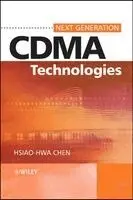
    Next Generation CDMA Technologies

    AvHsiao-Hwa Chen

    Inbunden, Engelska, 2007

    1 774 kr

    Beställningsvara. Skickas inom 11-20 vardagar. Fri frakt över 249 kr.

    Fler format och utgåvor

    E-bok

    2 082 kr

    Beskrivning

    Future wireless communication systems should be operating mainly, if not completely, on burst data services carrying multimedia traffic.The need to support high-speed burst traffic has already posed a great challenge to all currently available air-link technologies based either on TDMA or CDMA.The first generation CDMA technology has been used in both 2G and 3G mobile cellular standards and it has been suggested that it is not suitable for high-speed burst-type traffic. There are many problems with the first generation CDMA technology, such as its low spreading efficiency, interference-limited capacity and the need for precision power control, etc... 'The Next Generation Technologies' will offer first-hand information on how to make use of various innovative technologies to implement the next generation CDMA technology.As an all-in-one reference for telecommunications engineers, advanced R & D personnels, undergraduate and postgraduate students, this book is must-read material. Addresses various important issues about the next generation CDMA technologies as the major air-link technology for beyond 3G wireless applications.Covers topics from next generation CDMA system modelling to analytical methodology, starting with the basics and progressing to advanced research topics.Contains many new and previously unpublished research results.Introduces many innovative CDMA technologies such as DS/CC-CDMA, OS/CC-CDMA, space-time complementary coding CDMA, M-ary CDMA, optical complementary coded CDMA, etc.

    Produktinformation

    • Utgivningsdatum:2007-07-20
    • Mått:173 x 252 x 33 mm
    • Vikt:1 043 g
    • Format:Inbunden
    • Språk:Engelska
    • Antal sidor:476
    • Förlag:John Wiley & Sons Inc
    • ISBN:9780470022948

    Utforska kategorier

    • Elektronik och kommunikationer inom Naturvetenskap och teknik

    Mer om författaren

    Professor HH Chen is the Director of the Institute of Communications Engineering at the National Sun Yat-Sen University in Taiwan.  He is also an Honorable Guest Professor at Zhejiang University in China and a Visiting Professor at the Chinese University of Hong Kong. Dr. Chen received his BSc and MSc degrees from Zhejiang University, China, and his PhD degree from the University of Oulu, Finland, in 1982, 1985 and 1990, respectively, all in Electrical Engineering. Since then he has held a number of posts within academia in Finland, Taiwan, Germany, Japan and Hong Kong.  His research efforts in spread spectrum and CDMA communication systems has resulted in nine US, Finnish and Taiwanese patents, most of which have been licensed to industry for commercial applications. He has served and been serving as the Editor of the special issues of IEEE Journal on Selected Areas in Communications and is a recipient of the numerous research and teaching Awards from the National Science Council, the Ministry of Education and other professional associations in Taiwan. He has recently become the Editor for Asia & the Pacific for the Wiley journal Wireless Communications & Mobile Computing.

    Innehållsförteckning

    • Preface ixAbout the Author xi1 Introduction 12 Basics of CDMA Communications 92.1 CDMA Codes and Their Properties 122.2 Direct Sequence CDMA Techniques 172.3 Frequency Hopping CDMA Techniques 342.4 Time Hopping CDMA Techniques 422.5 Spread Spectrum or Time? 442.6 Characteristic Features of CDMA Systems 452.7 Multi-Code and M-ary CDMA Techniques 602.8 Multi-Carrier CDMA Systems 682.9 OFDM CDMA Techniques 703 CDMA-Based 2G and 3G Systems 753.1 EIA/TIA IS-95 System 763.2 ETSI WCDMA System 953.3 Discussion: Lessons to Learn 1314 Technical Limitations of Traditional CDMA Technology 1354.1 Problems with Traditional CDMA Codes 1354.2 Spreading Modulations 1504.3 Scrambling Techniques 1564.4 Near-Far Effect 1574.5 Asynchronous Transmissions in Uplink Channels 1594.6 Random Signs in Consecutive Symbols 1614.7 Multipath Interference 1624.8 High-Speed Bursty-Type Traffic 1644.9 Rate-Matching Problems 1654.10 Asymmetric Data Rate in Up- and Down-Links 1664.11 Sensitivity to Time-Selective Fading 1674.12 Impaired Power-Efficiency Due to MAI 1685 What is Next Generation CDMA Technology? 1775.1 Application Scenarios 1845.2 Innovative Spreading Modulations 2005.3 Isotropic MAI-Free and MI-Free Operation 2135.4 Bandwidth Efficiency Versus Power Efficiency 2185.5 High Speed Burst Data Access and Next Generation CDMA 2225.6 Integration of MIMO and CDMA Technologies 2255.7 M-ary CDMA Technologies 2276 Complementary Codes 2296.1 Magic Power of Complementary Codes 2306.2 Different Types of Complementary Codes 2306.3 Generation of Complementary Codes 2457 CDMA Systems Based on Complementary Codes 2757.1 Direct Sequence Spreading and DS/CC-CDMA Systems 2767.2 Offset Stacking Spreading and OS/CC-CDMA Systems 2978 Integration of Space-Time Coding with CC-CDMA Technologies 3138.1 Motivations 3148.2 STCC DS/CC-CDMA System Model 3148.3 Properties of Orthogonal Complementary Codes 3188.4 Dual Transmitter Antennas 3228.5 Arbitrary Number of Transmitter Antennas 3258.6 Results and Discussions on STCC DS/CC-CDMA 3278.7 Summary on STCC DS/CC-CDMA 3318.8 Why STCC OS/CC-CDMA? 3318.9 STCC OS/CC-CDMA System Model 3338.10 Slow Flat Fading Channels 3368.11 Frequency-Selective Fading Channels 3408.12 Results and Discussions on STCC OS/CC-CDMA 3438.13 Summary on STCC OS/CC-CDMA 3469 M-ary CDMA Technologies 3499.1 BPSK M-ary CDMA System Model 3509.2 BPSK M-ary CDMA Constellation Optimization 3529.3 Preliminaries for Performance Analysis 3559.4 MAI Analysis 3569.5 BER Analysis for BPSK M-ary CDMA 3619.6 Results and Discussion 3639.7 Summary 36610 Next Generation Optical CDMA Communications 36910.1 Peculiarities in Optical Communications 36910.2 Previous Research on OCDMA Communications 37110.3 Existing Sequences for Optical CDMA 37310.4 Complementary Codes for OCDMA 379A Relation between Periodic and Aperiodic Correlation Functions 401B Proof of Flock-wise Orthogonality of CC Codes 409C Proof of n-Chip Orthogonality of CC Codes 415D Proof of Equation (8.27) 419E List of Complete Complementary Codes (PG = 8 ∼ 512) 421F List of Super Complementary Codes (PG = 4 ∼ 64) 427References 439Index 451