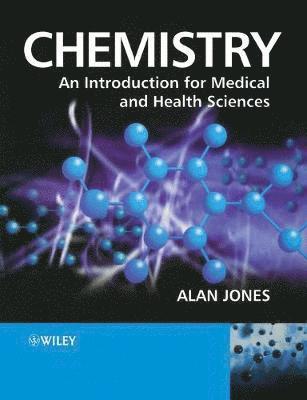
Chemistry: An Introduction for Medical and Health Sciences
Häftad, Engelska, 2005
845 kr
Beställningsvara. Skickas inom 5-8 vardagar. Fri frakt över 249 kr.
Beskrivning
Chemistry: An Introduction for Medical and Health Sciences provides students and practitioners with a clear, readable introduction to the chemical terms and concepts that are relevant to their study and practice. Assuming little prior knowledge of the subject the book describes and explains the chemistry underlying many of the most commonly prescribed drugs and medicines. It also includes information on chemical aspects of digestion and nutrition, oxidation, radioactivity and an overview of how chemicals fight disease. Excellent pedagogy including learning objectives, diagnostic tests and questions in each chapter and a comprehensive glossaryExperienced author team with many years experience of teaching chemistry to non-chemists
Produktinformation
- Utgivningsdatum:2005-04-15
- Mått:190 x 247 x 16 mm
- Vikt:595 g
- Format:Häftad
- Språk:Engelska
- Antal sidor:272
- Förlag:John Wiley & Sons Inc
- ISBN:9780470092897
Utforska kategorier
Mer om författaren
Professor Alan Jones is a recently retired Academic that is still involved in aspects of chemistry education. For many years Alan Jones taught chemistry to health students at Nottingham Trent University.
Recensioner i media
"an excellent book to refresh long forgotten chemistry related-facts... full of cartoons that will give you a chuckle." (Accident and Emergency Nursing Journal, July 2006)"... well written and organized book... " (Education in Chemistry, January 2007)
Innehållsförteckning
- Preface ixIntroduction 1How to use the book 11 Starting Chemistry 31.1 Terminology and processes used in drug manufacture 41.2 Atoms and things 91.3 Chemical reactions and the periodic table 112 Covalent Compounds and Organic Molecules 152.1 How to make stable molecules 182.2 Covalent compounds 182.3 General Properties of Covalent Compounds 222.4 Characteristic shapes and bond angles within covalent molecules 232.5 Some covalent bonds with slight ionic character 242.6 Double-bonded carbon compounds or ‘unsaturated’ carbon bonds 252.7 Some further compounds of carbon 272.8 The carbon cycle 282.9 Isomerism: some different arrangements of atoms within a molecule 292.10 Naming organic compounds if you really want to know! 332.11 Ring structures 362.12 Compounds of carbon containing other groups 372.13 Some further examples with explanations 373 Organic Compounds Containing Carbon, Hydrogen and Oxygen: Alcohols and Ethers 433.1 Alcohols, Cn H2n +1OH 453.2 Properties of alcohols: monohydric alcohols with one OH group 463.3 Other alcohols: di- and tri-hydric alcohols 483.4 Aromatic OH compounds: phenol 493.5 Ethers are isomers of alcohols 504 Carbonyl compounds: compounds containing C=O Groups 554.1 Simple aldehydes and ketones: carboxylic acids and esters 564.2 Carbohydrates, monosaccharides and sugars 584.3 Disaccharides 604.4 Digestion of sugars 614.5 More about sugars – if you really need to know! 624.6 Carboxylic acids: another set of CHO compounds containing C=O groups 634.7 Salts and esters 634.8 Lipids or fats 654.9 Chemical energy in cells 674.10 Chemicals in food 684.11 Soaps and detergents 695 Organic Compounds Containing Nitrogen 735.1 Amines and amino acids 755.2 Amino acids 765.3 Peptide formation and protein synthesis 775.4 Hydrolysis (action of water) of peptides 785.5 Other properties of amino acids 795.6 Protein metabolism 795.7 Nucleic acids, DNA and RNA 806 Vitamins, Steroids, Hormones and Enzymes 856.1 Vitamins 866.2 Steroids and hormones 946.3 Enzymes 967 Ions, Electrolytes, Metals and Ionic Bonding 1037.1 Introduction to ionic bonding 1057.2 Some common properties of ions and ionic bonds 1077.3 Electrolytes and ions of the body 1097.4 Major cations (positive ions) in the body: sodium, potassium and calcium ions 1107.5 Balance between fluids 1137.6 Essential elements present in small quantities: micronutrients and minerals 1147.7 Cancer treatments and chemotherapies that use metal compounds 1158 Water 1198.1 Introduction What makes water so unique? 1218.2 Chemical reactions in aqueous solution 1238.3 Dissolving and solubility: water is a great solvent 1248.4 Osmosis 1268.5 Dialysis 1278.6 Colloids 1288.7 Water, washing and detergents 1298.8 Water vapour 1308.9 Evaporation from skin 1318.10 Solid water 1328.11 Hydrolysis 1339 Acids and Bases 1359.1 Acids 1379.2 Bases and alkali 1409.3 Bases containing nitrogen 1419.4 Amino acids and zwitterions 1429.5 Salts 1429.6 Neutralization 1439.7 Buffer solutions 1439.8 Buffers in the body 1449.9 Digestion and acid attack 1459.10 Acids in the environment 14610 Oxidation and Reduction 14910.1 Definitions of oxidation and reduction 15010.2 Burning and oxidation 15310.3 Some applications of redox reactions to metabolic processes 15310.4 Nitric oxide, NO or N(II)O 15410.5 Oxygen gas 15611 Analytical Techniques 15911.1 The need for analysis 16011.2 Mass spectroscopy 16211.3 Chromatography 16511.4 Spectroscopy of various types 16811.5 Electron microscopes and scanning electron microscopy (SEM) 17011.6 Magnetic resonance spectroscopy (MRS) or magnetic resonance imaging (MRI) 17311.7 General conclusions 17412 Radioactivity 17712.1 Introduction to the effects of radiation 17812.2 Isotopes and radioactivity 17912.3 Splitting the nuclei of atoms 18112.4 Properties of alpha, beta and gamma radiation 18212.5 Half-life 18512.6 Radiation everywhere 18612.7 Conclusion 18813 Rates of Reaction 19113.1 Effect of temperature on reactions and metabolism 19313.2 Why does a chemical reaction slow down on cooling? 19413.3 Free radicals 19713.4 Effect of concentration on chemical reactions 19713.5 Catalysts and enzymes 19813.6 How catalysts and enzymes work 19913.7 Application of chemical reactions to drug use 20114 Overview of Chemicals Fighting Diseases 20514.1 Drugs ancient and modern 20514.2 Cancer treatments 21014.3 Pain killers 21314.4 Stopping attack by ‘aliens’ on our bodies: viruses and bacteria 21414.5 AIDS and HIV 21514.6 Gene therapy 21714.7 Some changes of use of existing drugs 21715 Numbers and Quantities 22115.1 Standard notation, powers of 10 22315.2 Moles 22315.3 Powers of numbers and logs 22415.4 Moles in formulae and equations 22815.5 Moles in solution 22915.6 Concentration in ppm, parts per million 23015.7 Dilutions 23015.8 Percentage by mass 231Appendix 1: Alphabetical List of the Common Elements 235Appendix 2: Periodic Classification of the Common Elements 237Glossary 239Bibliography 253Index 257
Hoppa över listan


Mer från samma författare
Schaum's Outline of Biochemistry, Third Edition
Philip Kuchel, Simon Easterbrook-Smith, Vanessa Gysbers, J. Mitchell Guss, Dale Hancock, Jill Johnston, Alan Jones, Jacqui Matthews
Häftad, 2009
347 kr
Hoppa över listan


Du kanske också är intresserad av
- Signerad!
- Nyhet
Del 2
- -19%
- -30%
- Signerad!
- -22%
Del 3
- -30%
- -22%
Del 1
- -22%
Del 2