• Fri frakt över 249 kr
  • •
  • Snabba leveranser
  • •
  • Billiga böcker
Kundservice

Du är på sajten för privatpersoner.

Företag, bibliotek eller offentlig verksamhet?

Du handlar på classic.bokus.com, där alla dina funktioner finns intakta.
Till classic.bokus.com
Bokus logotyp. Gå till startsidan.
  • Erbjudanden
  • Nyheter
  • Student
  • Topplistor
  • Barn & ungdom
  • Bokus Play
  • E-böcker
  • Pocketböcker
  • Spel & pussel

10% rabatt på allt med kod: NYSTART10 →

Sidfot

Mina sidor

    Hjälp

    • Kundservice
    • Vanliga frågor och svar
    • Frakt och leverans
    • Retur vid ångerrätt
    • Reklamera vara
    • Betalning
    • Köpvillkor
    • Allmänna villkor
    • Information om webbplatsens tillgänglighet

    Om Bokus

    • Om oss
    • Pressrum
    • För studenter
    • För företag
    • För bibliotek och offentlig verksamhet
    • För leverantörer
    • Hållbarhet

    Populärt

    • Aktuella erbjudanden
    • Presentkort
    • Studentlitteratur
    • Nya böcker
    • Topplistor
    • Signerade böcker
    • Engelska böcker

    Inspiration

    • Boktips
    • BookTok
    • Populära bokserier
    • Barnbokskaraktärer
    • Populära författare
    Logotyp för Bokus
    Följ oss på Facebook (extern länk)Följ oss på Instagram (extern länk)Följ oss på YouTube (extern länk)Följ oss på TikTok (extern länk)
    bokus @ CookiesAnpassa cookiesIntegritetspolicyKöpvillkor
    Till Citymail hemsida (extern länk)Till Budbee hemsida (extern länk)Till Postnord hemsida (extern länk)Till Schenker hemsida (extern länk)Till Early Bird hemsida (extern länk)Till Walleys hemsida (extern länk)
    1. Naturvetenskap och teknik
    2. Matematik och naturvetenskap
    3. Matematik

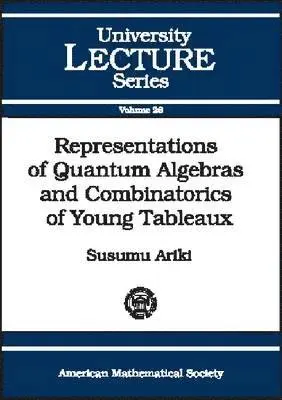
    Representations of Quantum Algebras and Combinatorics of Young Tableaux

    AvAmerican Mathematical Society

    Häftad, Engelska, 2002

    Del i serien University Lecture Series

    814 kr

    Beställningsvara. Skickas inom 5-8 vardagar. Fri frakt över 249 kr.

    Beskrivning

    This book contains most of the nonstandard material necessary to get acquainted with this new rapidly developing area. It can be used as a good entry point into the study of representations of quantum groups. Among several tools used in studying representations of quantum groups (or quantum algebras) are the notions of Kashiwara's crystal bases and Lusztig's canonical bases. Mixing both approaches allows us to use a combinatorial approach to representations of quantum groups and to apply the theory to representations of Hecke algebras. The primary goal of this book is to introduce the representation theory of quantum groups using quantum groups of type $A_{r-1}^{(1)}$ as a main example.The corresponding combinatorics, developed by Misra and Miwa, turns out to be the combinatorics of Young tableaux. The second goal of this book is to explain the proof of the (generalized) Lascoux-Leclerc-Thibon conjecture. This conjecture, which is now a theorem, is an important breakthrough in the modular representation theory of the Hecke algebras of classical type. The book is suitable for graduate students and research mathematicians interested in representation theory of algebraic groups and quantum groups, the theory of Hecke algebras, algebraic combinatorics, and related fields.

    Produktinformation

    • Utgivningsdatum:2002-06-30
    • Vikt:312 g
    • Format:Häftad
    • Språk:Engelska
    • Serie:University Lecture Series
    • Förlag:American Mathematical Society
    • ISBN:9780821832325

    Utforska kategorier

    • Matematik inom Naturvetenskap och teknik
    • Grupper och gruppteori inom Naturvetenskap och teknik
    • Algebra inom Naturvetenskap och teknik

    Innehållsförteckning

    • Introduction The Serre relations Kac-Moody Lie algebras Crystal bases of $U_v$-modules The tensor product of crystals Crystal bases of $U_v^-$ The canonical basis Existence and uniqueness (part I) Existence and uniqueness (part II) The Hayashi realization Description of the crystal graph of $V(\Lambda)$ An overview of the application to Hecke algebras The Hecke algebra of type $G(m,1,n)$ The proof of Theorem 12.5 Reference guide Bibliography Index.