• Fri frakt över 249 kr
  • •
  • Snabba leveranser
  • •
  • Billiga böcker
Kundservice

Du är på sajten för privatpersoner.

Företag, bibliotek eller offentlig verksamhet?

Du handlar på classic.bokus.com, där alla dina funktioner finns intakta.
Till classic.bokus.com
Bokus logotyp. Gå till startsidan.
  • Erbjudanden
  • Student
  • Topplistor
  • Barn & ungdom
  • Bokus Play
  • E-böcker
  • Ljudböcker
  • Pocketböcker
  • Spel och pussel

Pocketfynda! Hundratals böcker för 49 kr/st →

Sidfot

Mina sidor

    Hjälp

    • Kundservice
    • Vanliga frågor och svar
    • Frakt och leverans
    • Retur vid ångerrätt
    • Reklamera vara
    • Betalning
    • Köpvillkor
    • Allmänna villkor
    • Information om webbplatsens tillgänglighet

    Om Bokus

    • Om oss
    • Pressrum
    • För studenter
    • För företag
    • För bibliotek och offentlig verksamhet
    • För leverantörer
    • Hållbarhet

    Populärt

    • Aktuella erbjudanden
    • Presentkort
    • Studentlitteratur
    • Nya böcker
    • Topplistor
    • Signerade böcker
    • Engelska böcker

    Inspiration

    • Boktips
    • BookTok
    • Barnbokskaraktärer
    • Populära författare
    Logotyp för Bokus
    Följ oss på Facebook (extern länk)Följ oss på Instagram (extern länk)Följ oss på YouTube (extern länk)Följ oss på TikTok (extern länk)
    bokus @ CookiesAnpassa cookiesIntegritetspolicyKöpvillkor
    Till Citymail hemsida (extern länk)Till Budbee hemsida (extern länk)Till Postnord hemsida (extern länk)Till Schenker hemsida (extern länk)Till Early Bird hemsida (extern länk)Till Walleys hemsida (extern länk)
    1. Språk och ordböcker
    2. Språkundervisning och språkinlärning

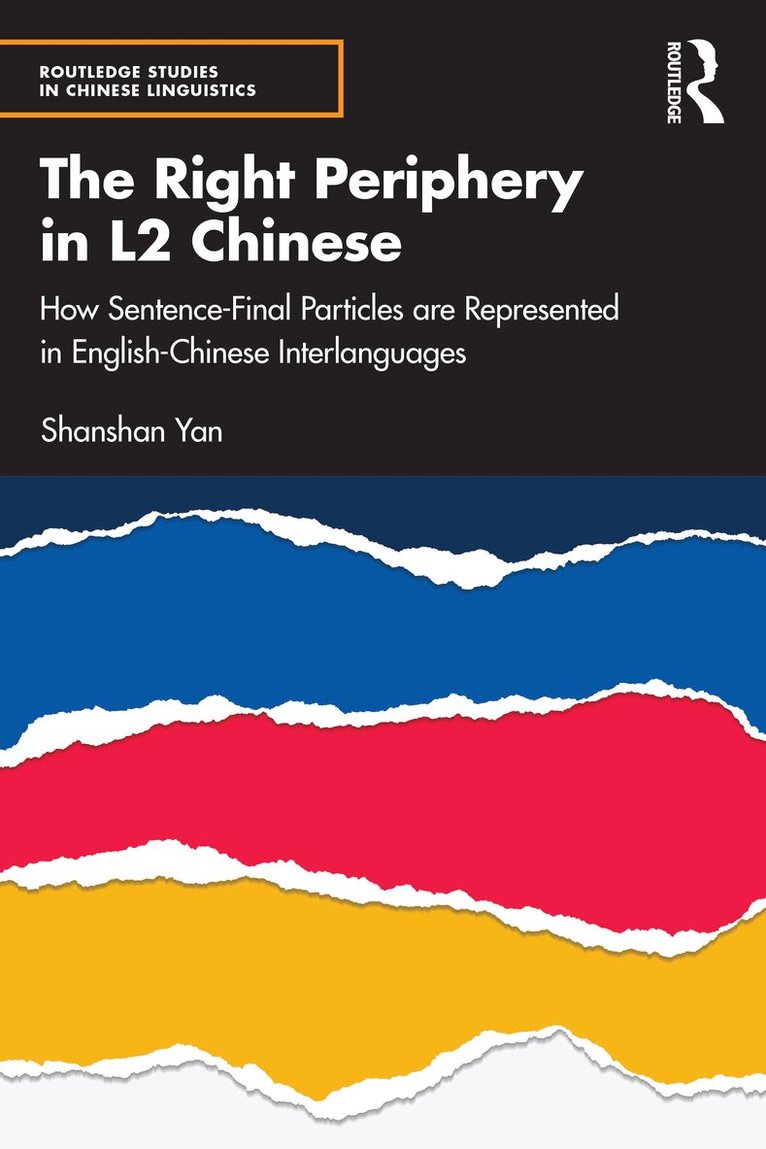
    Right Periphery in L2 Chinese

    How Sentence-Final Particles are Represented in English-Chinese Interlanguages

    AvShanshan Yan

    Häftad, Engelska, 2022

    Del i serien Routledge Studies in Chinese Linguistics

    495 kr

    Skickas . Fri frakt över 249 kr.

    Fler format och utgåvor

    E-bok

    725 kr

    E-bok

    725 kr

    Inbunden

    2 108 kr

    Beskrivning

    The Right Periphery in L2 Chinese is among the first books to try to incorporate both advanced linguistic and acquisition perspectives to show how eight sentence-final particles are represented in English-speaking learners’ L2 Chinese. This book will inform researchers of the general construction of the right periphery in L2 grammars. Drawing on up-to-date theoretical frameworks and findings from advanced empirical studies, it sketches the general picture of the periphery that these particles occupy in English-Chinese interlanguages. Readers will grasp the problems and difficulties, and particularly the ambiguities, which learners of Chinese must grapple with in the process of acquiring sentence-final particles. Possible influential factors underlying the acquisition process are explicitly discussed as well. Researchers will also find insights in the advanced methodologies and statistics that are used to study Chinese. The book will be illuminating for researchers interested in SLA, linguists of generative theories, and educators teaching Chinese as a second/foreign language.

    Produktinformation

    • Utgivningsdatum:2022-12-29
    • Mått:156 x 234 x 15 mm
    • Vikt:260 g
    • Format:Häftad
    • Språk:Engelska
    • Serie:Routledge Studies in Chinese Linguistics
    • Antal sidor:160
    • Förlag:Taylor & Francis Ltd
    • ISBN:9781032230481

    Utforska kategorier

    • Språkundervisning och språkinlärning inom Språk och ordböcker
    • Språkvetenskap och lingvistik inom Språk och ordböcker

    Mer om författaren

    Shanshan Yan is an assistant professor at the School of Chinese as a Second Language, Peking University. She obtained her MPhil in Second Language Education and PhD in Linguistics and Acquisition from the University of Cambridge. Her research expertise includes language acquisition, Chinese linguistics, and Chinese as a second language education.

    Innehållsförteckning

    • List of figuresList of tablesList of boxesPrefaceAcknowledgementsList of abbreviations1 Introduction2 Core concepts in SFP and L2 theories2.1 Chinese SFPs in CP2.1.1 SFPs in split-CP2.1.2 Relationship with other CP elements2.1.3 Head-directionality2.1.4 Homomorphous SFP: one SFP or several SFPs2.2 CP in English2.3 Feature in generative theories2.3.1 Feature2.3.2 Feature in L1 and L2 acquisition2.4 Theoretical frameworks in SLA2.4.1 L1 transfer2.4.2 Feature Reassembly Hypothesis2.4.3 Dormant Feature Hypothesis2.4.4 Form-meaning connections2.4.5 Interface Hypothesis2.5 Summary3 SFP1 layer: cluster of tense and aspects3.1 SFP le3.1.1 Features attached to the SFP le3.1.2 L2 acquisition of the SFP le3.2 SFP ne13.2.1 Features attached to the SFP ne13.2.2 L2 acquisition of the SFP ne13.3 Methodological issues3.4 Summary4 SFP2 layer: force and clause-typing 4.1 SFP ma4.1.1 Features attached to the SFP ma4.1.2 Typing yes-no questions in L2 grammars4.2 SFP ba14.2.1 Features attached to the SFP ba14.2.2 Imperative force in L2 grammars4.3 SFP ne24.3.1 Features attached to the SFP ne24.3.2 L2 acquisition of the SFP ne24.4 Methodological issues4.5 Summary5 SFP3 layer: attitudes and discourses5.1 SFP ba25.1.1 Features attached to the SFP ba25.1.2 Behaviors of the SFP ba2 in L2 grammar5.2 SFPs a and ne35.2.1 Features attached to the SFP a and the SFP ne35.2.2 Behaviors of the SFPs a and ne3 in L2 grammars5.3 Methodological issues5.4 Summary6 Interaction among layers and SFPs in terms of their similarities6.1 Homomorphous SFPs6.1.1 SFP ba1 and SFP ba26.1.2 SFP ne1, SFP ne2, and SFP ne36.2 SFPs with similar features6.2.1 SFP ma and SFP ba26.2.2 SFP a and SFP ne36.3 Co-occurrence of SFPs6.3.1 Behaviors and reasons for the (non)co-occurrence of SFPs6.3.2 Co-occurrence of SFPs in L2 grammars6.4 Summary7 Conclusions7.1 Establishment of the right periphery7.2 Factors affecting the building of the blocks7.2.1 L1 transfer7.2.2 L2 effect7.2.3 Feature reassembly and feature dormancy7.2.4 Interfaces7.2.5 Form-meaning connections7.3 The role of sentence-final particles in L2 Chinese7.4 Future directions and pedagogical implications7.4.1 Future directions for the study of Chinese SFPs7.4.2 Pedagogical implications7.5 SummaryBibliographyIndex