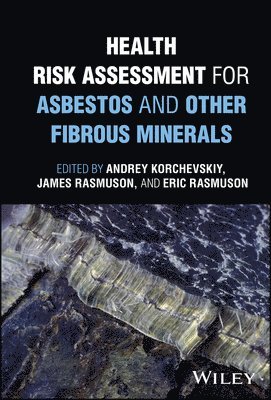
Health Risk Assessment for Asbestos and Other Fibrous Minerals
AvAndrey Korchevskiy,Andrey Korchevskiy
1 885 kr
Beställningsvara. Skickas inom 5-8 vardagar. Fri frakt över 249 kr.
Beskrivning
Produktinformation
- Utgivningsdatum:2024-07-04
- Mått:161 x 236 x 33 mm
- Vikt:1 220 g
- Format:Inbunden
- Språk:Engelska
- Antal sidor:480
- Förlag:John Wiley & Sons Inc
- ISBN:9781119438434
Utforska kategorier
Mer om författaren
Andrey Korchevskiy, PhD, DABT, CIH is a biologist, mathematician, certified toxicologist, and certified industrial hygienist. He is the Director of Research and Development at Chemistry & Industrial Hygiene, Inc. James Rasmuson, PhD, CIH, DABT, and AIHA Fellow, is the founder and senior scientist at Chemistry & Industrial Hygiene, Inc. Eric Rasmuson, MS, MHS, DABT, CIH is the President/CEO of Chemistry & Industrial Hygiene, Inc.
Innehållsförteckning
- List of Contributors xvPreface xviiPart I Hazard Identification 11 Mineralogical Characteristics and Risk Assessment of Elongate Mineral Particles (EMPs): Asbestos, Fiber, and Fragment 3Ann G. WylieIntroduction 3Nomenclature 6Source Specificity: Chemical and Physical Properties 8Source Specificity: Dimension 11Structural Groupings of Common Elongate Minerals 13Establishing the Chemical Composition of Minerals 15Mineral Intergrowths and Associations 16Bioreactivity of Mineral Surfaces: Chemical Factors 17The Specificity of Mineral Surfaces: The Example of Quartz 17General Considerations of Solubility 18Formation of Reactive Oxygen Species (ROS) 20Coatings 21Surface Charge 22EMP Surfaces: Chain Silicates and Zeolites 23Physical Factors 24Specific Surface Area 24Enthalpy and Other Thermodynamic Properties 26Density and Aerodynamic Diameter 26Stiffness and Tensile Strength 28The Effects of Heat 30Dimensionality: General Considerations 30Establishing Measurement Protocols 32Optical vs. Electron Microscopy Methods 32Stratified Counting 34Sample Preparation for TEM: Direct vs. Indirect Preparation 34Frequency Distributions of Length and Width 35Lung Burden 37Dimensionality and Carcinogenicity 38Discussion 39References 402 Toxicology of Mineral Fibers and Implications for Risk Assessment 52Brooke T. MossmanIntroduction 52Use of Rodent Models to Analyze the Toxicity to Disease Potential of Naturally Occurring and Synthetic Fibers 53Inhalation Studies 53Intratracheal Instillation and Oropharyngeal Aspiration Studies 54Intrapleural Injection Studies 54Intraperitoneal Injection Studies 54Comparative Results on Effects of Asbestos and Other Naturally Occurring Fibers in Rodent Studies 54In vitro Models of Toxicity 66Advantages and Disadvantage of In vitro Models 66Contributions of In vitro Models to Understanding Mechanisms of Cytotoxicity and Carcinogenesis by Mineral Fibers 67Properties of Mineral Fibers Important in Toxicity and Carcinogenic Effects 68A Systems Biology Approach to Understanding Connections and Interactions Between Adverse Outcomes in Mineral Fiber-Induced Diseases 71References 723 Health Outcomes of Asbestos Exposure – A Pathology and Diagnostic Perspective 82Bruce CaseIntroduction 82Nonmalignant Change in Structure or Function 83Nonmalignant Asbestos-Related Disease 84Pleural 84Asbestos Effusion 84Pleural Plaques and Localized Pleural Thickening (LPT) 84Diffuse Pleural Thickening 88Rounded Atelectasis 89Lung 89Asbestosis 89Malignant Diseases Attributable to Asbestos Exposure 92General Comments 92Asbestos-Related Lung Cancer 94Mesothelioma – Accelerating Knowledge 96References 102Part II Exposure Assessment 1094 Principles of Exposure Assessment for Elongate Mineral Particles (EMPs) 111Eric Rasmuson, James Rasmuson, and Andrey KorchevskiyGeneral Principles and Methods 113Gathering Information 113Evaluating the Quality of Data 114Measurement Techniques 116Comparison of the Results of Different Analytical Methodologies 120Proximity to the Emission Source 121Adjusting Results for Censored Data 122Correlation of EMP Exposures and Lung Burden Analysis 122References 1235 Asbestos Exposure Measurements: Principles of Current and Historical Data Interpretation 127Garry BurdettAim and Background 127Causes of Asbestos-Related Lung Disease and Their Relationship to Exposure Assessment 128Exposure Measurement 130Historic Methods of Asbestos Exposure Measurement 131Gravimetric Methods 131Impaction Sampling and Microscopic Particle Counting 132Impinger Sampling and Microscopic Particle Counting 132Thermal Precipitator (TP) Sampling and Microscopic Particle Counting 133Direct Reading Instruments for Particle and Fiber Counting 134Early Sampling Strategies 135Development of the Current Analytical Methods for Fiber Counting 136Membrane Filter Sampling and Phase Contrast Microscopy Fiber Counting (MF-PCM) 136Membrane Filter Sampling and Electron Microscopy (EM) Analysis 137Limitations of Current Indices of Exposure Assessment 139Variability of the MF-PCM Index Over Time 140Sampling Method 140Sample Preparation 141Microscope Equipment and Set-Up 142Fiber Definition 143Counting Procedures and Performance 144Effect of Changes to the MF-PCM Counts Over Time 145Conclusion 146Acknowledgements 147References 1476 Asbestos Exposure Modeling Using Advanced Tools Including Computational Fluid Dynamics (CFD) 153Daniel Hall, James Rasmuson, and Cassidy StrodeIntroduction 153Validation and Application of CFD Air Dispersion Modeling 155Overview of CFD General Methodology 157CFD Simulation Set-Up 159Geometry Creation and Set-Up 159Mesh Creation 160Parameter Set-Up 160Computational Solve 162Post-processing 162Complementary Modeling Software Tools 163Other Software Tools 164Indoor and Outdoor Modeling Examples 164First Example – Indoor CFD Modeling 164Preliminary Outdoor CFD Wind Simulation – Effect on Indoor Ventilation 166Indoor CFD Simulations 168Mill Ventilation 168Other Model Parameters 169Source Descriptions 170Reheat Furnace Brick Removal Source 170Pipe Insulation Removal Source 171CFD Results 172Second Example – Outdoor CFD, AERMOD, and CALPUFF Models 174Model Geometry 177Receptor Descriptions 177Source Descriptions 177Fugitive Plant Emission – Manufacturing, Finishing, Fiber Warehouse, Tray Loading, and Stripping Station 180Baghouse Source Emission Rates 182Pipe Storage and Shipping Yard Source Emission Rate 183Crusher Source Emission Rate 183Meteorology 184CFD Results 186EPA Outdoor Dispersion Models 188Geophysical Set-Up 188CALMET Set-Up 189CALPUFF Processor 189CALPUFF Results 191AERMOD Model 191Geophysical Set-Up 191Meteorology Set-Up 191AERMOD Set-Up 193AERMOD Results 194Comparison of CFD, CALPUFF, and AERMOD Results 194Discussion and Conclusions 194References 197Part III Dose-Response Assessment 2017 Asbestos Dose–Response Assessment: The Peto Model and Its Application in the US EPA and Berman and Crump Studies 203Andrey KorchevskiyRationale and Meaning of the Peto Model 203Utilization of the Peto Model by the US EPA 212Berman and Crump Meta-analysis Based on Peto Model 218References 2288 The Hodgson and Darnton Approach to Quantifying the Risks of Mesothelioma and Lung Cancer in Relation to Asbestos Exposure 233Lucy DarntonIntroduction 233Overview of the Hodgson and Darnton Approach 234Metrics and Data Requirements 235Lung Cancer 235Mesothelioma 236Other Data Issues 236Summary of Cohorts Included in the Original and Updated Meta-Analyses 237Crocidolite Cohorts 238Amosite Cohorts 239Other Amphiboles: Vermiculite Miners and Associated Workers, Libby, Montana, USA 241Chrysotile Cohorts 242Summary of Original and Updated Meta-Analyses 245Mesothelioma 245Lung Cancer 250Nonlinear Exposure–Response Relationship 256Pleural Mesothelioma 257Peritoneal Mesothelioma 259Lung Cancer 260Summary 262Application of Hodgson and Darnton for Risk Assessment 262Conclusions 264References 2669 Prediction of Mesothelioma Mortality in the Context of Country-wide Risk Evaluation 270Lucy DarntonConclusions 284References 28410 Implications of Exposure Measurement Methodologies for Dose–Response Assessment in Asbestos Worker Cohorts 286Garry BurdettElectron Microscopy Fiber Size Distribution for Different Cohorts and Their Relationship to PCM Fiber Counts 287TEM Fiber-Size-Distribution in Cohorts from Mines and Mills 288TEM Size Distributions from Manufacturing Cohorts 289SEM Size Distributions from Manufacturing Cohorts 292EM Determinations of Asbestos Fiber Types in Asbestos Industry Cohorts 293Natural Occurrence 294Mixed-Use 295External Sources 296Lung Burden Analysis 296Conversions of Historic Cohort Measurement Indices to MF-PCM Fiber Counts 296Conversion from Impinger Counts to MF-PCM 297Conversions from Other Particle Counting Methods 299Conversions from Gravimetric Measurement 299Crocidolite Cohort Exposures 302Wittenoom Occupational 302Wittenoom Environmental 305South African Mines and Mills 306Massachusetts Cigarette Filter Manufacturing 309UK Gas Mask Workers 310Other Cohorts Exposed to Crocidolite 311Crocidolite Summary 311Amosite Cohort Exposures 311South African Amosite Mining 311Patterson, New Jersey 314Tyler, Texas 315Uxbridge 315Amosite Summary 316Chrysotile Mining and Milling Cohort Exposures 317Quebec, Canada 318Balangero, Italy 318Qinghai, China 319Uralasbest, Russia 321Chrysotile Mining Summary 322Chrysotile Textiles 322South Carolina Textile Workers 324North Carolina Textile Workers 325Chongqing Chrysotile Cohort 327Chrysotile Textiles Summary 328Other Chrysotile Cohorts 328Discussion and Outlook 330Acknowledgement 333References 33311 Mathematical Modeling of Cancer Potency for Various Fibrous Minerals 344Andrey Korchevskiy, James Rasmuson, and Eric RasmusonReferences 36012 Theoretical and Practical Aspects of Asbestos Dose–Response Assessment 366Andrey Korchevskiy and James RasmusonGeneral Considerations and Model of Asbestos Dose–Response Assessment 366Linear Model 367Nonlinear Model 368Relationship Between Different Estimation of Mesothelioma and Lung Cancer Potency Factors 371Life Tables and Life Expectancy of the Exposed Population 374Linearity and Nonlinearity of the Dose–Response Curves 375Threshold and Benchmark Dose Response in Asbestos Risk Assessment 376Community and Occupational Risk Assessment 378Peritoneal Mesothelioma 378Other Types of Cancer 380Inhalation Unit Risk (IUR) for Asbestos Fibers 383Asbestos Dose–Response and Tobacco Smoking 385Other Factors Impacting the Dose–Response Relationship for Elongate Mineral Particles 387References 388Part IV Risk Characterization 39313 Risk Characterization for Occupational and Environmental Exposure to Asbestos: Case Studies 395James Rasmuson, Andrey Korchevskiy, and Eric RasmusonReferences 40814 Asbestos in Soil: Risk Characterization for Occupational and Environmental Exposures 412Andrey Korchevskiy and Robert StrodeReferences 42415 Asbestos in Brakes: Risk Assessment for Exposure Patterns with Nonlinear Dynamics 427Andrey Korchevskiy, Robert Strode, and Arseniy KorchevskiyAmbient Air Emissions from the Brakes in Street Canyons 428Fibers in Car Brakes: Chaotic Behavior of Emissions in a Self-regulated Community 433Diagnosing the Chaotic Trends 439References 441Index 443
Mer från samma författare
Health Risk Assessment for Asbestos and Other Fibrous Minerals
Eric Rasmuson, James Rasmuson, Andrey Korchevskiy
2 183 kr
Health Risk Assessment for Asbestos and Other Fibrous Minerals
Eric Rasmuson, James Rasmuson, Andrey Korchevskiy
2 183 kr
Du kanske också är intresserad av
Health Risk Assessment for Asbestos and Other Fibrous Minerals
Eric Rasmuson, James Rasmuson, Andrey Korchevskiy
2 183 kr
Health Risk Assessment for Asbestos and Other Fibrous Minerals
Eric Rasmuson, James Rasmuson, Andrey Korchevskiy
2 183 kr
- 4 för 3
Brevbäraren i Lizzanello
Francesca Giannone
Pocket, 2026
99 kr
- 4 för 3
- 4 för 3
En flicka som kallas Alice
Kristin Hannah
Pocket, 2025
99 kr
- 4 för 3
- 4 för 3