• Fri frakt över 249 kr
  • •
  • Snabba leveranser
  • •
  • Billiga böcker
Kundservice

Du är på sajten för privatpersoner.

Företag, bibliotek eller offentlig verksamhet?

Du handlar på classic.bokus.com, där alla dina funktioner finns intakta.
Till classic.bokus.com
Bokus logotyp. Gå till startsidan.
  • Erbjudanden
  • Student
  • Topplistor
  • Barn & ungdom
  • Bokus Play
  • E-böcker
  • Ljudböcker
  • Pocketböcker
  • Spel och pussel

5% studentrabatt – använd koden KURSBOK27 →

Sidfot

Mina sidor

    Hjälp

    • Kundservice
    • Vanliga frågor och svar
    • Frakt och leverans
    • Retur vid ångerrätt
    • Reklamera vara
    • Betalning
    • Köpvillkor
    • Allmänna villkor
    • Information om webbplatsens tillgänglighet

    Om Bokus

    • Om oss
    • Pressrum
    • För studenter
    • För företag
    • För bibliotek och offentlig verksamhet
    • För leverantörer
    • Hållbarhet

    Populärt

    • Aktuella erbjudanden
    • Presentkort
    • Studentlitteratur
    • Nya böcker
    • Topplistor
    • Signerade böcker
    • Engelska böcker

    Inspiration

    • Boktips
    • BookTok
    • Barnbokskaraktärer
    • Populära författare
    Logotyp för Bokus
    Följ oss på Facebook (extern länk)Följ oss på Instagram (extern länk)Följ oss på YouTube (extern länk)Följ oss på TikTok (extern länk)
    bokus @ CookiesAnpassa cookiesIntegritetspolicyKöpvillkor
    Till Citymail hemsida (extern länk)Till Budbee hemsida (extern länk)Till Postnord hemsida (extern länk)Till Schenker hemsida (extern länk)Till Early Bird hemsida (extern länk)Till Walleys hemsida (extern länk)
    1. Naturvetenskap och teknik
    2. Teknik och industri
    3. Elektronik och kommunikationer

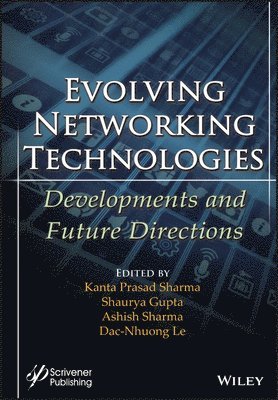
    Evolving Networking Technologies

    Developments and Future Directions

    AvKanta Prasad Sharma,Shaurya Gupta

    Inbunden, Engelska, 2025

    2 241 kr

    Beställningsvara. Skickas inom 5-8 vardagar. Fri frakt över 249 kr.

    Beskrivning

    EVOLVING NETWORKING TECHNOLOGIES This book discusses in a practical manner some of the critical security challenges facing the ever-evolving networking technologies of today. In an age of explosive worldwide growth of electronic data storage and communications, effective protection of information has become a critical requirement, especially when used in coordination with other tools for information security and cryptography in all of its applications, including data confidentiality, data integrity, and user authentication. While the importance of cryptographic technique, i.e., encryption, in protecting sensitive and critical information and resources cannot be overemphasized, an examination of the technical evolution within several industries reveals an approaching precipice of scientific change. The glacially paced but inevitable convergence of quantum mechanics, nanotechnology, computer science, and applied mathematics will revolutionize modern technology. The implications of such changes will be far-reaching, with one of its greatest impacts affecting information security and, more specifically, modern cryptography. The book takes the reader through these issues. As the security systems design becomes more and more complex to meet these challenges, a mistake that is committed most often by security specialists is not making a comprehensive analysis of the system to be secured before choosing which security mechanism to deploy. Often, the security mechanism chosen turns out to be either incompatible with, or inadequate for, handling the complexities of the system. In addition, the book also discusses three main points: Configuration management is a critical issue, and as networks are increasing in size, their configuration needs to be managed. Devices may conflict with each other in terms of configuration. Therefore, it becomes challenging for firewalls to be up-to-date according to network policies.Scalability of the network is another big challenge, it would be easier to address if the network stays the same, but the network is ever expanding with a constant increase in the number of devices devoted to the network.Vendor lock-in: Business decisions that are taken today are revolving around the assumptions and capabilities of the current vendor and environment scenario. Buying the best solutions from today’s vendors involves how to interoperate, integrate, and support multiple solutions. It may involve tearing out all of the longstanding kits without tearing down the entire network at the same time.Audience This book specifically appeals to industry practitioners, IT researchers, and students regarding network technological management.

    Produktinformation

    • Utgivningsdatum:2025-04-30
    • Vikt:780 g
    • Format:Inbunden
    • Språk:Engelska
    • Antal sidor:272
    • Förlag:John Wiley & Sons Inc
    • ISBN:9781119836209

    Utforska kategorier

    • Elektronik och kommunikationer inom Naturvetenskap och teknik

    Mer om författaren

    Kanta Prasad Sharma, PhD, is an assistant professor in the Computer Science & Engineering Department at GL BAJAJ Group of Institutions. His PhD in Information Technology was obtained from Amity University, and he has published 15+ research papers in international journals and conference proceedings. Shaurya Gupta, PhD, is an assistant professor at the University of Petroleum and Energy Studies, Dehradun, Uttarakhand, India. He completed his PhD in Information Technology from Amity University and has published research articles in international journals. His areas of interest are Delay Tolerant Networks, Wireless Sensor Networks, Ad Hoc Networks, IOT, and Machine Learning. Ashish Sharma, PhD, is one of the key faculty members of the information retrieval and data mining group at GLA University, India. He has published many research papers in international journals, and his research interests are in the applications of data mining, machine learning, big data, business analytics, data/text mining, healthcare informatics, and service-oriented computing. Dac-Nhuong Le obtained his PhD in computer science from Vietnam National University, Vietnam in 2015. He is Deputy-Head of the Faculty of Information Technology, Haiphong University, Vietnam. His area of research includes evaluation computing and approximate algorithms, network communication, security and vulnerability, network performance analysis and simulation, cloud computing, IoT, and image processing in biomedicine. He has over 50 publications and edited/authored 15 computer science books.

    Innehållsförteckning

    • List of Figures xvList of Tables xixForeword xxiPreface xxiiiAcknowledgments xxvAcronyms xxvii1 5G Technologies, Architecture and Protocols 1Shweta Bondre, Ashish Sharma, Vipin Bondre1.1 Evolution of Wireless Technologies 21.2 5G Cellular Network Architecture 41.2.1 5G E2E Network Architecture 61.2.2 Network Slicing Architecture 61.2.3 NFV Management and Orchestration 71.2.4 NGMN Envisioned 5G Design 91.3 5G Energy Efficiency 101.3.1 Full Duplex 101.3.2 High Network Data Rate 111.3.3 Dense Small Cell Deployment 111.3.4 Massive MIMO Antennas 111.4 Security in 5G 121.5 5G Applications 131.5.1 Rapid Data Transmission 131.5.2 5G Flexibility for Smart Mobility 131.5.3 5G in Smart Cities 141.5.4 5G Augmented Reality 141.6 Conclusion 14References 152 Scope and Challenges of IoT and Blockchain Integration 21Sara Shree, Monika Sharma2.1 Introduction 222.2 Literature Review 222.3 Internet of Things and Its Centralized System 232.3.1 Application Layer 242.3.2 Network Layer 242.3.3 Device Layer 252.4 Blockchain Technology 252.4.1 Characteristics of Blockchain 252.4.2 Working Mechanisms of Blockchain 262.4.3 Example of Blockchain Transactions 272.4.4 Need for Blockchain Technology 272.5 Integration of Blockchain and IoT Technology 282.5.1 Interactions of IoT and Blockchain Integrations 292.5.2 Blockchain Platforms for IoT 302.5.3 Advantages of Integrating IoT with Blockchain 312.5.4 Challenges of Blockchain and IoT Integration 332.5.5 Applications of IoT-Blockchain Integration 342.6 Conclusion 36References 373 Data Communication and Information Exchange in Distributed IoT Environment 41Rachna Jain, Kanta Prasad Sharma, Rana Majumdar, Dac-Nhuong Le3.1 Introduction 423.2 IoT Technologies and Their Uses 433.2.1 How WSN Works 433.2.2 Communication with RIFD-Enabled Devices 433.2.3 WWW - Things on the Web 443.3 Centralized vs. Distributed Approach 443.3.1 Centralized System and Its Physiognomies 453.3.2 Advantages 453.3.3 Disadvantages of Centralized System 453.4 Distributed System Architecture 463.4.1 Advantages of Distributed System Architecture 463.4.2 Drawbacks of Distributed System Architecture 473.5 Data Communication Taking Place in Distributed IoT Environment 483.5.1 Internet of Things (IoT) Protocol 483.5.2 Constrained Application Protocol (CoAP) 483.5.3 Message Queuing Telemetry Transport (MQTT) 483.5.4 Wi-Fi 493.5.5 Zigbee 493.5.6 Extensible Messaging and Presence Protocol (XMPP) 493.5.7 Data Distribution Service (DDS) 493.5.8 Advanced Message Queuing Protocol (AMQP) 493.5.9 Smart Home and IoT Applications: An Example 503.5.10 IoT Services, Machines and Applications 503.5.11 Sensor-Based IoT Services 503.5.12 Application in IoT Environment 503.5.13 Future of IoT in a COVID-19 Pandemic 513.6 Conclusion 51References 524 Contribution of Cloud-Based Services in Post-Pandemic Technology Sustainability and Challenges: A Future Direction 55Neeraj Kumar Pandey, Sampoorna Kashyap, Ashish Sharma, Manoj Diwakar4.1 Introduction 564.2 Cloud-Based Solutions 594.2.1 Information and Communications Technology 594.2.2 Artificial Intelligence and Machine Learning 594.2.3 Data Analytics and Business Intelligence 624.3 Impact of Industry 4.0 in the Cloud Computing Industry 634.3.1 Agriculture and Forestry 644.3.2 Entertainment, Media, and Hospitality 654.3.3 Robotics and Automation, Manufacturing and Maintenance 654.4 Significance and Impact of Cloud in the Pandemic Outbreak 664.5 Conclusion and Future Directions 66References 675 Network Security in Evolving Networking Technologies: Developments and Future Directions 75Uma Yadav, Ashish Sharma5.1 Introduction 765.2 Background on Attacks, Security Services and Challenges 775.2.1 Types of Attacks Possible on Network 775.2.2 Security Services 795.2.3 Challenges 805.3 Evolution of Network Security Strategies 815.4 Different Evolving Security Approaches 825.4.1 Conventional Approaches 835.4.2 Confidentiality Approaches 845.4.3 Privacy Approaches 865.4.4 Availability Approaches 875.4.5 Modern Approaches 885.5 Discussion 915.6 Conclusion 92References 926 The State of CDNs Today and What AI-Assisted CDN Means for the Future 97Darothi Sarkar, Rana Majumdar, Dac-Nhuong Le6.1 Introduction 986.2 CDN and Its Challenges 996.2.1 Replica Server Placement 996.2.2 Content Replication 1006.2.3 Request Routing 1016.2.4 Load Balancing 1026.3 Importance of AI in CDN 1036.4 Pandemic and CDN 1046.5 Security Threats in CDN 1056.6 Conclusion 106References 1077 Challenges and Opportunities in Smart City Network Management Through Blockchain and Cloud Computing 111Jayden Pires, Vinod Kumar Shukla, Leena Wanganoo, Sonali Vyas7.1 Introduction 1127.2 Literature Review 1127.2.1 Smart City and Network Management 1137.2.2 Blockchain and Network 1167.3 Blockchain and Smart City 1187.3.1 Smart Healthcare 1187.3.2 Smart E-Voting 1187.3.3 Smart Logistics and Supply Chains 1197.4 Cloud Computing and Challenges 1197.4.1 Cloud Computing 1197.5 Research Methodology 1227.6 Conclusion 124References 1258 Role of IoT in Smart Homes and Offices 129Shaurya Gupta, Sonali Vyas, Kanta Prasad Sharma8.1 Introduction 1308.2 Smart Building Constituents 1308.3 Concept of Smart Office Service Devices 1328.4 IoT in Smart Homes and Offices 1338.4.1 Smart Environment Models 1358.4.2 IoT Control Systems for Smart Home Devices 1368.4.3 Prevailing Designs in Smart Homes 1388.4.4 Smart Home Constituents 1398.4.5 Cloud Topological Structure 1408.4.6 Smart Home-Based Cloud Architectural Design 1408.5 Future Research Directions and Limitations of Smart Home-Based Technology 1418.6 Conclusion 141References 1419 Role of IoT in the Prevention of COVID- 19 145Ankit Saxena, Akash Sanghi, Swapnesh Taterh, Neeraj Bhargava9.1 Introduction 1469.2 A Modern Era Problem 1469.2.1 Current Risk 1479.2.2 Awareness by Social Media 1499.2.3 Review of Current Solutions 1519.2.4 Current Treatment 1519.3 Technology 1529.3.1 Touchless User Interface 1529.3.2 IR Sensor Working Principle 1529.4 IoT Sensors and Board 1549.4.1 Arduino UNO Board 1549.4.2 Arduino USB Cable 1559.4.3 Pulse Rate Sensor 1559.4.4 IR Sensor 1569.4.5 Temperature Sensors 1579.4.6 Proximity Sensors 1579.4.7 Pressure Sensors 1579.4.8 LCD Display 1589.4.9 Relay 1589.4.10 Power Supply 1599.4.11 Jumping Wires 1599.5 Use of IoT in COVID-19 Prevention 1609.6 Conclusion 161References 16210 Role of Satellites in Agriculture 165Prashant Johri, Kanta Prasad Sharma, Aadrit Chauhan, Sunilkkhatri10.1 Introduction 16610.2 Processing Satellite Images 16710.3 Product Levels of Satellite Remote Sensing Data 16810.3.1 A Brief Discussion and Review of Analysis Techniques 16810.3.2 Machine Learning 16910.3.3 Deep Learning 17010.4 Future Challenges 17310.5 Conclusion 174References 17411 Search Engine Evaluation Methodology 177JN Singh, Prashant Johri, Gaurav Dhuriya, Kanta Prasad Sharma11.1 Introduction 17811.2 Performance Evaluation Forum 17811.2.1 Text Retrieval Conference 17811.2.2 Text Retrieval Conference Tracks 17811.3 Search Engine Evaluation Parameters 17911.3.1 Precision 17911.3.2 Recall 18011.3.3 Problems with Precision and Recall 18011.3.4 Discounted Cumulative Gain 18111.3.5 Normalized DCG 18111.3.6 Click-Through 18211.3.7 Eye Tracking 18211.3.8 Coverage 18311.3.9 Response Time 18311.4 Factors Affecting Search Engines 18311.4.1 Evaluation 18311.4.2 Query Formulation 18411.4.3 User Feedback to a Web Page 18411.4.4 W3 Rules 18511.4.5 Web Developers’ Fake Techniques 18611.5 Conclusion 186References 18712 Synthesis and Analysis of Digital IIR Filters for Denoising ECG Signal on FPGA 189Seema Nayak, Manoj Nayak, Shamla Matri, Kanta Prasad Sharma12.1 Introduction 19012.2 Literature Survey 19012.3 Methods and Materials 19212.3.1 Conversion of MATLAB Code into Verilog HDL 19212.3.2 Synthesis of Digital Filters on FPGA 19312.4 Results and Discussion 19412.4.1 Butterworth Filter 19512.4.2 Chebyshev-I Filter 19812.4.3 Chebyshev-II Filter 20112.4.4 Elliptic Filter 20412.5 Conclusion and Future Scope 207References 20813 Neural Networks and Their Applications 211Shivani Joshi, Anju Gera, Sweta Bhadra13.1 Introduction 21213.2 Main Work of Neuron 21213.3 Comparison Between Artificial Neural Network (ANN) and Biological Neural Network (BNN) 21213.4 How Artificial Neural Network Works 21313.4.1 Processing of ANN Building Blocks 21413.4.2 Neural Network Learning Rules 21713.5 Neural Networks and Their Applications 22013.5.1 Image Processing and Character Recognition 22113.5.2 Business Forecasting 22113.5.3 Financial Prediction 22113.5.4 Additional Neural Network Uses in the Economic World 22113.5.5 The Traveling Salesman Problem 22213.5.6 Medicine 22313.5.7 Electronic Nose 22313.5.8 Security 22413.5.9 Loans and Credit Cards 22413.5.10 Other Applications of Neural Networks 22413.6 Conclusion and Future Scope 225References 225Editors 229