• Fri frakt över 249 kr
  • •
  • Snabba leveranser
  • •
  • Billiga böcker
Kundservice

Du är på sajten för privatpersoner.

Företag, bibliotek eller offentlig verksamhet?

Du handlar på classic.bokus.com, där alla dina funktioner finns intakta.
Till classic.bokus.com
Bokus logotyp. Gå till startsidan.
  • Erbjudanden
  • Student
  • Topplistor
  • Barn & ungdom
  • Bokus Play
  • E-böcker
  • Ljudböcker
  • Pocketböcker
  • Spel och pussel

Pocketfynda! Hundratals böcker för 49 kr/st →

Sidfot

Mina sidor

    Hjälp

    • Kundservice
    • Vanliga frågor och svar
    • Frakt och leverans
    • Retur vid ångerrätt
    • Reklamera vara
    • Betalning
    • Köpvillkor
    • Allmänna villkor
    • Information om webbplatsens tillgänglighet

    Om Bokus

    • Om oss
    • Pressrum
    • För studenter
    • För företag
    • För bibliotek och offentlig verksamhet
    • För leverantörer
    • Hållbarhet

    Populärt

    • Aktuella erbjudanden
    • Presentkort
    • Studentlitteratur
    • Nya böcker
    • Topplistor
    • Signerade böcker
    • Engelska böcker

    Inspiration

    • Boktips
    • BookTok
    • Barnbokskaraktärer
    • Populära författare
    Logotyp för Bokus
    Följ oss på Facebook (extern länk)Följ oss på Instagram (extern länk)Följ oss på YouTube (extern länk)Följ oss på TikTok (extern länk)
    bokus @ CookiesAnpassa cookiesIntegritetspolicyKöpvillkor
    Till Citymail hemsida (extern länk)Till Budbee hemsida (extern länk)Till Postnord hemsida (extern länk)Till Schenker hemsida (extern länk)Till Early Bird hemsida (extern länk)Till Walleys hemsida (extern länk)
    1. Medicin
    2. Medicin: icke kliniska discipliner
    3. Fysiologi

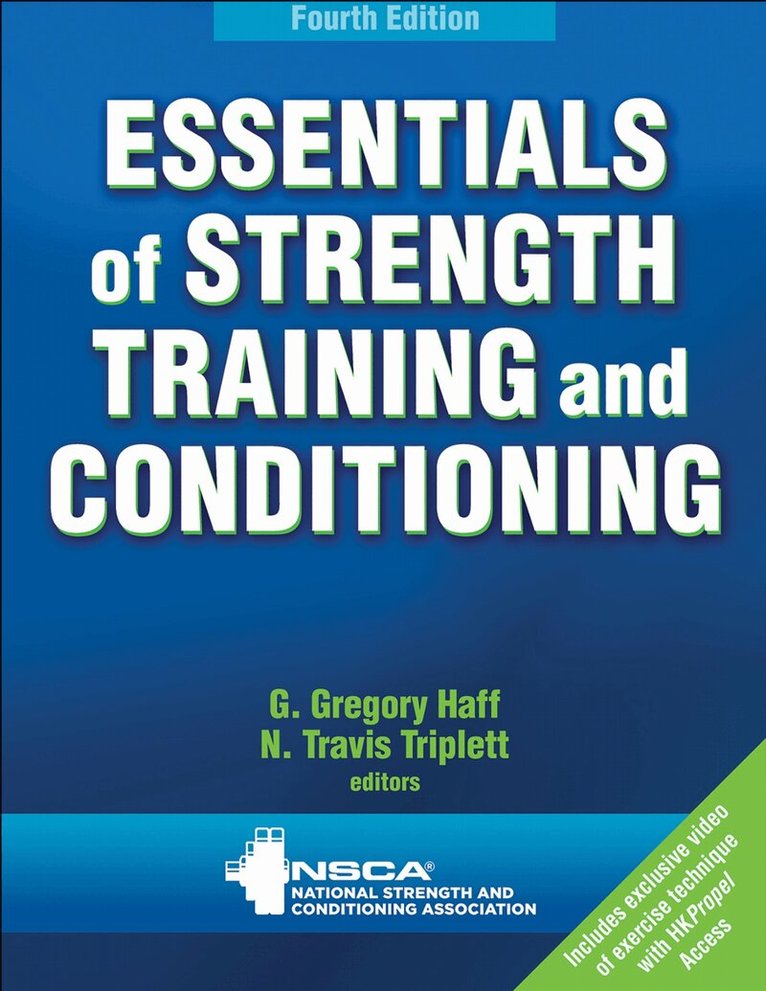
    Essentials of Strength Training and Conditioning

    AvG.Gregory Haff,N. Travis Triplett

    Inbunden, Engelska, 2021

    1 171 kr

    Beställningsvara. Skickas inom 5-8 vardagar. Fri frakt över 249 kr.

    Beskrivning

    Developed by the National Strength and Conditioning Association (NSCA) and now in its fourth edition, Essentials of Strength Training and Conditioning is the essential text for strength and conditioning professionals and students. This comprehensive resource, created by 30 expert contributors in the field, explains the key theories, concepts, and scientific principles of strength training and conditioning as well as their direct application to athletic competition and performance.The scope and content of Essentials of Strength Training and Conditioning, Fourth Edition With HKPropel Access, have been updated to convey the knowledge, skills, and abilities required of a strength and conditioning professional and to address the latest information found on the Certified Strength and Conditioning Specialist (CSCS) exam. The evidence-based approach and unbeatable accuracy of the text make it the primary resource to rely on for CSCS exam preparation.The text is organized to lead readers from theory to program design and practical strategies for administration and management of strength and conditioning facilities. The fourth edition contains the most current research and applications and several new features: Online videos featuring 21 resistance training exercises demonstrate proper exercise form for classroom and practical use.Updated research-specifically in the areas of high-intensity interval training, overtraining, agility and change of direction, nutrition for health and performance, and periodization-helps readers better understand these popular trends in the industry.A new chapter with instructions and photos presents techniques for exercises using alternative modes and nontraditional implements.Ten additional tests, including those for maximum strength, power, and aerobic capacity, along with new flexibility exercises, resistance training exercises, plyometric exercises, and speed and agility drills help professionals design programs that reflect current guidelines.Key points, chapter objectives, and learning aids including key terms and self-study questions provide a structure to help students and professionals conceptualize the information and reinforce fundamental facts. Application sidebars provide practical application of scientific concepts that can be used by strength and conditioning specialists in real-world settings, making the information immediately relatable and usable. Online learning tools delivered through HKPropel provide students with 11 downloadable lab activities for practice and retention of information. Further, both students and professionals will benefit from the online videos of 21 foundational exercises that provide visual instruction and reinforce proper technique.Essentials of Strength Training and Conditioning, Fourth Edition, provides the most comprehensive information on organization and administration of facilities, testing and evaluation, exercise techniques, training adaptations, program design, and structure and function of body systems. Its scope, precision, and dependability make it the essential preparation text for the CSCS exam as well as a definitive reference for strength and conditioning professionals to consult in their everyday practice.  Note: A code for accessing HKPropel is included with all new print books.

    Produktinformation

    • Utgivningsdatum:2021-06-21
    • Mått:216 x 279 x 40 mm
    • Vikt:2 336 g
    • Format:Inbunden
    • Språk:Engelska
    • Antal sidor:752
    • Upplaga:4
    • Förlag:Human Kinetics Publishers
    • ISBN:9781718210868

    Utforska kategorier

    • Fysiologi inom Medicin

    Mer om författaren

    The National Strength and Conditioning Association (NSCA) is the world’s leading organization in the field of sport conditioning. Drawing on the resources and expertise of the most recognized professionals in strength training and conditioning, sport science, performance research, education, and sports medicine, the NSCA is the world’s trusted source of knowledge and training guidelines for coaches and athletes. The NSCA provides the crucial link between the lab and the field.G. Gregory Haff, PhD, CSCS,*D, FNSCA, is the course coordinator for the postgraduate degree in strength and conditioning at Edith Cowan University in Joondalup, Australia. He is the president of the National Strength and Conditioning Association (NSCA) and a senior associate editor for the Journal of Strength and Conditioning Research. Dr. Haff was the United Kingdom Strength and Conditioning Association (UKSCA) Strength and Conditioning Coach of the Year for Research and Education and the 2011 NSCA William J. Kraemer Outstanding Sport Scientist award winner. He is a certified strength and conditioning specialist with distinction, a UKSCA-accredited strength and conditioning coach, and an accredited Australian Strength and Conditioning Association level 2 strength and conditioning coach. Additionally, he is a national-level weightlifting coach in the United States and Australia. He serves as a consultant for numerous sporting bodies, including teams in the Australian Football League, Australian Rugby Union, Australian Basketball Association, and National Football League.  N. Travis Triplett, PhD, CSCS,*D, FNSCA, is a professor and chairperson of the department of health and exercise science at Appalachian State University in Boone, North Carolina. She has served as the secretary-treasurer of the board of directors for the National Strength and Conditioning Association (NSCA) and was the 2010 NSCA William J. Kraemer Outstanding Sport Scientist award winner. She has served on two panels for NASA, one for developing resistance exercise countermeasures to microgravity environments for the International Space Station, and was a sports physiology research assistant at the U.S. Olympic Training Center in Colorado Springs, Colorado. Dr. Triplett is currently a senior associate editor for the Journal of Strength and Conditioning Research and is a certified strength and conditioning specialist with distinction as well as a USA Weightlifting club coach.

    Recensioner i media

    “This is the most comprehensive reference available for exercise professionals in the area of strength and conditioning. The depth of information is unmatched, and the level of current research dissemination is excellent.”©Doody’s Review Service, 2016, Kimberly Friedman, MS, The Ohio State University

    Innehållsförteckning

    • Chapter 1. Structure and Function of Body SystemsN. Travis Triplett, PhDMusculoskeletal SystemNeuromuscular SystemCardiovascular SystemRespiratory SystemConclusionLearning AidsChapter 2. Biomechanics of Resistance ExerciseJeffrey M. McBride, PhDSkeletal MusculatureAnatomical Planes and Major Body MovementsHuman Strength and PowerSources of Resistance to Muscle ContractionJoint Biomechanics: Concerns in Resistance TrainingConclusionLearning AidsChapter 3. Bioenergetics of Exercise and TrainingTrent J. Herda, PhD, and Joel T. Cramer, PhDEssential TerminologyBiological Energy SystemsSubstrate Depletion and RepletionBioenergetic Limiting Factors in Exercise PerformanceOxygen Uptake and the Aerobic and Anaerobic Contributions to ExerciseMetabolic Specificity of TrainingConclusionLearning AidsChapter 4. Endocrine Responses to Resistance ExerciseWilliam J. Kraemer, PhD, Jakob L. Vingren, PhD, and Barry A. Spiering, PhDSynthesis, Storage, and Secretion of HormonesMuscle as the Target for Hormone InteractionsRole of Receptors in Mediating Hormonal ChangesCategories of HormonesHeavy Resistance Exercise and Hormonal IncreasesMechanisms of Hormonal InteractionsHormonal Changes in Peripheral BloodAdaptations in the Endocrine SystemPrimary Anabolic HormonesAdrenal HormonesOther Hormonal ConsiderationsConclusionLearning AidsChapter 5. Adaptations to Anaerobic Training ProgramsDuncan French, PhDNeural AdaptationsMuscular AdaptationsConnective Tissue AdaptationsEndocrine Responses and Adaptations to Anaerobic TrainingCardiovascular and Respiratory Responses to Anaerobic ExerciseCompatibility of Aerobic and Anaerobic Modes of TrainingOvertrainingDetrainingConclusionLearning AidsChapter 6. Adaptations to Aerobic Endurance Training ProgramsAnn Swank, PhD, and Carwyn Sharp, PhDAcute Responses to Aerobic ExerciseChronic Adaptations to Aerobic ExerciseAdaptations to Aerobic Endurance TrainingExternal and Individual Factors Influencing Adaptations to Aerobic Endurance Training  Overtraining: Definition, Prevalence, Diagnosis, and Potential MarkersConclusionLearning AidsChapter 7. Age- and Sex-Related Differences and Their Implications for Resistance ExerciseRhodri S. Lloyd, PhD, and Avery D. Faigenbaum, EdDChildrenFemale AthletesOlder AdultsConclusionLearning AidsChapter 8. Psychology of Athletic Preparation and PerformanceTraci A. Statler, PhD, and Andrea M. DuBois, MSRole of Sport PsychologyIdeal Performance StateEnergy Management: Arousal, Anxiety and StressInfluence of Arousal and Anxiety on PerformanceMotivationAttention and FocusPsychological Techniques for Improved PerformanceEnhancing Motor Skill Acquisition and LearningConclusionLearning AidsChapter 9. Basic Nutrition Factors in HealthMarie Spano, MS, RDRole of Sport Nutrition ProfessionalsStandard Nutrition GuidelinesMacronutrientsVitaminsMineralsFluid and ElectrolytesConclusionLearning AidsChapter 10. Nutrition Strategies for Maximizing PerformanceMarie Spano, MS, RDPrecompetition, During-Event, and Postcompetition NutritionNutrition Strategies for Altering Body CompositionFeeding and Eating DisordersConclusionLearning AidsChapter 11. Performance-Enhancing Substances and MethodsBill Campbell, PhDTypes of Performance-Enhancing SubstancesHormonesDietary SupplementsConclusionLearning AidsChapter 12. Principles of Test Selection and AdministrationMichael McGuigan, PhDReasons for TestingTesting TerminologyEvaluation of Test QualityTest SelectionTest AdministrationConclusionLearning AidsChapter 13. Administration, Scoring, and Interpretation of Selected TestsMichael McGuigan, PhDMeasuring Parameters of Athletic PerformanceSelected Test Protocols and Scoring DataStatistical Evaluation of Test DataConclusionLearning AidsChapter 14. Warm-Up and Flexibility TrainingIan Jeffreys, PhDWarm-UpFlexibilityTypes of StretchingConclusionStatic Stretching TechniquesDynamic Stretching TechniquesLearning AidsChapter 15. Exercise Technique for Free-Weight and Machine TrainingScott Caulfield, BSFundamentals of Exercise TechniqueSpotting Free-Weight ExercisesConclusionResistance Training ExercisesLearning AidsChapter 16. Exercise Technique for Alternative Modes and Nontraditional Implement TrainingG. Gregory Haff, PhD, Doug Berninger, MEd, and Scott Caulfield, BSGeneral GuidelinesBody-Weight Training MethodsCore Stability and Balance Training MethodsVariable-Resistance Training MethodsNontraditional Implement Training MethodsUnilateral TrainingConclusionAlternative Modes and Nontraditional ExercisesLearning AidsChapter 17. Program Design for Resistance TrainingJeremy M. Sheppard, PhD, and N. Travis Triplett, PhDPrinciples of Anaerobic Exercise PrescriptionStep 1: Needs AnalysisStep 2: Exercise SelectionStep 3: Training FrequencyStep 4: Exercise OrderStep 5: Training Load and RepetitionsStep 6: VolumeStep 7: Rest PeriodsConclusionLearning AidsChapter 18. Program Design and Technique for Plyometric Training  David H. Potach, PT, and Donald A. Chu, PhD, PTPlyometric Mechanics and PhysiologyDesign of Plyometric Training Programs  Age ConsiderationsPlyometrics and Other Forms of ExerciseSafety ConsiderationsConclusionPlyometric DrillsLearning AidsChapter 19. Program Design and Technique for Speed and Agility Training  Brad H. DeWeese, EdD, and Sophia Nimphius, PhDSpeed and Agility MechanicsNeurophysiological Basis for SpeedRunning SpeedAgility Performance and Change-of-Direction Ability  Methods of Developing SpeedMethods of Developing AgilityProgram DesignSpeed Development StrategiesAgility Development StrategiesConclusionSpeed and Agility DrillsLearning AidsChapter 20. Program Design and Technique for Aerobic Endurance Training  Benjamin H. Reuter, PhD, and J. Jay Dawes, PhD  Factors Related to Aerobic Endurance PerformanceDesigning an Aerobic Endurance ProgramTypes of Aerobic Endurance Training ProgramsApplication of Program Design to Training SeasonsSpecial Issues Related to Aerobic Endurance TrainingConclusionAerobic Endurance Training ExercisesLearning AidsChapter 21. PeriodizationG. Gregory Haff, PhDCentral Concepts Related to PeriodizationPeriodization HierarchyPeriodization PeriodsApplying Sport Seasons to the Periodization PeriodsUndulating Versus Linear Periodization ModelsExample of an Annual Training PlanConclusionLearning AidsChapter 22. Rehabilitation and Reconditioning    David H. Potach, PT, and Terry L. Grindstaff, DPTTypes of InjuryTissue HealingRehabilitation and Reconditioning StrategiesProgram DesignReducing Risk of Injury and ReinjuryConclusionLearning AidsChapter 23. Facility Design, Layout, and OrganizationAndrea Hudy, MAGeneral Aspects of New Facility DesignExisting Strength and Conditioning FacilitiesAssessing Athletic Program NeedsDesigning the Strength and Conditioning FacilityArranging Equipment in the Strength and Conditioning FacilityMaintaining and Cleaning Surfaces and EquipmentConclusionLearning AidsChapter 24. Facility Policies, Procedures, and Legal IssuesTraci Statler, PhD, and Victor Brown, MSMission Statement and Program GoalsLegal and Ethical IssuesStaff Policies and ActivitiesFacility AdministrationEmergency Planning and ResponseConclusion