• Fri frakt över 249 kr
  • •
  • Snabba leveranser
  • •
  • Billiga böcker
Kundservice

Du är på sajten för privatpersoner.

Företag, bibliotek eller offentlig verksamhet?

Du handlar på classic.bokus.com, där alla dina funktioner finns intakta.
Till classic.bokus.com
Bokus logotyp. Gå till startsidan.
  • Erbjudanden
  • Student
  • Topplistor
  • Barn & ungdom
  • Bokus Play
  • E-böcker
  • Ljudböcker
  • Pocketböcker
  • Spel och pussel

5% studentrabatt – använd koden KURSBOK27 →

Sidfot

Mina sidor

    Hjälp

    • Kundservice
    • Vanliga frågor och svar
    • Frakt och leverans
    • Retur vid ångerrätt
    • Reklamera vara
    • Betalning
    • Köpvillkor
    • Allmänna villkor
    • Information om webbplatsens tillgänglighet

    Om Bokus

    • Om oss
    • Pressrum
    • För studenter
    • För företag
    • För bibliotek och offentlig verksamhet
    • För leverantörer
    • Hållbarhet

    Populärt

    • Aktuella erbjudanden
    • Presentkort
    • Studentlitteratur
    • Nya böcker
    • Topplistor
    • Signerade böcker
    • Engelska böcker

    Inspiration

    • Boktips
    • BookTok
    • Barnbokskaraktärer
    • Populära författare
    Logotyp för Bokus
    Följ oss på Facebook (extern länk)Följ oss på Instagram (extern länk)Följ oss på YouTube (extern länk)Följ oss på TikTok (extern länk)
    bokus @ CookiesAnpassa cookiesIntegritetspolicyKöpvillkor
    Till Citymail hemsida (extern länk)Till Budbee hemsida (extern länk)Till Postnord hemsida (extern länk)Till Schenker hemsida (extern länk)Till Early Bird hemsida (extern länk)Till Walleys hemsida (extern länk)
    1. Naturvetenskap och teknik
    2. Teknik och industri
    3. Byggnadsteknik

    Physical Models

    Their Historical and Current Use in Civil and Building Engineering Design

    AvBill Addis,Karl-Eugen Kurrer

    Inbunden, Engelska, 2020

    1 486 kr

    Skickas . Fri frakt över 249 kr.

    Fler format och utgåvor

    Inbunden

    2 492 kr

    Beskrivning

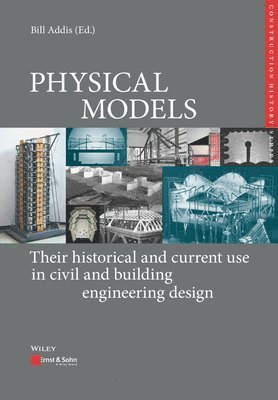
    Physical models have been, and continue to be used by engineers when faced with unprecedented challenges, when engineering science has been non-existent or inadequate, and in any other situation when the engineer has needed to raise their confidence in a design proposal to a sufficient level to begin construction. For this reason, models have mostly been used by designers and constructors of highly innovative projects, when previous experience has not been available.The book covers the history of using of physical models in the design and development of civil and building engineering projects including bridges in the mid-18th century, William Fairbairn?s Britannia bridge in the 1840s, the masonry Aswan Dam in the 1890s, concrete dams in the 1920s, thin concrete shell roofs and the dynamic behaviour of tall buildings in earthquakes from the 1930s, tidal flow in estuaries and the acoustics of concert halls from the 1950s, and cable-net and membrane structures in the 1960s.Traditionally, progress in engineering has been attributed to the creation and use of engineering science, the understanding materials properties and the development of new construction methods. The book argues that the use of reduced scale models have played an equally important part in the development of civil and building engineering. However, like the history of engineering design itself, this crucial contribution has not been widely reported or celebrated. The book concludes with reviews of the current use of physical models alongside computer models, for example, in boundary layer wind tunnels, room acoustics, seismic engineering, hydrology, and air flow in buildings.

    Produktinformation

    • Utgivningsdatum:2020-09-09
    • Mått:180 x 252 x 53 mm
    • Vikt:2 064 g
    • Format:Inbunden
    • Språk:Engelska
    • Antal sidor:1 114
    • Förlag:Wiley-VCH Verlag GmbH
    • ISBN:9783433032572

    Utforska kategorier

    • Byggnadsteknik inom Naturvetenskap och teknik

    Mer om författaren

    Bill Addis, born in 1949, studied engineering sciences and philosophy at the University of Cambridge before working as an engineer in the aerospace industry. He later spent over 15 years in the Department of Construction Management at the University of Reading, and then 15 years as a consulting engineering with the firm Buro Happold in London. He developed his interest in building and civil engineering history, and in the use of model testing during five decades, including work on his doctorate on the history and philosophy of engineering. He has written several books and over a hundred academic papers on the history of building engineering and construction, and has recently been enjoying lecturing and research as a visiting professor in universities in Rome, Innsbruck, San Sebastian, Zurich, Brussels and Munich.

    Innehållsförteckning

    • Preface Construction History Series (by Karl-Eugen Kurrer)Foreword (by Werner Sobek)Introduction (by Bill Addis)SECTION A -PHYSICAL MODELS FROM ANCIENT TIMES TO THE 1880s1 Dirk Bühler: Models in civil engineering from ancient times to the Industrial Revolution2 Santiago Huerta: Block models of the masonry arch and vault3 Rainer Graefe: The catenary and the line of thrust as a means for shaping arches and vaults4 Andreas Kahlow: Leonhard Euler and the model tests for a 300 metre timber arched bridge in St. Petersburg5 Dennis Smith: The use of models in early nineteenth-century British suspension bridge design6 Bill Addis: Models used during the design of the Conwy and Britannia tubular bridgesSECTION B -PHYSICAL MODELS USED IN STRUCTURAL DESIGN, 1890s-1930s7 Mike Chrimes: The use of models to inform the structural design of dams, 1890-19408 Bill Addis: Models used during the design of the Boulder Dam9 Roland May: The role of models in the early development of Zeiss-Dywidag shells10 Mario Chiorino & Gabriele Neri: Model testing of structures in pre-war Italy; the School of Arturo Danusso11 Joaquin Antuna: Eduardo Torroja and his use of models up to 193612 Bill Addis: Photoelastic stress analysisSECTION C -PHYSICAL MODELS USED IN STRUCTURAL DESIGN, 1940s TO 1980s13 Bernard Espion: Structural modelling technique14 Christiane Weber: Physical modelling at the University of Stuttgart15 Mario Chiorino & Gabriele Neri: Model testing of structures in post-war Italy: the activity of ISMES 1951-197416 Joaquin Antuna: Eduardo Torroja and his use of models from 193917 Edwin Trout: Scale models for structural testing at the Cement and Concrete Association, UK: 1951-7318 Pepa Casinello: Heinz Hossdorf: his contribution to the development of physical model testing19 Berthold Burkhardt: Soap film and soap bubble models20 Lukas Ingold: The model as an ideal building: the origins of the design methods of Sergio Musmeci21 John Chilton: Heinz Isler and his use of physical models22 Ian Liddell: Models for the design development, engineering and construction of the Multihalle for the 1975 Bundesgartenschau in MannheimSECTION D -PHYSICAL MODELS USED IN NON-STRUCTURAL ENGINEERING DISCIPLINES23 Bill Addis: The historical use of physical model testing in free-surface hydraulic engineering24 Bill Addis: The historical use of physical model testing in wind engineering25 Bill Addis: The historical use of physical model testing in earthquake engineering26 Raf Orlowski: The historical use of models in the acoustic design of buildings27 Bill Craig: Geotechnical centrifuge models ? a history of their role in pre-construction designSECTION E -PHYSICAL MODELLING IN THE TWENTY-FIRST CENTURY28 Mamoru Kawaguchi: Physical models as powerful weapons in structural design29 Bruce Martin: Physical modelling of structures for contemporary building design 30 David Wendland: Using physical models in the design of complex masonry structures31 James Sutherland: Physical modelling of free surface water ? current practice32 Francesco Dorigatti: Boundary-layer wind tunnel model testing ? current practice33 Amarnath Kasalanati: Model testing using shake tables ? current practice34 Raf Orlowski: The use of physical models in acoustic design ? current practice35 David White: Geotechnical centrifuge modelling ? current practice36 Owen Connick: Water-bath modelling ? small-scale simulation of natural ventilation flows37 Jan Knippers: The use of biological models for building engineering design38 Mamoru Kawaguchi: Flying a 100 metre long Jumbo Koinobori39 Dirk Bühler & Christiane Weber: Epilogue: A future for models from the past APPENDICES -Earliest writings in engineering literature about scaling and the use of reduced-scale models A1 Original source 15BC Vitruvius.A2 Original source 1638 Galileo.A3 Original source 1772 Leonard Euler.A4Original source 1801 Report on Telford?s arch bridge across the ThamesA5 Original source 1846 Short article on models in The Builder.A6 Original source 1847 Short article in Civil Engineer and Architects? Journal.A7 Original source 1887 part of paper by Osborne Reynolds.100 AUTHOR BIOGRAPHIES