• Fri frakt över 249 kr
  • •
  • Snabba leveranser
  • •
  • Billiga böcker
Kundservice

Du är på sajten för privatpersoner.

Företag, bibliotek eller offentlig verksamhet?

Du handlar på classic.bokus.com, där alla dina funktioner finns intakta.
Till classic.bokus.com
Bokus logotyp. Gå till startsidan.
  • Erbjudanden
  • Student
  • Topplistor
  • Barn & ungdom
  • Bokus Play
  • E-böcker
  • Ljudböcker
  • Pocketböcker
  • Spel och pussel

Pocketfynda! Hundratals böcker för 49 kr/st →

Sidfot

Mina sidor

    Hjälp

    • Kundservice
    • Vanliga frågor och svar
    • Frakt och leverans
    • Retur vid ångerrätt
    • Reklamera vara
    • Betalning
    • Köpvillkor
    • Allmänna villkor
    • Information om webbplatsens tillgänglighet

    Om Bokus

    • Om oss
    • Pressrum
    • För studenter
    • För företag
    • För bibliotek och offentlig verksamhet
    • För leverantörer
    • Hållbarhet

    Populärt

    • Aktuella erbjudanden
    • Presentkort
    • Studentlitteratur
    • Nya böcker
    • Topplistor
    • Signerade böcker
    • Engelska böcker

    Inspiration

    • Boktips
    • BookTok
    • Barnbokskaraktärer
    • Populära författare
    Logotyp för Bokus
    Följ oss på Facebook (extern länk)Följ oss på Instagram (extern länk)Följ oss på YouTube (extern länk)Följ oss på TikTok (extern länk)
    bokus @ CookiesAnpassa cookiesIntegritetspolicyKöpvillkor
    Till Citymail hemsida (extern länk)Till Budbee hemsida (extern länk)Till Postnord hemsida (extern länk)Till Schenker hemsida (extern länk)Till Early Bird hemsida (extern länk)Till Walleys hemsida (extern länk)
    1. Data och IT
    2. Systemvetenskap och AI
    • Nyhet

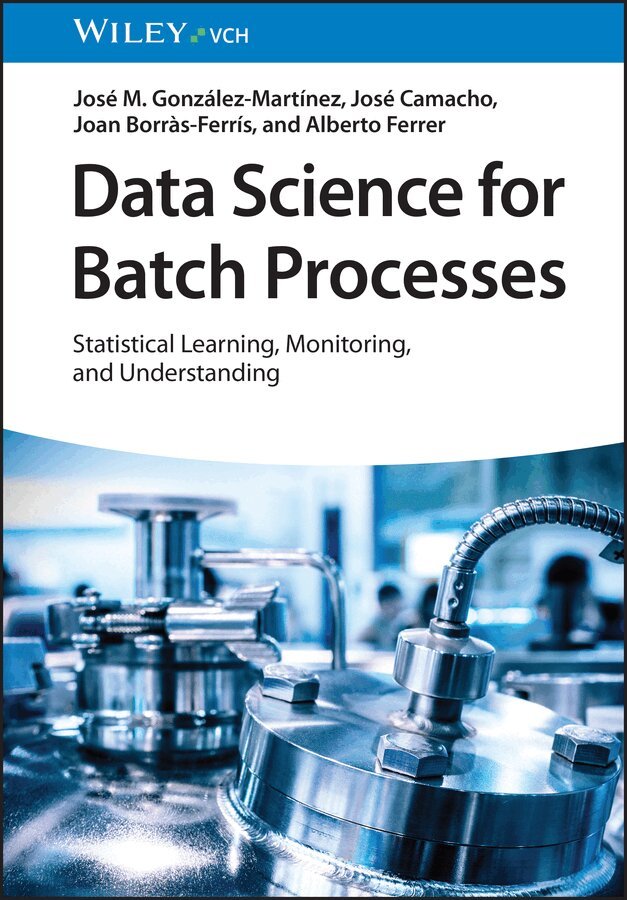
    Data Science for Batch Processes

    Statistical Learning, Monitoring and Understanding

    AvJosé M. González-Martínez,José Camacho

    Inbunden, Engelska, 2026

    1 366 kr

    Beställningsvara. Skickas inom 5-8 vardagar. Fri frakt över 249 kr.

    Beskrivning

    Overview of methods for bilinear modeling of batch data, including theory, methodologies and examples for experienced professionals in the biotech, pharmaceutical and petrochemical industries.Process Analytical Technologies (PAT) have become increasingly important with the establishment of the quality-by-design paradigm in industrial processes, particularly where batch operation is standard. PAT plays an instrumental role in advancing process understanding and operational efficiency, while strengthening safety and reliability to ensure consistent on-spec product quality and minimize environmental impact. Empirical methods based on latent variables, often referred to as chemometric methods, are a main component of PAT. When used alongside Batch Multivariate Statistical Process Control (BMSPC), these methods enable the timely detection and diagnosis of process upsets. Furthermore, process understanding can be improved by applying Latent Variable Models (LVMs), such as Principal Component Analysis (PCA) and Partial Least Squares (PLS), particularly relevant in batch processes, where the inherent complexity of the model results in a high degree of uncertainty in the operation.Data Science for Batch Processes: Statistical Learning, Monitoring and Understanding provides a comprehensive and rigorous examination of the bilinear modeling and monitoring of batch processes, comprising data alignment, pre-processing, three-way-to-two-way data transformation, data analysis and design of monitoring systems, including practical challenges and considerations when analyzing multi-dimensional batch data. Case studies and hands-on MATLAB examples using the MVBatch toolbox bridge theory and practice, illustrating how these methods can be applied.Data Science for Batch Processes: Statistical Learning, Monitoring and Understanding is an essential guide for professionals and academics who seek both foundational knowledge and advanced techniques in batch processes and data analysis.

    Produktinformation

    • Utgivningsdatum:2026-07-22
    • Mått:170 x 240 x 170 mm
    • Vikt:680 g
    • Format:Inbunden
    • Språk:Engelska
    • Antal sidor:224
    • Förlag:Wiley-VCH Verlag GmbH
    • ISBN:9783527326402

    Utforska kategorier

    • Systemvetenskap och AI inom Data och IT

    Mer om författaren

    José M. González-Martínez is Manager of the Department of Chemometrics and Digital Chemistry at Shell in the Netherlands, overseeing worldwide operations and leading key consultancy efforts, new technology developments and R&D business initiatives. He specializes in Chemometrics and Statistics for Chemicals, Catalysis, Integrated Gas, CO2 Abatement, and Low Carbon Fuel and Gas solutions. He has published multiple scientific articles and patents, and has been awarded several academic and industry prizes.José Camacho is a Full Professor at the Department of Signal Theory, Telematics and Communication and leader of the Computational Data Science Laboratory (CoDaS Lab) at the University of Granada, Spain. He specializes in extracting knowledge from data and the design of new data science algorithms and software in domains like precision medicine, industrial processes, cybersecurity or ecology. He is Scientific Advisor at Datharsis.Joan Borràs-Ferrís is a researcher and specialist in chemical engineering, applied statistics, and process modeling in digitalized industrial environments. He holds a PhD in Statistics and Optimization from the Universitat Politcnica de Valencia, Spain. He is currently Chief Technology Officer at Kensight Solutions. He has received the ENBIS Young Statistician Award for his work introducing innovative methods that promote the use of statistics in daily practice.Alberto Ferrer is a Full Professor of Statistics at the Universitat Politècnica de València, Spain, head of the Multivariate Statistical Engineering Group, Chief Scientific Officer at Kenko Imalytics, Scientific Advisor at Kensight Solutions, and elected member of the International Statistical Institute. His research focuses on the development and integration of machine learning and multivariate statistics to address the digitalization challenges in industry, healthcare, and technology. He is the recipient of the ENBIS Box Medal Award 2025.

    Innehållsförteckning

    • Foreword viiPrologue: Challenges for the Third Millennium ix1 Introduction 11.1 Industrial Batch Processes 11.2 Types of Sensors 31.3 Batch Process Modeling 51.3.1 Knowledge-based Models 51.3.2 Data-driven Models 61.3.3 Hybrid Models 71.4 Bilinear Modeling Cycle for Batch Process Monitoring 72 Data-driven Models Based on Latent Variables 132.1 Compression 132.2 Principal Component Analysis 182.2.1 Data Preprocessing 212.2.2 Selection of the Number of Principal Components 262.2.3 Parameters Stability 302.3 Regression 332.4 Regression Models Based on Latent Variables 352.4.1 Principal Component Regression 352.4.2 Partial Least Squares 362.4.3 Data Preprocessing 382.4.4 Selection of the Number of Latent Variables 412.4.5 PLS Versus Other Regression Models 422.5 Multivariate Exploratory Data Analysis 432.6 Missing Data 462.6.1 Model Exploitation 472.6.2 Model Building 522.6.3 Final Reflections About Missing Data Imputation and MSPC 523 Batch Data Equalization 553.1 Introduction 553.2 Challenges in Batch Equalization 563.3 Equalization of Variables Within a Batch 593.3.1 Discarding Intermediate Values 623.3.2 Estimating Missing Values 643.3.2.1 Comparison of Equalization Methods Based on Latent Variable Models 703.3.3 Rearranging Data 713.4 Multirate System 744 Batch Synchronization 794.1 Introduction 794.2 Synchronization Approaches 814.2.1 Indicator Variable 834.2.2 Time Linear Expanding/Compressing 874.2.2.1 Observation (OWU) Level and TLEC Synchronization Approach 894.2.3 Dynamic Time Warping 904.2.3.1 Warping Function Constraints 924.2.3.2 The DTW Algorithm 944.2.3.3 Optimization Problem 954.2.3.4 End-of-batch DTW Synchronization for Batch Process Monitoring 974.2.3.5 On the Use of Warping Information 1004.2.4 Relaxed Greedy Time Warping 1054.2.4.1 Enhanced Global Constraints 1074.2.4.2 Cross-validation for the Estimation of the RGTW Parameters 1104.2.5 Multisynchro 1144.2.5.1 Asynchronism Detection 1154.2.5.2 Specific Batch Synchronization 1174.2.5.3 Iterative Batch Synchronization and Anomaly Detection Procedure 1204.3 Effects of Synchronization on the Correlation Structure 1295 Batch Data Preprocessing 1415.1 Batch Preprocessing Operations 1415.2 Mean Centering 1435.3 Scaling 1446 Three-way to Two-way Transformation 1496.1 Introduction 1496.2 Single-model Approach 1506.2.1 Batch-wise Unfolding 1506.2.2 Variable-wise Unfolding 1566.2.3 Batch Dynamic Unfolding 1606.3 K-models Approach 1626.3.1 Hierarchical-model Approach 1686.4 Multiphase Approach 1716.4.1 Phases in Batch-wise Data 1726.4.2 Phases in Variable-wise Data 1756.4.3 Phases in Batch Dynamic Data 1776.5 Conclusion 1787 Batch Process Data Analysis and Statistical Monitoring 1817.1 Introduction 1817.2 Historical Batch Data Analysis 1817.3 Batch Multivariate Statistical Process Control 1867.3.1 Phase I 1867.3.2 Phase II 1877.3.2.1 Post-batch Process Monitoring 1877.3.2.2 Real-time Process Monitoring 1887.4 Practical Issues 190List of Acronyms 197Bibliography 199Index 211