• Fri frakt över 249 kr
  • •
  • Snabba leveranser
  • •
  • Billiga böcker
Kundservice

Du är på sajten för privatpersoner.

Företag, bibliotek eller offentlig verksamhet?

Du handlar på classic.bokus.com, där alla dina funktioner finns intakta.
Till classic.bokus.com
Bokus logotyp. Gå till startsidan.
  • Erbjudanden
  • Student
  • Topplistor
  • Barn & ungdom
  • Bokus Play
  • E-böcker
  • Ljudböcker
  • Pocketböcker
  • Spel och pussel

Pocketfynda! Hundratals böcker för 49 kr/st →

Sidfot

Mina sidor

    Hjälp

    • Kundservice
    • Vanliga frågor och svar
    • Frakt och leverans
    • Retur vid ångerrätt
    • Reklamera vara
    • Betalning
    • Köpvillkor
    • Allmänna villkor
    • Information om webbplatsens tillgänglighet

    Om Bokus

    • Om oss
    • Pressrum
    • För studenter
    • För företag
    • För bibliotek och offentlig verksamhet
    • För leverantörer
    • Hållbarhet

    Populärt

    • Aktuella erbjudanden
    • Presentkort
    • Studentlitteratur
    • Nya böcker
    • Topplistor
    • Signerade böcker
    • Engelska böcker

    Inspiration

    • Boktips
    • BookTok
    • Barnbokskaraktärer
    • Populära författare
    Logotyp för Bokus
    Följ oss på Facebook (extern länk)Följ oss på Instagram (extern länk)Följ oss på YouTube (extern länk)Följ oss på TikTok (extern länk)
    bokus @ CookiesAnpassa cookiesIntegritetspolicyKöpvillkor
    Till Citymail hemsida (extern länk)Till Budbee hemsida (extern länk)Till Postnord hemsida (extern länk)Till Schenker hemsida (extern länk)Till Early Bird hemsida (extern länk)Till Walleys hemsida (extern länk)
    1. Skönlitteratur
    2. Litteraturvetenskap
    3. Litteraturvetenskap

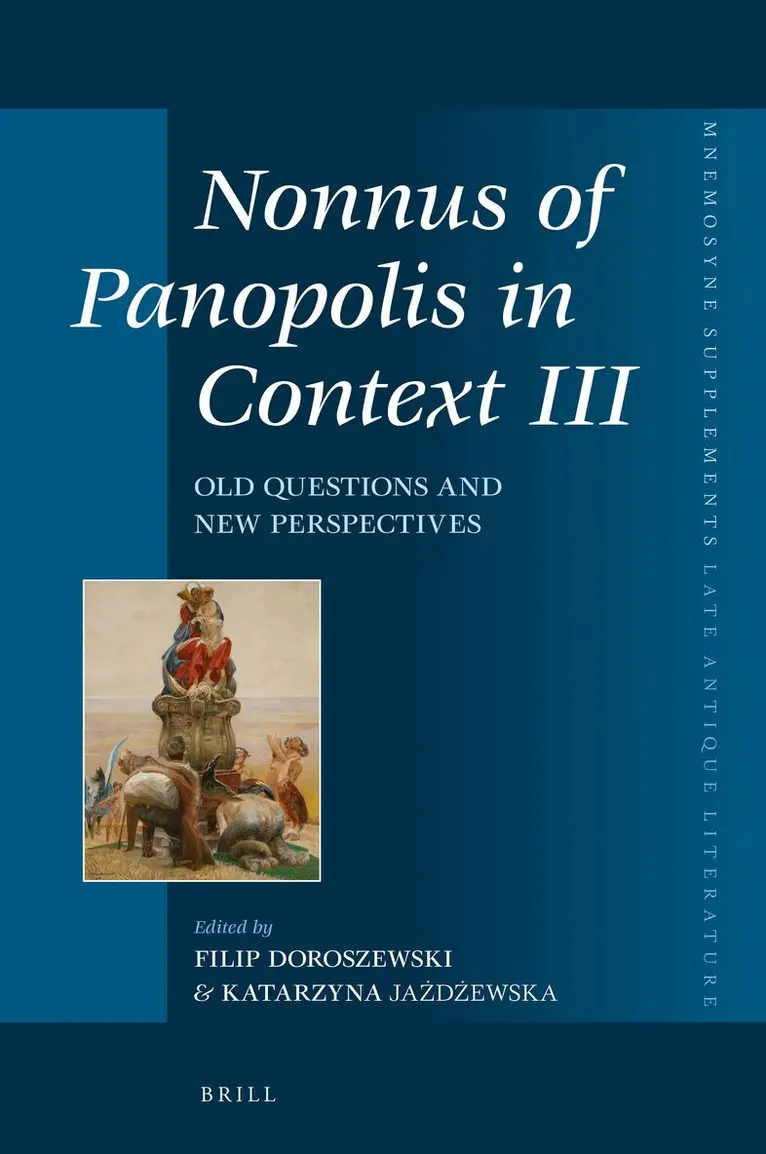
    Nonnus of Panopolis in Context III

    Old Questions and New Perspectives

    AvFilip Doroszewski

    Inbunden, Engelska, 2020

    Del 438 i serien Mnemosyne, Supplements, Late Antique Literature

    2 657 kr

    Beställningsvara. Skickas inom 5-8 vardagar. Fri frakt över 249 kr.

    Beskrivning

    Nonnus of Panopolis (5th c. AD), the most important Greek poet of Late Antiquity, is best known for his Dionysiaca, a grand epic that gathers together all myths associated with Dionysus, god of wine and mysteries. The poet also authored the Paraphrase of St. John’s Gospel which renders the Fourth Gospel into sophisticated hexameter verse. This volume, edited by Filip Doroszewski and Katarzyna Jażdżewska, brings together twenty-six essays by eminent scholars that discuss Nonnus’ cultural and literary background, the literary techniques and motifs used by the poet, as well as the composition of the Dionysiaca and the exegetical principles applied in the Paraphrase. As such, the book will significantly deepen our understanding of literary culture and religion in Late Antiquity.

    Produktinformation

    • Utgivningsdatum:2020-12-03
    • Mått:155 x 235 x 40 mm
    • Vikt:1 039 g
    • Format:Inbunden
    • Språk:Engelska
    • Serie:Mnemosyne, Supplements, Late Antique Literature
    • Antal sidor:526
    • Förlag:Brill
    • ISBN:9789004443235

    Utforska kategorier

    • Litteraturvetenskap inom Skönlitteratur

    Mer om författaren

    Filip Doroszewski is Assistant Professor of Classics at Cardinal Stefan Wyszynski University in Warsaw. His recent publications include a monograph on Nonnus’ Paraphrase (De Gruyter, forthcoming) as well as an edited volume on Dionysus and politics in antiquity (Routledge, forthcoming).Katarzyna Jażdżewska is Associate Professor at Cardinal Stefan Wyszynski University. She published numerous articles on Greek imperial literature and the genre of dialogue. She is currently working on the monograph Greek Dialogue in Antiquity: Post-Platonic Transformations (contracted with Oxford University Press).Contributors are: Domenico Accorinti, Benjamin Acosta-Hughes, Gianfranco Agosti, Cosetta Cadau, Katerina Carvounis, Gennaro D’Ippolito, Margherita Maria Di Nino, Nestan Egetashvili, Roberta Franchi, Laura Franco, Camille Geisz, Fotini Hadjittofi, David Hernández de la Fuente, Nicole Kröll, Anna Lefteratou, Jane Lucy Lightfoot, Enrico Magnelli, Laura Miguélez-Cavero, Ewa Osek, Marta Otlewska-Jung, Sophia Papaioannou, Michael Paschalis, A. Sophie Schoess, Fabian Sieber, Konstantinos Spanoudakis, Berenice Verhelst, Mary Whitby, Maria Ypsilanti.

    Recensioner i media

    "The Nonnus of Panopolis in Context series has been, for a number of years, the largest gathering of interesting perspectives and ideas on Nonnus and his works, and this third volume continues that tradition while setting out directions for the future. With this volume, the field of Nonnian scholarship finally feels like a fully mature, confident academic space, rather than the more hesitant area of study strivingfor legitimacy and attention that it has been until recently. None of the hesitation or acknowledgement of older, extremely questionable theories and questions of minimal value that have been so prevalent in Nonnian scholarship can be found in this collection, which instead approaches the poems with fresh eyes and exciting ideas. The volume serves as an excellent overview of where the field stands in 2021 and sets out clear aspirations of where we should go next." Oliver Gerlach, The Classical Review 71.2 379–381."In sum, this collection, which is accompanied by, inter alia, a wide bibliography and useful indices, marks another step forward in the studies on Nonnus' poetry and, at the same time, demonstrates once again how deep and complex it is by providing many starting points for further research." Arianna Magnolo in BMCR 2022.03.11

    Innehållsförteckning

    • PrefaceList of FiguresNotes on ContributorsIntroduction: Solved and Still Unsolved Issues about Nonnus and His WorksGennaro D’IppolitoPart 1 Nonnus and the Literary Tradition1 “Breaking the Fourth Wall”: On Literariness and Metalepsis in Nonnus’ DionysiacaBerenice Verhelst2 Junctures of Epic and Encomium in the Dionysiaca: The Episode of StaphylosLaura Miguélez-Cavero3 Aura’s Metamorphosis in the Dionysiaca of Nonnus: A Tale of Classical Resonances and Christian ImageryAnna Lefteratou4 I Had Only an Untimely Love: The Ephebic ‘Epyllia’ of Dionysiaka 10–11Benjamin Acosta-Hughes5 Nonnus’ Dionysiaca and the Latin Tradition: The Episode of AmpelusKaterina Carvounis and Sophia Papaioannou6 Nonnus and Coptic Literature: Further ExplorationsGianfranco AgostiPart 2 Literary Structure and Motifs in the Dionysiaca7 Visualizing Actaeon: The Motif of Recognition in Nonnus’ Treatment of the MetamorphosisA. Sophie Schoess8 Structure and Meaning through Analogy: Remarks on the Use of Spatial Form in the DionysiacaCamille Geisz9 Some Aspects of Nonnus’ Poetics: Antitypical Poetry in the DionysiacaNestan Egetashvili10 Ἁρμονίη κόσμου and ἁρμονίη ἀνδρῶν: On the Different Concepts of Harmony in the Dionysiaca of NonnusMarta Otlewska-Jung11 The Awakening of Ariadne in Nonnus: A Deliberate MetaphorDavid Hernández de la Fuente12 Female Characterization and Gender Reversal in Nonnus and ColluthusCosetta Cadau13 Empowered Effeminacy? The Inversion of Gender Norms in the Episodes of Europa and CadmusFotini HadjittofiPart 3 Exegesis through Paraphrase14 Ἀληθείῃ καὶ πνεύματι (Par. 4.114): Some Doctrinal Issues in Nonnus’ Paraphrase and Their Theological ImplicationsRoberta Franchi15 Nonnus and the BookJane Lucy Lightfoot16 Shepherding the Past: Nonnus’ Parable of the Good Shepherd between Pagan Models and Christian ExegesisMargherita Maria di Nino and Maria Ypsilanti17 Amplification in Juvencus’ Evangeliorum Libri iv and in Nonnus’ Μεταβολὴ τοῦ κατὰ Ιωάννην ἁγίου εὐαγγελίουMichael Paschalis18 Presentation of Biblical Figures in Poetic Paraphrase: John the Baptist and Pontius Pilate in Nonnus’ Paraphrase of St. John’s GospelLaura Franco and Maria YpsilantiPart 4 Nonnus and Late Antique Culture19 Sacrificing a Serpent: Nonnus’ Dionysiaca 2.671–679 and the Orphic Lithica 736–744Ewa Osek20 The Mystic Reception of Theocritus in Late AntiquityKonstantinos Spanoudakis21 Sites and Cities in Late Antique Literature: Athens, Berytus, and Cultural Self-Identification in the Dionysiaca of Nonnus of PanopolisNicole KröllPart 5 Reception of Nonnus22 An Unknown “Nonnian” Poet: John of MemphisEnrico Magnelli23 Nonnus, Christodorus, and the Epigrams of George of PisidiaMary Whitby24 Photius, the Suda, and Eustathius: Eloquent Silences and Omissions in the Reception of Nonnus’ Work in Byzantine LiteratureDomenico Accorinti25 Boom Years of Nonnian Studies? On the Reception of Nonnus in Germany (1880–1976)Fabian SieberIndex