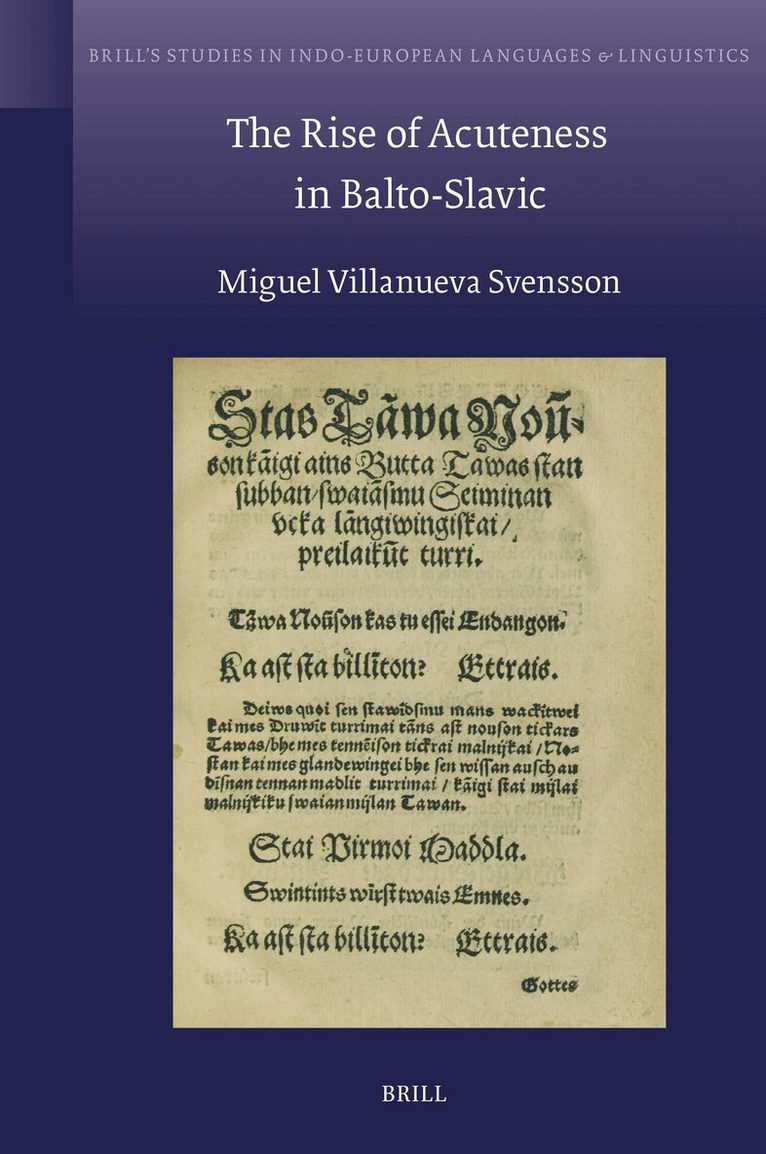
Del 27 i serien Brill's Studies in Indo-European Languages & Linguistics
1 968 kr
Beställningsvara. Skickas inom 5-8 vardagar. Fri frakt över 249 kr.
Beskrivning
The development of the prosodic system from Indo-European to Balto-Slavic is dominated by two major innovations: the rise of mobility and the rise of acuteness. This book provides a new account of the latter. It stands out from previous works for being informed by recent advances in phonological typology and tonogenesis and, especially, for its comprehensiveness. All matters related to the rise of acuteness are treated in detail. As a result, the book includes new insights on several issues of Balto-Slavic historical phonology and morphology as well.
Produktinformation
- Utgivningsdatum:2023-09-28
- Mått:155 x 235 x 29 mm
- Vikt:694 g
- Format:Inbunden
- Språk:Engelska
- Serie:Brill's Studies in Indo-European Languages & Linguistics
- Antal sidor:360
- Förlag:Brill
- ISBN:9789004682672
Utforska kategorier
Mer om författaren
Miguel Villanueva Svensson, Ph.D. (2003), Complutense University of Madrid, is Associate Professor at Vilnius University. He is the author of numerous articles on Baltic, Balto-Slavic and Indo-European linguistics.
Innehållsförteckning
- PrefaceList of TablesAbbreviations1 Introduction1.1 Purpose of This Study1.2 Language Labels1.3 Prosodic Terminology. Notation of Reconstructed Forms1.4 Structure of the Work2 Balto-Slavic Prosodics: Stress Position2.1 Introduction2.2 Lithuanian2.3 Latvian2.4 Old Prussian2.5 Slavic2.6 Balto-Slavic Stress: Mobile Nominal Paradigms2.7 Balto-Slavic Stress: Valences2.8 Stress Position in Balto-Slavic and PIE2.9 Rise of Mobility: the State of the Art2.10 PIE and Balto-Slavic Accentual Systems (General)2.11 Hirt’s Law2.12 Illič-Svityč’s Accentual Correlations Revisited2.13 PIE and Balto-Slavic Stress Position: Conclusions and Consequences for the Rise of Acuteness3 Balto-Slavic Prosodics: the Nature of Balto-Slavic Acuteness3.1 Introduction3.2 Lithuanian3.3 Latvian3.4 Old Prussian3.5 Baltic: Interim Summary and Further Prospects: Indirect Evidence3.6 Baltic Circumflex Metatony (with Development *ii̯as > *īs, *ii̯ā > *ē)3.7 Baltic Word-Final *ī > *i3.8 Baltic Secondary Local Cases3.9 Balto-Slavic Local Adverbs3.10 Common Slavic Tones (Evidence)3.11 Slavic Evidence for Acuteness in Unstressed Syllables3.12 Mobility and Acuteness (Meillet’s Law)3.13 Balto-Slavic Acuteness: Summary3.14 Approaches to the Realization of Balto-Slavic Acuteness3.15 Comparative Arguments: PIE Background3.16 Comparative Arguments: Balto-Slavic Data3.17 The Areal Dimension3.18 Balto-Slavic Acuteness from a Typological Perspective3.19 The Realization of Balto-Slavic Acuteness: Summary4 The Origin of Balto-Slavic Acuteness: the State of the Art4.1 Introduction4.2 (PostNeogrammarian Approach4.3 (PostNeogrammarian Approach: Word-Final Syllables4.4 (PostNeogrammarian Approach: Word-Internal Position4.5 Kortlandt’s ‘Glottalization’ Approach4.6 Jasanoff’s Approach4.7 The Rise of Acuteness so far: Summary and Criticism4.8 Conclusion and Further Prospects5 The Indo-European Lengthened Grade in Balto-Slavic5.1 Introduction5.2 PIE Lengthened Grade: Main Types5.3 PIE Lengthened Grade: Origin and Antiquity5.4 PIE Lengthened Grade: Nature of the Evidence5.5 Kortlandt’s Theory of the Origin of the PIE Lengthened Grade5.6 Evidence for Balto-Slavic Non-Acute5.7 Evidence for Balto-Slavic Acute: Verbal Formations5.8 Evidence for Balto-Slavic Acute: Nominal Formations5.9 Word-Final Position: Consonant-Stem Nominative Singular5.10 Word-Final Position: Other Endings5.11 Conclusion5.12 Implications for the Rise of Acuteness and Further Prospects6 Balto-Slavic Non-acute Monophthongs6.1 Introduction: the Problem6.2 Non-acute Monophthongs and Contractional Length6.3 Contractional Length: Nominal Endings6.4 Contractional Length: Verbal Formations6.5 Contractional Length: Other Formations6.6 Loanwords6.7 Monosyllabic Circumflexion6.8 Nikolaev’s Metatony: the Evidence6.9 Origin of Nikolaev’s Metatony6.10 Sources of Acute and Non-acute Monophthongs: Summary and Problems6.11 Winter’s Law6.12 The Rise of Acuteness in Monophthongs7 Osthoff’s Law in Balto-Slavic7.1 Introduction7.2 Osthoff’s Law in Balto-Slavic: the State of the Art7.3 Nature of the Evidence7.4 East Baltic: Word-Internal Position7.5 East Baltic: Long Diphthongs in Absolute Word-Final Position7.6 East Baltic: o-stem Instrumental Plural7.7 East Baltic: Accusative Plural and the Chronology of Osthoff’s Law7.8 East Baltic: Secondary Local Cases7.9 Old Prussian7.10 Slavic: Long Diphthongs in Absolute Word-Final Position7.11 Slavic: Word-Final Syllables7.12 Slavic: Word-Initial *ort-7.13 Slavic: Word-Internal Position7.14 Conclusion8 Acute and Length in Balto-Slavic Diphthongs8.1 Introduction. Typological Unlikeliness of *ERHT > *ĒRT8.2 Lack of Independent Evidence for *ĒRT. Other Approaches8.3 East Baltic Word-Final *-ei̯, *-ai̯ > *ẹ̄ vs. *-ēi̯, *-āi̯ > Lith. ei, 8.4 Baltic ā-stem Locative Singular8.5 Baltic ā-Stem Nominative-Accusative Dual8.6 Baltic ē-stems. Infinitive *-tei̯8.7 Baltic o-Stem Nominative Plural8.8 Baltic Verbal Endings8.9 Lith. pusiau and the Locative Dual8.10 Slavic8.11 Word-Internal Position: i̯e/o-presents to ERH-roots8.12 Word-Internal Position: *-EHU- Sequences8.13 Conclusion: No Length Involved in *ERHT > *ERT8.14 The Rise of Acuteness in Diphthongs8.15 The Rise of Balto-Slavic Acuteness: Framing the Problem8.16 The Rise of Acuteness in Balto-Slavic9 Concluding Remarks9.1 The Rise of Acuteness in Balto-Slavic: Summary and Pending Questions9.2 Contraction across Laryngeals and Balto-Slavic Tonogenesis9.3 The Development of the PIE Laryngeals in Northern Indo-European and Balto-Slavic Tonogenesis9.4 Topics for Future StudyBibliographyIndex of Forms
Hoppa över listan


Mer från samma serie
Del 1
Del 2
Del 11
Studies on the Collective and Feminine in Indo-European from a Diachronic and Typological Perspective
Sergio Neri, Roland Schuhmann
Inbunden
2 603 kr
Del 18
Del 19
Del 26
Del 23
Del 22
Del 24
Hoppa över listan


Du kanske också är intresserad av
Del 23
Del 2
Del 24
Del 19
Del 18
Del 26
Del 22
Del 11
Studies on the Collective and Feminine in Indo-European from a Diachronic and Typological Perspective
Sergio Neri, Roland Schuhmann
Inbunden
2 603 kr