2011 Kaid, Lynda Lee died April 13 - Böcker
Visar alla böcker från författaren 2011 Kaid, Lynda Lee died April 13. Handla med fri frakt och snabb leverans.
3 produkter
3 produkter
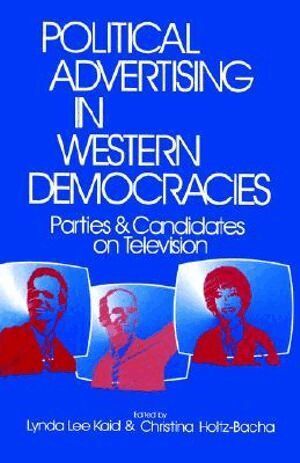
Political Advertising in Western Democracies
Parties and Candidates on Television
Häftad, Engelska, 1995
1 714 kr
Skickas inom 3-6 vardagar
An interesting study about political advertising on TV.... The material in the book can work as a good guide for both the Ministry of information and Broadcasting (including Doordarshan bosses) and major political parties while preparing to use TV as an effective medium for the next election campaign. --The Hindustan Times "This invaluable work significantly advances the cross-national, comparative study of political advertising broadly defined. In pellucid prose, the editors and contributors identify commonalities and differences among media systems, regulations, contents, and styles and point to their likely impact and effects. It is essential reading." --David L. Paletz, Duke University In recent years, political campaigns in Western democracies have increasingly relied on television advertising to promote candidates and/or political parties. Although North America was the first to channel political messages in this way and many European campaigns have been based on the U.S. model, Political Advertising in Western Democracies highlights the differences as well as the similarities of campaigns in Western democracies. The various campaign styles, their methods, and approaches reflect the unique political and cultural traditions of each country. Viewed individually and comparatively, they formulate the first comprehensive study to date on the role that television plays in the electoral process. The chapters, written by well-known contributors, are all based on original research of the most recent campaigns in England, France, Germany, Italy, Israel, Denmark, the Netherlands, Finland, and the United States. An invaluable resource for anyone interested in this topic, Political Advertising in Western Democracies is also an ideal supplement for courses such as Survey of Political Communication, Mass Communication and Politics, International Communication, Political Advertising, Comparative Political Communication, and Political Campaigning.
3 019 kr
Skickas inom 3-6 vardagar
The SAGE Handbook of Political Advertising provides a comprehensive view of the role political advertising plays in democracies around the world. Editors Lynda Lee Kaid and Christina Holtz-Bacha, along with an international group of contributors, examine the differences as well as the similarities of political advertising in established and evolving democratic governments. Key Features: Offers an international perspective: This Handbook examines the political television advertising process that has evolved in democracies around the world, including countries in Asia, Europe, Australia, Africa, Latin America, and North America. In addition, a comparative overview addresses the effects of political advertising on the voters and the systems of which it is a part.Provides comprehensive coverage: For each country presented, an analysis is given of its political advertising history, its cultural implications, the political and regulatory systems related to political advertising, the effects of media system structures, and the effects of new technologies. Includes examples from recent elections: The role specific candidate- or party-controlled television plays in a specific region′s electoral process is examined. Original research on recent elections confirms the expanding significance of this form of political communication.This is an excellent resource for media professionals and practicing journalists, as well as a welcome addition to any academic library. It can also be used as a textbook for advanced undergraduate and graduate courses on Political Advertising in the fields of Political Science, Communication, Broadcasting, Journalism, and International Relations.
5 567 kr
Tillfälligt slut
2008 Best Reference, Library JournalPolitical communication began with the earliest studies of democratic discourse by Aristotle and Plato. However, modern political communication relies on an interdisciplinary base, which draws on concepts from communication, political science, journalism, sociology, psychology, history, rhetoric, and others. This two-volume resource considers political communication from a broad interdisciplinary perspective, encompassing the many different roles that communication plays in political processes in the United States and around the world. The Encyclopedia of Political Communication discusses the major theoretical approaches to the field, including direct and limited effects theories, agenda-setting theories, sociological theories, framing and priming theories, and other past and present conceptualizations. With nearly 600 entries, this resource pays considerable attention to important political messages such as political speeches, televised political advertising, political posters and print advertising, televised political debates, and Internet sites. The audiences for political communications are also central, necessitating concentration on citizen reactions to political messages, how the general public and voters in democratic systems respond to political messages, and the effects of all types of media and message types. Key Features Encompasses several channels of political communication including interpersonal and public communication, radio, television, newspapers, and the World Wide Web Provides news media coverage and journalistic analysis of politics, political issues, political figures, and political institutions Concentrates on the field of political communication since the middle of the 20th century Emphasizes political communication from the point of view of the United States, but there is substantial and important research and scholarship on political communication in international contextsConsiders the role of communication in governing, incorporating communication activities that influence the operation of executive, legislative, and judicial bodies, political parties, interest groups, political action committees, and other participants in political processes Key Themes Biographies Books, Films, Journals, Television Democracy, Democratization Education and Nonprofit Organizations Elections Government Operations and Institutions Legal and Regulatory Media Events Media Outlets and Programs Role of Media in Political Systems News Media Coverage of Politics, Political Affairs Theoretical Approaches Types of Political Media Political Attitudes Political Campaigns Political Events Political Groups and Organizations Political Issues Political Journalism Theoretical Concepts Women in Politics The Encyclopedia of Political Communication is designed for libraries, undergraduates, and members of the public with an interest in political affairs. Media and political professionals, as well as government officials, lobbyists, and participants in independent political organizations, will find these volumes useful in developing a better understanding of how the media and communication function in political settings.