A. Cunningham - Böcker
Visar alla böcker från författaren A. Cunningham. Handla med fri frakt och snabb leverans.
6 produkter
6 produkter
852 kr
Skickas inom 10-15 vardagar
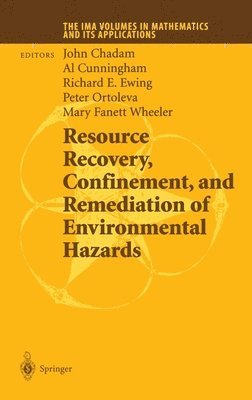
The papers in this volume arose out of two workshops entitled 'Confinement and Remediation of Environmental Hazards', and 'Resource Recovery', as part of the IMA 1999-2000 program year. These workshops brought together mathematicians, engineers and scientists to summarize recent theoretical, computational, and experimental advances in the theory of phenomena in porous media. The first workshop focused on the mathematical problems which arise in groundwater transport of contamination, and the spreading, confinement and remediation of biological, chemical and radioactive waste. In the second conference, the processes underlying petroleum recovery and the geological time scale of deformation, flow and reaction in porous media were discussed.Simulation techniques were used to simulate complex domains with widely-ranging spatial resolution and types of physics. Probability functional methods for determining the most probable state of the subsurface and related uncertainty were discussed. Practical examples included breakout from chemical and radioactive waste repositories, confinement by injection of pore plugging material and bioremediation of petroleum and other wastes.This volume will be of interest to subsurface science practitioners who would like a view of recent mathematical and experimental efforts to examine subsurface science phenomena related to resource recovery and remediation issues.
2 624 kr
Skickas inom 10-15 vardagar
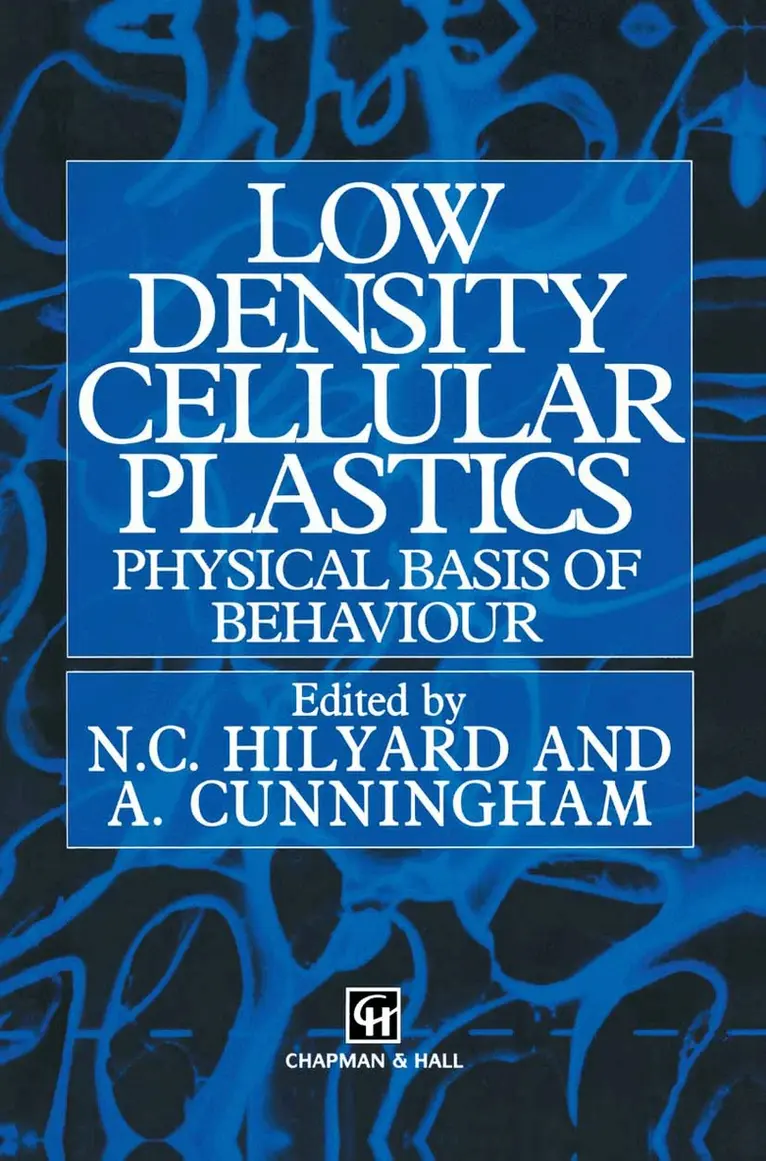
Density reduction of cellular materials can be directly converted into cost savings and consequently commercially produced foams are being driven towards their lowest possible density for a given application. However, as densities become even lower, the control and optimization of the cellular structure and physical properties becomes more complex and a better understanding of the fundamental relationships between composition, cellular structure, matrix morphology and the physical properties is required. To facilitate this understanding, a world-wide group of authors from industry and academia at the forefront of research have been brought together. The fundamental basis of the formation and the physical behaviour of low density cellular polymers are described and analyzed and they report, explain and quantify, using empirical data, phenomenological modelling and mathematical analysis; the current understanding of fundamental issues concerning foam formation and physical behaviour. Current model representations of physical behaviour are critically reviewed and model predictions compared with experimental data.Unlike other books on polymeric foams, which concentrate on the chemistry and process technology of foams, it focuses on the essential material science issues of the quantification and mathematical modelling of physical behaviour whether it be mechanical, pneumatic, thermal or acoustic. In addressing fundamental issues concerning the physics of low density cellular plastics, the reader's attention is directed to the many possibilities in foam development which have potential for commercial exploitations. This book should be of interest to senior undergraduates, graduates and researchers working in the plastics field; those working in the plastics industry.
208 kr
Skickas inom 3-6 vardagar
377 kr
Skickas inom 5-8 vardagar
238 kr
Skickas inom 5-8 vardagar
2 624 kr
Skickas inom 10-15 vardagar
Foams are gas filled integral structures in which the gas is finely dispersed throughout acontinuouslyconnected solid phase. The bulk density is usually substantially lower than that of the solid component, and for the foams which form the focus for this book the volume fraction of the gas phase is considerably greater than 0.5 and in most instances in excess of 0.9. Many ofthe materials encountered in every day experience, such as bread, plants and trees, structural materials for buildings, comfort materials for domestic and automotive seating, shock absorbers or car bumpers and materials for noise control, have one thing in common - the cellular nature of their physical structure. Whyare thesestructuressoimportantin the naturaland man-made world? The reasons are both technical and commercial. From a technical viewpoint cellular materials offer: 1. high specific stiffness and strength - making them suitable for structural applications; 2. closeto idealenergymanagement - hencetheir useinthermalandacoustic insulation, vibration damping, acoustic absorption and shock mitigation; and 3. comfort - hence their use for domestic and automotive seating.