A. John Bailer - Böcker
Visar alla böcker från författaren A. John Bailer. Handla med fri frakt och snabb leverans.
7 produkter
7 produkter
2 040 kr
Skickas
Conservation agriculture is a sustainable production model that not only optimizes crop yields, but also reaps economic and environmental benefits as well. The adoption of successful conservation agriculture methods has resulted in energy savings, higher organic matter content and biotic activity in soil, increased crop-water availability and thus resilience to drought, improved recharge of aquifers, less erosion, and reduced impacts from the weather associated with climate change in general. Agricultural Impacts of Climate Change examines several important aspects of crop production, such as climate change, soil management, farm machinery, and different methods for sustainable conservation agriculture. It presents spatial distribution of a daily, monthly and annual precipitation concentration indices, Diffuse Reflectance Fourier Transform Infrared Spectroscopy for analyzing the organic matter in soil, and adaptation strategies for climate-related plant disease scenarios. It also discusses solar energy-based greenhouse modeling, precision farming using remote sensing and GIS, and various types of machinery used for conservation agriculture. Features: Examines the effects of climate change on agriculture and the related strategies for mitigation through practical, real-world examples Explores innovative on-farm technology options to increase system efficiency resulting in improved water usage Presents examples of precision farming using climate-resilient technologies
1 113 kr
Skickas inom 10-15 vardagar
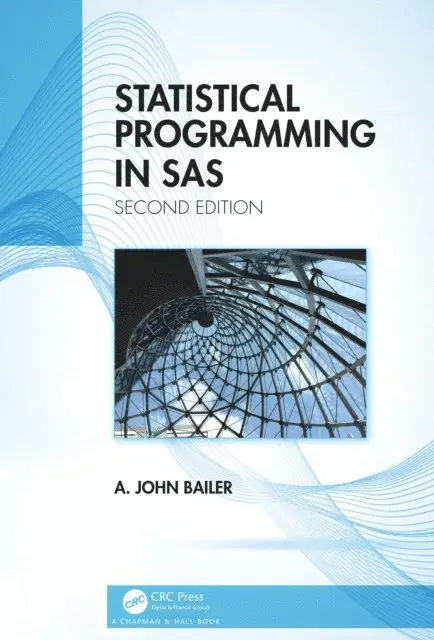
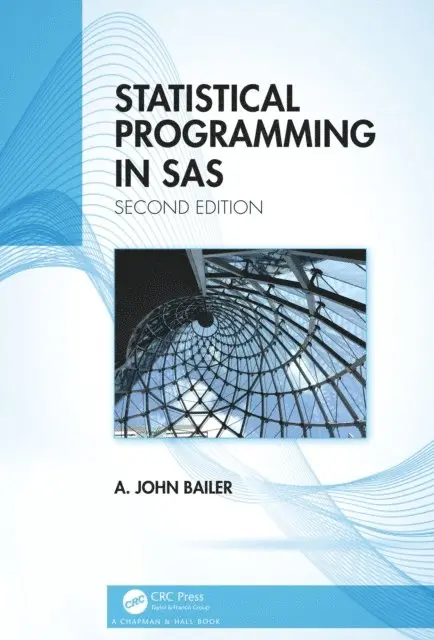
Statistical Programming in SAS Second Edition provides a foundation for programming to implement statistical solutions using SAS, a system that has been used to solve data analytic problems for more than 40 years. The author includes motivating examples to inspire readers to generate programming solutions. Upper-level undergraduates, beginning graduate students, and professionals involved in generating programming solutions for data-analytic problems will benefit from this book. The ideal background for a reader is some background in regression modeling and introductory experience with computer programming.The coverage of statistical programming in the second edition includesGetting data into the SAS system, engineering new features, and formatting variablesWriting readable and well-documented codeStructuring, implementing, and debugging programs that are well documentedCreating solutions to novel problemsCombining data sources, extracting parts of data sets, and reshaping data sets as needed for other analysesGenerating general solutions using macrosCustomizing outputProducing insight-inspiring data visualizationsParsing, processing, and analyzing textProgramming solutions using matrices and connecting to RProcessing textProgramming with matricesConnecting SAS with RCovering topics that are part of both base and certification exams.
2 644 kr
Skickas inom 10-15 vardagar
Statistical Programming in SAS Second Edition provides a foundation for programming to implement statistical solutions using SAS, a system that has been used to solve data analytic problems for more than 40 years. The author includes motivating examples to inspire readers to generate programming solutions. Upper-level undergraduates, beginning graduate students, and professionals involved in generating programming solutions for data-analytic problems will benefit from this book. The ideal background for a reader is some background in regression modeling and introductory experience with computer programming.The coverage of statistical programming in the second edition includesGetting data into the SAS system, engineering new features, and formatting variablesWriting readable and well-documented codeStructuring, implementing, and debugging programs that are well documentedCreating solutions to novel problemsCombining data sources, extracting parts of data sets, and reshaping data sets as needed for other analysesGenerating general solutions using macrosCustomizing outputProducing insight-inspiring data visualizationsParsing, processing, and analyzing textProgramming solutions using matrices and connecting to RProcessing textProgramming with matricesConnecting SAS with RCovering topics that are part of both base and certification exams.
389 kr
Skickas inom 10-15 vardagar
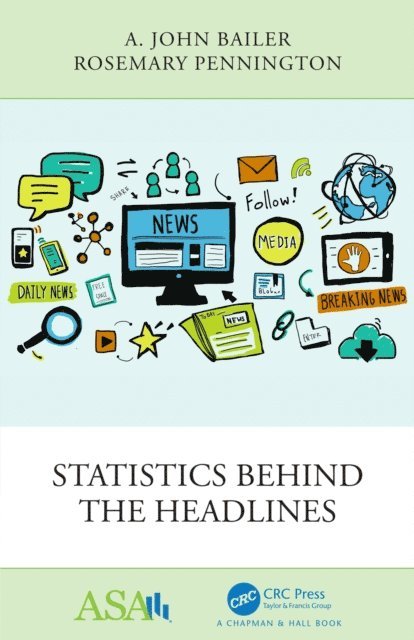
How do you learn about what’s going on in the world? Did a news headline grab your attention? Did a news story report on recent research? What do you need to know to be a critical consumer of the news you read? If you are looking to start developing your data self-defense and critical news consumption skills, this book is for you! It reflects a long-term collaboration between a statistician and a journalist to shed light on the statistics behind the stories and the stories behind the statistics. The only prerequisite for enjoying this book is an interest in developing the skills and insights for better understanding news stories that incorporate quantitative information.Chapters in Statistics Behind the Headlines kick off with a news story headline and a summary of the story itself. The meat of each chapter consists of an exploration of the statistical and journalism concepts needed to understand the data analyzed and reported in the story. The chapters are organized around these sections:What ideas will you encounter in this chapter?What is claimed? Is it appropriate?Who is claiming this?Why is it claimed? What makes this a story worth telling?Is this a good measure of impact?How is the claim supported?What evidence is reported?What is the quality/strength of the evidence?Does the claim seem reasonable?How does this claim fit with what is already known?How much does this matter?Considering the coverageChapters close with connections to the Stats + Stories podcast.
908 kr
Skickas inom 10-15 vardagar
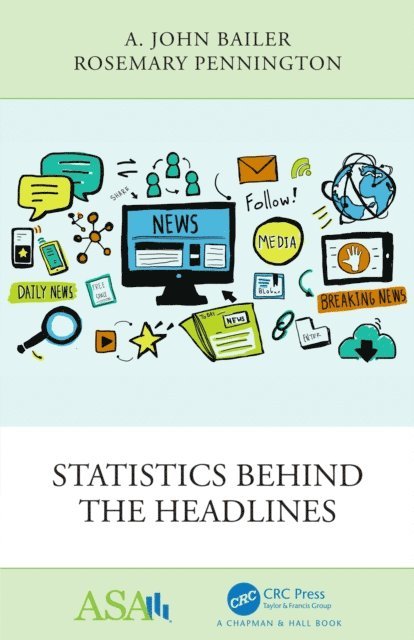
How do you learn about what’s going on in the world? Did a news headline grab your attention? Did a news story report on recent research? What do you need to know to be a critical consumer of the news you read? If you are looking to start developing your data self-defense and critical news consumption skills, this book is for you! It reflects a long-term collaboration between a statistician and a journalist to shed light on the statistics behind the stories and the stories behind the statistics. The only prerequisite for enjoying this book is an interest in developing the skills and insights for better understanding news stories that incorporate quantitative information.Chapters in Statistics Behind the Headlines kick off with a news story headline and a summary of the story itself. The meat of each chapter consists of an exploration of the statistical and journalism concepts needed to understand the data analyzed and reported in the story. The chapters are organized around these sections:What ideas will you encounter in this chapter?What is claimed? Is it appropriate?Who is claiming this?Why is it claimed? What makes this a story worth telling?Is this a good measure of impact?How is the claim supported?What evidence is reported?What is the quality/strength of the evidence?Does the claim seem reasonable?How does this claim fit with what is already known?How much does this matter?Considering the coverageChapters close with connections to the Stats + Stories podcast.
2 306 kr
Skickas inom 10-15 vardagar
Statistics for Environmental Biology and Toxicology presents and illustrates statistical methods appropriate for the analysis of environmental data obtained in biological or toxicological experiments. Beginning with basic probability and statistical inferences, this text progresses through non-linear and generalized linear models, trend testing, time-to-event data and analysis of cross-classified tabular and categorical data. For the more complex analyses, extensive examples including SAS and S-PLUS programming code are provided to assist the reader when implementing the methods in practice.
1 000 kr
Skickas inom 7-10 vardagar
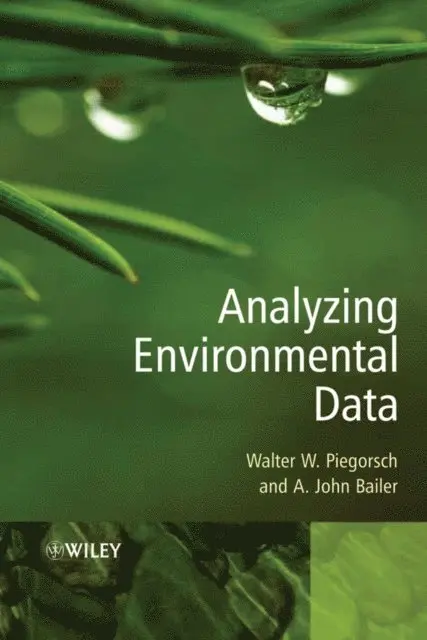
Environmental statistics is a rapidly growing field, supported by advances in digital computing power, automated data collection systems, and interactive, linkable Internet software. Concerns over public and ecological health and the continuing need to support environmental policy-making and regulation have driven a concurrent explosion in environmental data analysis. This textbook is designed to address the need for trained professionals in this area. The book is based on a course which the authors have taught for many years, and prepares students for careers in environmental analysis centered on statistics and allied quantitative methods of data evaluation. The text extends beyond the introductory level, allowing students and environmental science practitioners to develop the expertise to design and perform sophisticated environmental data analyses. In particular, it: Provides a coherent introduction to intermediate and advanced methods for modeling and analyzing environmental data. Takes a data-oriented approach to describing the various methods. Illustrates the methods with real-world examples Features extensive exercises, enabling use as a course text. Includes examples of SAS computer code for implementation of the statistical methods. Connects to a Web site featuring solutions to exercises, extra computer code, and additional material. Serves as an overview of methods for analyzing environmental data, enabling use as a reference text for environmental science professionals. Graduate students of statistics studying environmental data analysis will find this invaluable as will practicing data analysts and environmental scientists including specialists in atmospheric science, biology and biomedicine, chemistry, ecology, environmental health, geography, and geology.