A. K. Oppenheim – Författare
Visar alla böcker från författaren A. K. Oppenheim. Handla med fri frakt och snabb leverans.
5 produkter
5 produkter
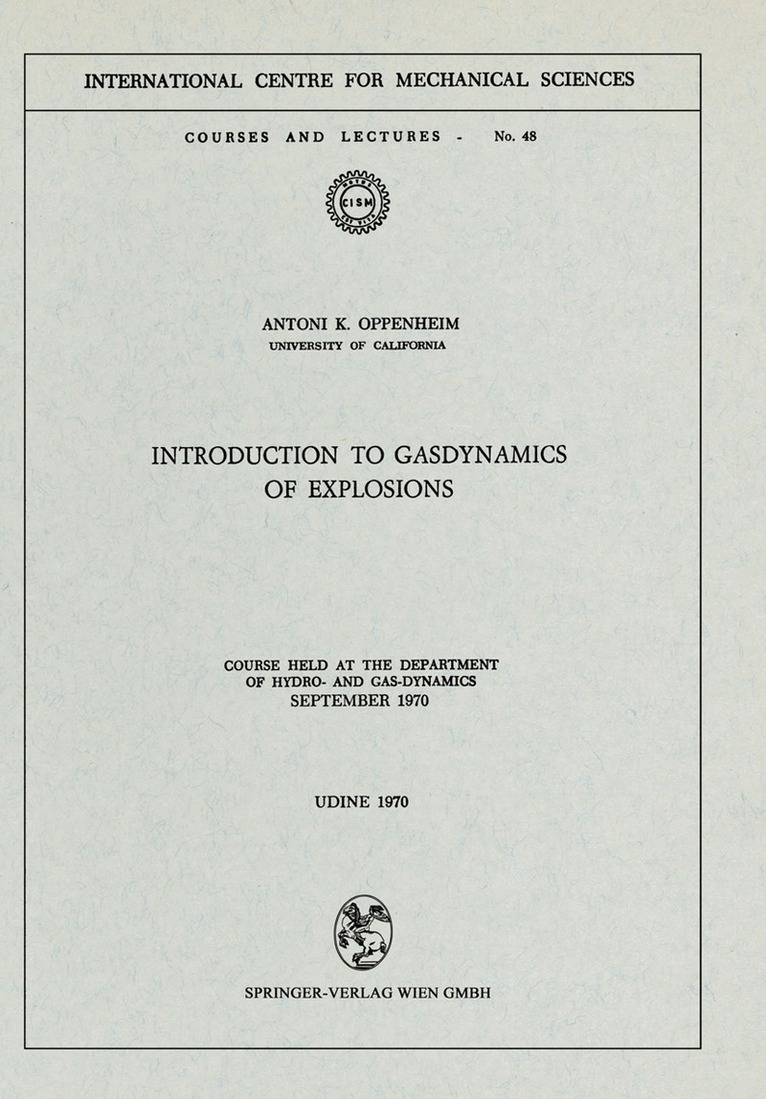
Del 48 - CISM International Centre for Mechanical Sciences
Introduction to Gasdynamics of Explosions
Course held at the Department of Hydro- and Gas-Dynamics, September 1970
Häftad, Engelska, 1972
534 kr
Skickas inom 10-15 vardagar
1 062 kr
Skickas inom 10-15 vardagar
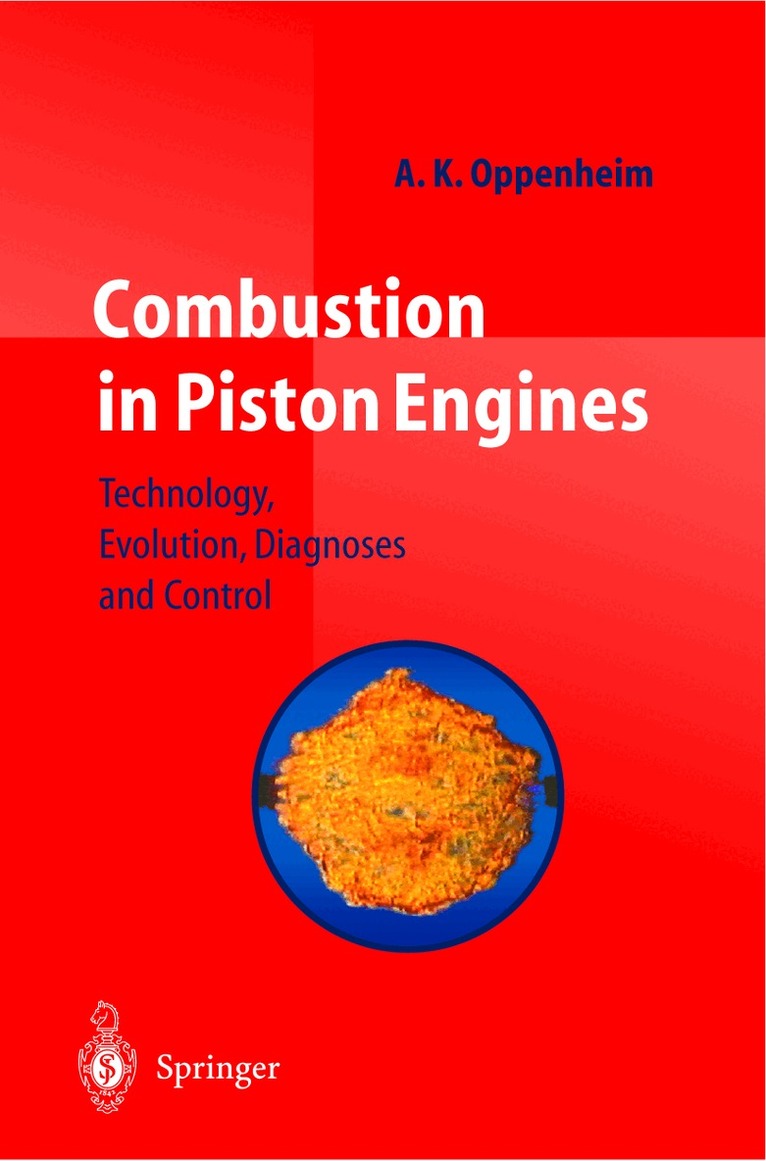
Upon a synthesis of the technology of Combustion in Piston Engines, its past, present and future, the book provides a recipe for its advancement. Engines of the future are visualized as featuring distributed combustion executed by means of PJI&I (Pulse Jet Injection and Ignition) actuators, modulated by MECC (Micro-Electronically Controlled Combustion) systems in response to signals provided by pressure sensors. To assist in the development of such engines, the book provides the method of pressure diagnostics - an analytical technique for interpreting the signal provided by a pressure sensor to assess the effectiveness with which fuel is utilized in an engine cylinder, and to monitor the operation of MECC in optimizing the performance of a PJI&I system. It is on this basis that a demonstration is produced of a representative car engine, for which, by the use of these systems, the formation of pollutants can be reduced by orders of magnitude, while the consumption of fuel is halved.
1 589 kr
Skickas inom 10-15 vardagar
Combustion systems are confined fields of compressible fluids where exothermic processes of combustion take place, subject to boundary conditions imposed at its borders. The subject of Dynamics of Combustion Systems is presented in three parts: Part 1. Exothermicity – considering the thermodynamic effects due to evolution of exothermic energy in a combustion system - Part 2. Field– exposing the dynamic properties of flow fields where the exothermic energy is deposited - Part 3. Explosions – revealing the dynamic features of fields and fronts due to rapid deposition of exothermic energy.
1 091 kr
Skickas inom 10-15 vardagar
Upon an exponential growth of life on earth, supported by a century of oil based energy economy, following a century of its coal-based phase, the world we live in is facing a point of inflection! at the threshold of an expo nential decay. It is, in fact, the quest for counteracting its dreaded conse quences that are bound to follow, which half a century ago provided the stimulus for launching the space program. Coal and oil are made out of carbon and hydrogen atoms. Hydrocarbon molecules consisting of these atoms are the essential ingredients of life by providing energy in a remarkably compact from. This property is due to the fact that hydrocarbons, by themselves, are not highly energetic materi als. The energy is derived from them by chemical reaction with oxygen supplied by the surrounding air. This reaction provides heat and is referred to for that reason as exothermic. The mass of oxidizer it requires is, in fact, ~ 3. 5 (if it is provided by oxygen alone) or ~ 15 (if it is supplied by air) times larger than that of the hydrocarbon. For vehicular transport, where the fuel has to be carried on board, this feature is of particular significance.
1 589 kr
Skickas inom 10-15 vardagar
Combustion systems are confined fields of compressible fluids where exothermic processes of combustion take place, subject to boundary conditions imposed at its borders. The subject of Dynamics of Combustion Systems is presented in three parts: Part 1. Exothermicity – considering the thermodynamic effects due to evolution of exothermic energy in a combustion system - Part 2. Field– exposing the dynamic properties of flow fields where the exothermic energy is deposited - Part 3. Explosions – revealing the dynamic features of fields and fronts due to rapid deposition of exothermic energy.