A. Sarlemijn – författare
Visar alla böcker från författaren A. Sarlemijn. Handla med fri frakt och snabb leverans.
5 produkter
5 produkter
E-bok
PDF, Engelska, 2012756 kr
Läs direkt efter köp
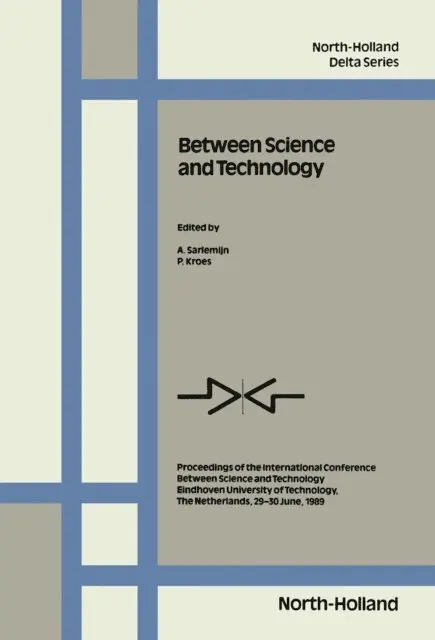
This book contains the papers presented at a conference organised in honour of H.B.G. Casimir''s 80th birthday. Outstanding scientists from different fields of research were invited to discuss important recent developments and put them in a broader perspective.The resulting book is devoted to the following relationships between fundamental physical research and technological developments:- - the prognoses of technologically relevant phenomena on the basis of physical research; - the dependence of technological developments on physical research; - the spin-off of physical research for other disciplines; - the fact that fundamental research is required for the advancement of physics in general and of applied physics in particular. The famous Dutch physicist H.B.G. Casimir has made substantial contributions to the development of 20th century physics and was for several years head of Philips Research Laboratories. The diversity of topics addressed in this book reflects his wide range of interests.
E-bok
PDF, Engelska, 2012756 kr
Läs direkt efter köp
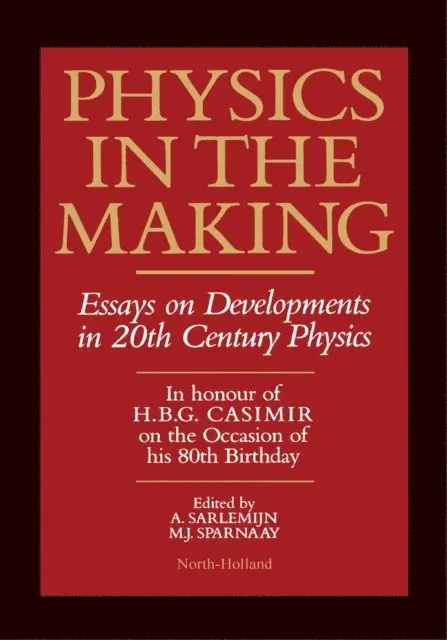
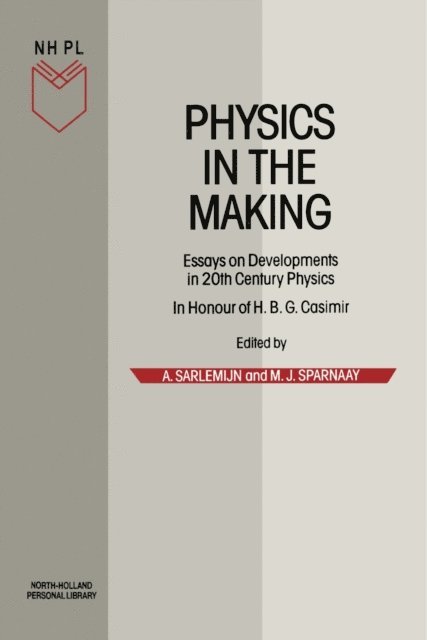
H.B.G. Casimir''s life, interests and works are intertwined with the importantdevelopments that have taken place in physics during this century. This book was compiled by his friends and admirers in honour of his 80th birthday andconcentrates mainly on Casimir''s achievements in the field of physics, thoughwithout ignoring the peripheral areas of the history and philosophy of physics in which he was greatly interested. The book is divided into four parts. Part I describes Casimir''s teachers, Ehrenfest, Bohr and Pauli, and will be of general interest due to the key role which these physicists played in moderndevelopments. The articles do give new facts and provide new insights into thehistory of modern physics. Part II consists of essays on recent developments invarious areas of physics in which Casimir has taken an active interest, such asthe modern concept of time, statistical foundations of electrodynamic theory andfield theory. The subjects covered in Part III have been selected because ofCasimir''s efforts in the industrial research area of physics. They cover past,present and future expectations in research. Part IV contains an essay whichdiscusses a philosophy of physics currently under discussion, which states thatphenomenological laws prevail over fundamental ones for the purpose ofexperimental and technical physics. A second chapter in this final part gives acritical analysis of this philosophical view. The book is concluded by anappendix discussing Casimir''s activities as a lecturer, written by a formerstudent.
E-bok
PDF, Engelska, 2013756 kr
Läs direkt efter köp
H.B.G. Casimir''s life, interests and works are intertwined with the important developments that have taken place in physics during this century. This book was compiled by his friends and admirers in honour of his 80th birthday and concentrates mainly on Casimir''s achievements in the field of physics, though without ignoring the peripheral areas of the history and philosophy of physics in which he was greatly interested. The book is divided into four parts. Part I describes Casimir''s teachers, Ehrenfest, Bohr and Pauli, and will be of general interest due to the key role which these physicists played in modern developments. The articles do give new facts and provide new insights into the history of modern physics.Part II consists of essays on recent developments in various areas of physics in which Casimir has taken an active interest, such as the modern concept of time, statistical foundations of electrodynamic theory and field theory.The subjects covered in Part III have been selected because of Casimir''s efforts in the industrial research area of physics. They cover past, present and future expectations in research.Part IV contains an essay which discusses a philosophy of physics currently under discussion, which states that phenomenological laws prevail over fundamental ones for the purpose of experimental and technical physics. A second chapter in this final part gives a critical analysis of this philosophical view.The book is concluded by an appendix discussing Casimir''s activities as a lecturer, written by a former student.
E-bok
PDF, Engelska, 2012687 kr
Läs direkt efter köp
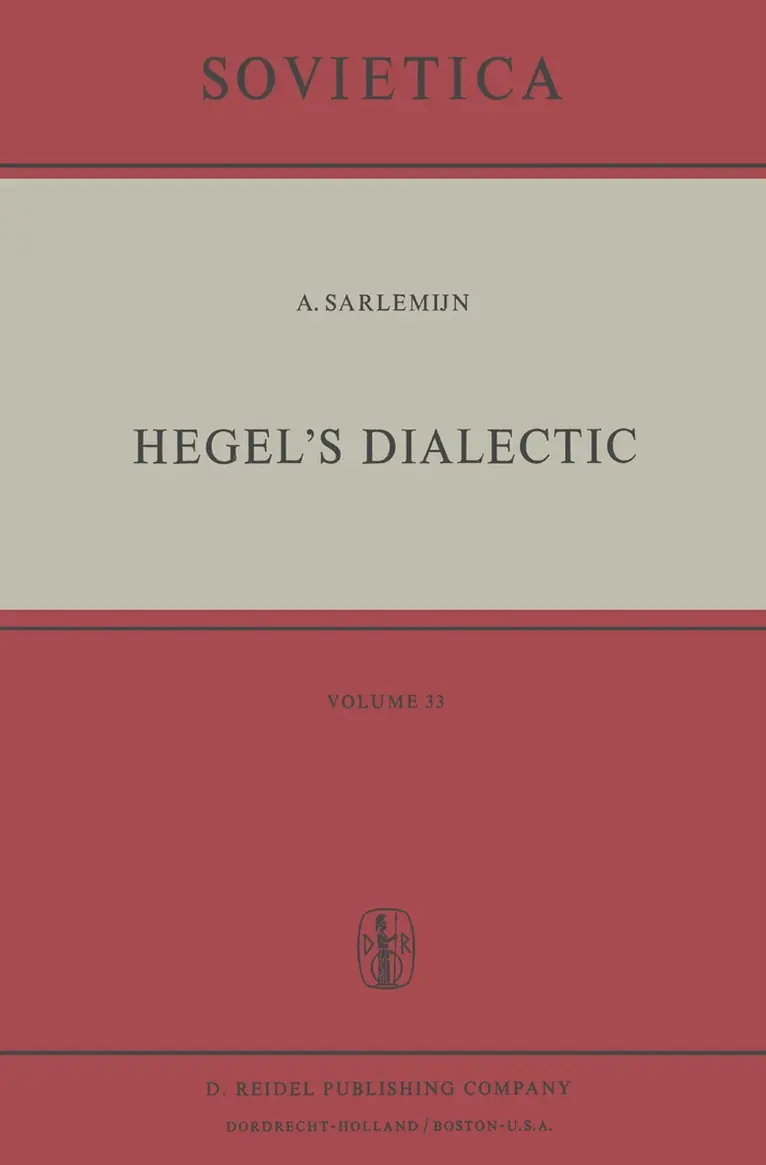
This book was written in 1968, and defended as a doctoral dissertation before the Philosophical Faculty at the University of Fribourg (Switzerland) in 1969. It treats of the systematic views of Hegel which led him to give to the princi ple of non-contradiction, the principle of double negation, and the principle of excluded middle, meanings which are difficult to understand. The reader will look in vain for the philosophical position of the author. A few words about the intentions which motivated the author to study and clarify Hegel''s thought are therefore not out of place. In the early sixties, when occupying myself with the history of Marxist philosophy, I discovered that the representatives of the logical-positivist tra dition were not alone in employing a principle of demarcation; that those of the dialectical Marxist tradition were also using such a principle (''self-move ment'') as a foundation of a scientific philosophy and as a means to delimit unscientific ideas. I aimed at a clear conception of this principle in order to be able to judge whether, and to what extent, it accords with the foundations of the analytical method. In this endeavor I encountered two problems: (1) What is to be understood by ''analytical method'' cannot be ascertained un equivocally.
Del 33 - Sovietica
Hegel’s Dialectic
Translated from the German by Peter Kirschemann
Häftad, Engelska, 2011
543 kr
Skickas inom 10-15 vardagar
This book was written in 1968, and defended as a doctoral dissertation before the Philosophical Faculty at the University of Fribourg (Switzerland) in 1969. It treats of the systematic views of Hegel which led him to give to the princi ple of non-contradiction, the principle of double negation, and the principle of excluded middle, meanings which are difficult to understand. The reader will look in vain for the philosophical position of the author. A few words about the intentions which motivated the author to study and clarify Hegel's thought are therefore not out of place. In the early sixties, when occupying myself with the history of Marxist philosophy, I discovered that the representatives of the logical-positivist tra dition were not alone in employing a principle of demarcation; that those of the dialectical Marxist tradition were also using such a principle ('self-move ment') as a foundation of a scientific philosophy and as a means to delimit unscientific ideas. I aimed at a clear conception of this principle in order to be able to judge whether, and to what extent, it accords with the foundations of the analytical method. In this endeavor I encountered two problems: (1) What is to be understood by 'analytical method' cannot be ascertained un equivocally.