Abraham Boekestein – författare
Visar alla böcker från författaren Abraham Boekestein. Handla med fri frakt och snabb leverans.
2 produkter
2 produkter
Häftad, Engelska, 1992
545 kr
Skickas inom 10-15 vardagar
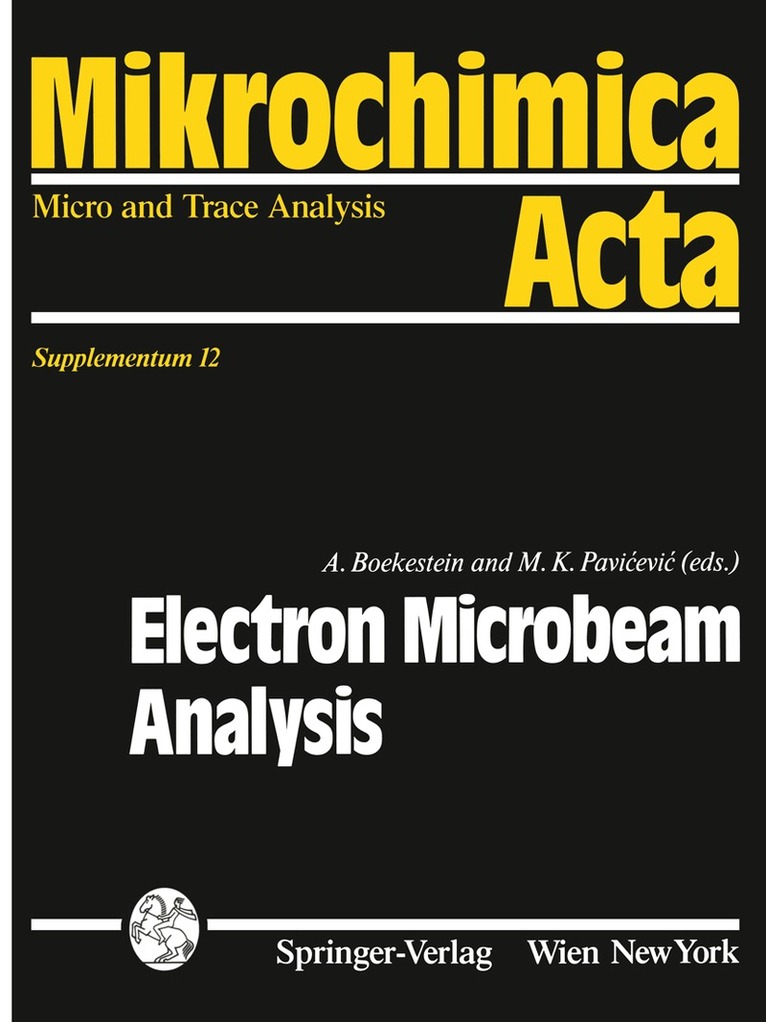
This volume treats the different methods used in electron microbeam analysis. The volume consists of five tutorial chapters which give an overview and an in-depth analysis of a particular section of electron microbeam analysis. In these chapters the state of the art technology is described together with the major obstacles which remain and a future outlook. Further, 25 brief articles are included which form the condensed scientific information of a poster session during the 2nd workshop of the European Microbeam Analysis Society held in Dubrovnik, May 1991. In this volume there are different categories of electron microbeam analysis (Electron probe microanalysis (EPMA), electron energy loss spectrometry (EELS) and Auger electron spectroscopy (AES)) intensively linked and discussed together. The versatility in the use of electron microbeams in chemical-analytical work is emphasized. The approach is strongly inititated from a methodological point of view: How are data derived and how can methods be improved further. The reliability of the particular method comes on the first place.The benefits to potential readers of this book is the state of the art overview which is enclosed in the tutorial papers and which are exemplified to some extent in the brief articles.
E-bok
PDF, Engelska, 2012687 kr
Läs direkt efter köp
This supplement of Mikrochimica Acta contains selected papers from the Second Workshop of the European Microbeam Analysis Society (EMAS) "Modern Developments and Applications in Microbeam Analysis", on which took place in May 1991 in Dubrovnik (Yugoslavia). EMAS was founded in 1987 by members from almost all European countries, in order to stimulate research, applications and development of all forms of microbeam methods. One of the most important activities EMAS is the organisation of biannual workshops for demonstrating the current status and developing trends of microbeam methods. For this meeting, EMAS chose to highlight the following topics: electron-beam microanalysis (EPMA) of thin films and quantitative analysis of ultra-light elements, Auger electron spectroscopy (AES), electron energy loss spec trometry (EELS), high-resolution transmission electron microscopy (HRTEM), quantitative analysis of biological samples and standard-less electron-beam microanalysis. Seven introductory lectures and almost seventy poster presentations were given by speakers from twelve European and two non-European (U.S.A. and Argentina) countries were made. One cannot assume that all fields of research in Europe were duly represented, but a definite trend is discernible. EPMA with wavelength-dispersive spectrometry (WDS) or energy-dispersive spectrometry (EDS) is the method with by far the widest range of applications, followed by TEM with EELS and then AES. There are also interesting suggestions for the further development of new appa ratus with new fields of application. Applications are heavily biased towards materials science (thin films in microelectronics and semicon ductors), ceramics and metallurgy, followed by analysis of biological and mineral samples.