
Adriana Michele Campos Johnson – författare
Visar alla böcker från författaren Adriana Michele Campos Johnson. Handla med fri frakt och snabb leverans.
3 produkter
3 produkter
746 kr
Skickas inom 5-8 vardagar
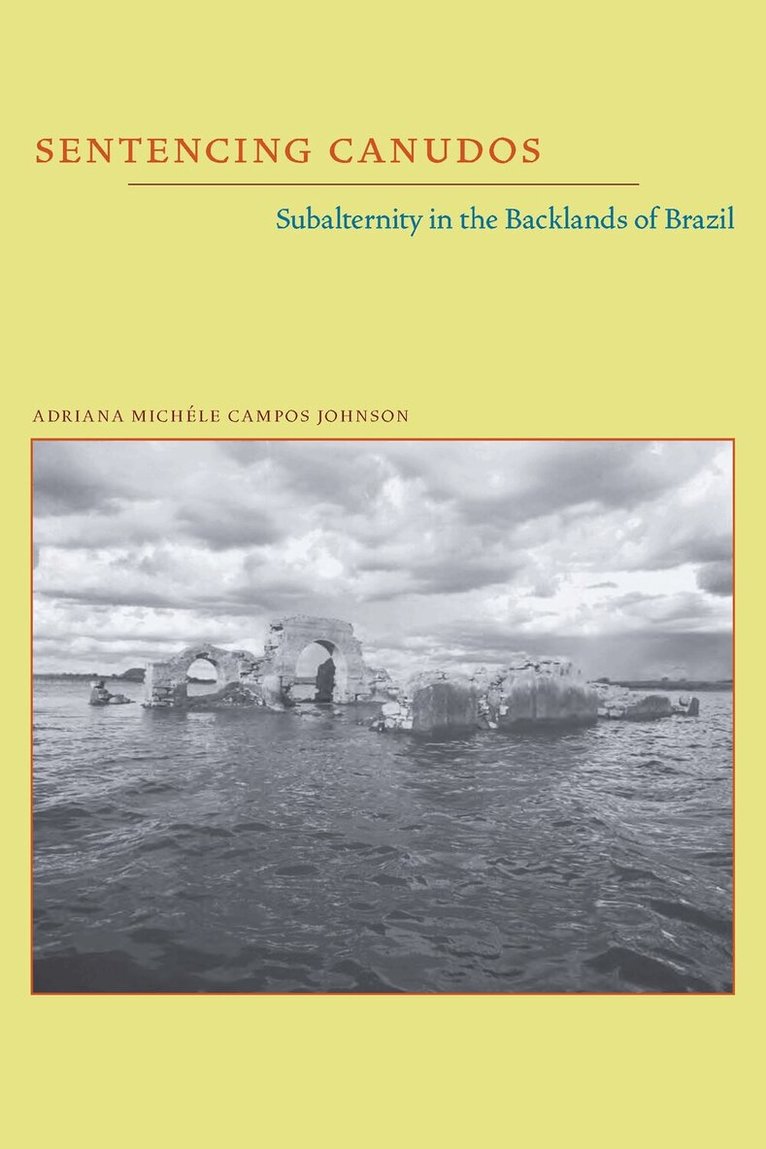
In the late nineteenth century, the Brazilian army staged several campaigns against the settlement of Canudos in northeastern Brazil. The colonyÆs residents, primarily disenfranchised former slaves, mestizos, landless farmers, and uprooted Indians, followed a man known as Antonio Conselheiro (\u201cThe Counselor\u201d), who promoted a communal existence, free of taxes and oppression. To the fledgling republic of Brazil, the settlement represented a threat to their system of government, which had only recently been freed from monarchy. Estimates of the death toll at Canudos range from fifteen thousand to thirty thousand. Sentencing Canudos offers an original perspective on the hegemonic intellectual discourse surrounding this monumental event in Brazilian history. In her study, Adriana Michele Campos Johnson offers a close examination of nation building and the silencing of \u201cother\u201d voices through the reinvisioning of history. Looking primarily to Euclides da CunhaÆs Os Sert\u00f5es, which has become the defining—and nearly exclusive—account of the conflict, she maintains that the events and people of Canudos have been \u201csentenced\u201d to history by this work. Johnson investigates other accounts of Canudos such as local oral histories, letters, newspaper articles, and the writings of CunhaÆs contemporaries, Afonso Arinos and Manoel Ben\u00edcio, in order to strip away political agendas. She also seeks to place the inhabitants and events of Canudos within the realm of \u201ceverydayness\u201d by recalling aspects of daily life that have been left out of official histories.Johnson analyzes the role of intellectuals in the process of culture and state formation and the ensuing sublimation of subaltern histories and populations. She echoes recent scholarship that posits subalternity as the product of discourse that must be disputed in order to recover cultural identities and offers a view of Canudos and postcolonial Latin America as a place to think from, not about.

1 007 kr
Kommande
Examining the interplay of visuality and infrastructure in Latin American films.Images do far more than we realize. They do not simply represent or depict; they run our world. Surveillance cameras and drones, medical imaging, social media platforms, market-data visualization––these and other technologies make the image an infrastructure of power, a tool for organizing and governing, impressing labor and extracting value.Adriana Johnson draws on the medium of film to sensitize us to the logics of visuality as a technology of power. In particular, Latin American cinema presents a key site for both crystallizing and retreating from these logics. Through close readings of Argentine, Paraguayan, and Brazilian movies—including the documentary Bus 174, the dystopian sci-fi The Aerial,and the farcical The Gold Bug—Johnson shows how filmmakers can amplify or attenuate the infrastructural reach of visuality. They also reveal visuality's otherwise-submerged power, and even engage in something like piracy: hacking into, rerouting, and deconstituting the workings of visual infrastructures. A deeply insightful and theoretically rich account, Cinema as Infrastructure reframes the political stakes of filmmaking in an era when visual forms have become means of production and order.
366 kr
Kommande
Examining the interplay of visuality and infrastructure in Latin American films.Images do far more than we realize. They do not simply represent or depict; they run our world. Surveillance cameras and drones, medical imaging, social media platforms, market-data visualization––these and other technologies make the image an infrastructure of power, a tool for organizing and governing, impressing labor and extracting value.Adriana Johnson draws on the medium of film to sensitize us to the logics of visuality as a technology of power. In particular, Latin American cinema presents a key site for both crystallizing and retreating from these logics. Through close readings of Argentine, Paraguayan, and Brazilian movies—including the documentary Bus 174, the dystopian sci-fi The Aerial,and the farcical The Gold Bug—Johnson shows how filmmakers can amplify or attenuate the infrastructural reach of visuality. They also reveal visuality's otherwise-submerged power, and even engage in something like piracy: hacking into, rerouting, and deconstituting the workings of visual infrastructures. A deeply insightful and theoretically rich account, Cinema as Infrastructure reframes the political stakes of filmmaking in an era when visual forms have become means of production and order.