Aeneas Tacticus – författare
Visar alla böcker från författaren Aeneas Tacticus. Handla med fri frakt och snabb leverans.
6 produkter
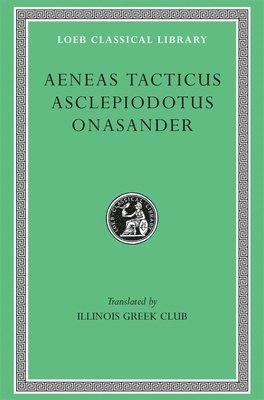
Aeneas Tacticus. Asclepiodotus. Onasander
Av Aeneas Tacticus, Asclepiodotus m. fl.
Inbunden, 1923
4,0 utav 5 stjärnor. Totalt antal röster: (1)
373 kr
Lägg i varukorg
Three tactical treatises.Aeneas was perhaps a general, and certainly author of several didactic military works of which the sole survivor is that on defense against siege. From it we can deduce that he was a Peloponnesian of the fourth century BC who served in the Aegean and in Asia Minor and …
How to Survive Under Siege
Av Aeneas Tacticus, Aineias Tacitus
Häftad, 2002
431 kr
Lägg i varukorg
Aineias Tacticus (mid-fourth century BC) is not only the earliest but also one of the most historically interesting of ancient military writers. Important, too, as a social commentator, he sheds valuable light on the nature of life and the psychological and strategic preoccupations of a typical …
Stadtverteidigung / Poliorketika
Griechisch - deutsch
Av Aeneas Tacticus, Kai Brodersen
E-bok, 2017
536 kr
Lägg i varukorg
Griechische Kriegsschriftsteller
Zweiter Theil
Av Hermann Köchly, Aeneas (Tacticus) m. fl.
Inbunden, 2022
499 kr
Tillfälligt slut
Griechische Kriegsschriftsteller
Zweiter Theil
Av Hermann Köchly, Aeneas (Tacticus) m. fl.
Häftad, 2022
382 kr
Tillfälligt slut
Stadtverteidigung / Poliorketika
Griechisch - Deutsch
Av Aeneas Tacticus, Kai Brodersen
Inbunden, 2017
482 kr
Tillfälligt slut