Aitor Blanco-Pérez – författare
Visar alla böcker från författaren . Handla med fri frakt och snabb leverans.
2 produkter
2 produkter
Inbunden, Engelska, 2026
1 447 kr
Kommande
Asia Minor and the Third Century CE: The Epigraphic Continuity of Civic Life in a Changing Roman Empire examines the inscriptions of southern and western Anatolia from the accession of Septimius Severus to the rise of Diocletian (193-284 CE). During these years of pivotal transition between the High and Late Roman Empire, scholarship has often characterised the period as one defined by systemic crisis and civic decline. It is frequently argued that such instability eroded the foundations of local governance, leaving provincial populations either unwilling or unable to sustain the financial and political burdens of civic life. However, this study moves beyond a binary attempt to confirm or deny the existence of a 'third-century crisis'. Instead, it provides a comprehensive analysis of the diverse testimonies that these political communities under Roman rule continued to produce and display publicly. By situating this habit within its broader socio-political context, the work undertakes a significant re-evaluation of the epigraphic evidence alongside related materials, including coins and literary sources, from cities and regions such as Ephesus, Aphrodisias, Termessos, Lydia, or Pamphylia. Rather than witnessing a collapse of traditional structures and civic mindsets, the available record reveals a notable resilience in communal action across Asia Minor. Ultimately, this analysis invites a reconsideration of the third century CE, highlighting the enduring vitality of a region that proved fundamental to a changing Roman Empire.
E-bok
PDF, Engelska, 2019637 kr
Läs direkt efter köp
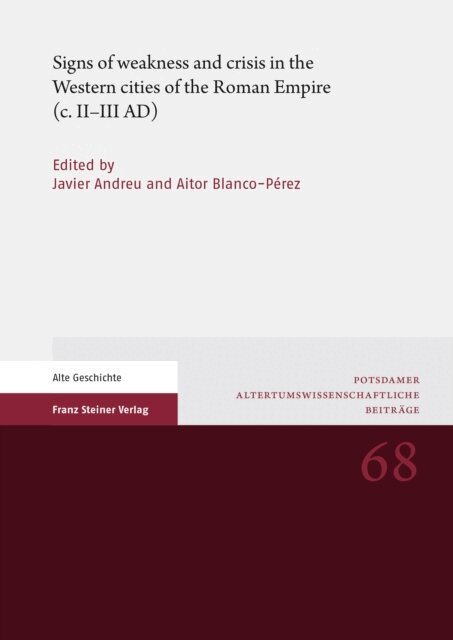
At the end of the 2nd century AD the urban network of the Roman Empire was subject to weakness and crisis. We know this on one hand through decrees from the Flavian era, comments of Pliny the Younger on the financial problems of some cities and on the other hand through notices in the Historia Augusta reporting the existence of oppida labentia -"e;cities in decline"e;.In this volume, we discuss some of these issues with the following questions: was the municipal system, at least in the Roman West and, particularly in Roman Spain, a useful and sustainable model of managing local autonomy? Was it a durable system? Were new cities more fragile than others in terms of financial sustainability? What were the causes and the indicators signalling the lack of strength of many urban centres from the 2nd century AD onwards?