Ajoy K. Datta – författare
Visar alla böcker från författaren Ajoy K. Datta. Handla med fri frakt och snabb leverans.
4 produkter
4 produkter
Häftad, Engelska, 2001
545 kr
Skickas inom 10-15 vardagar
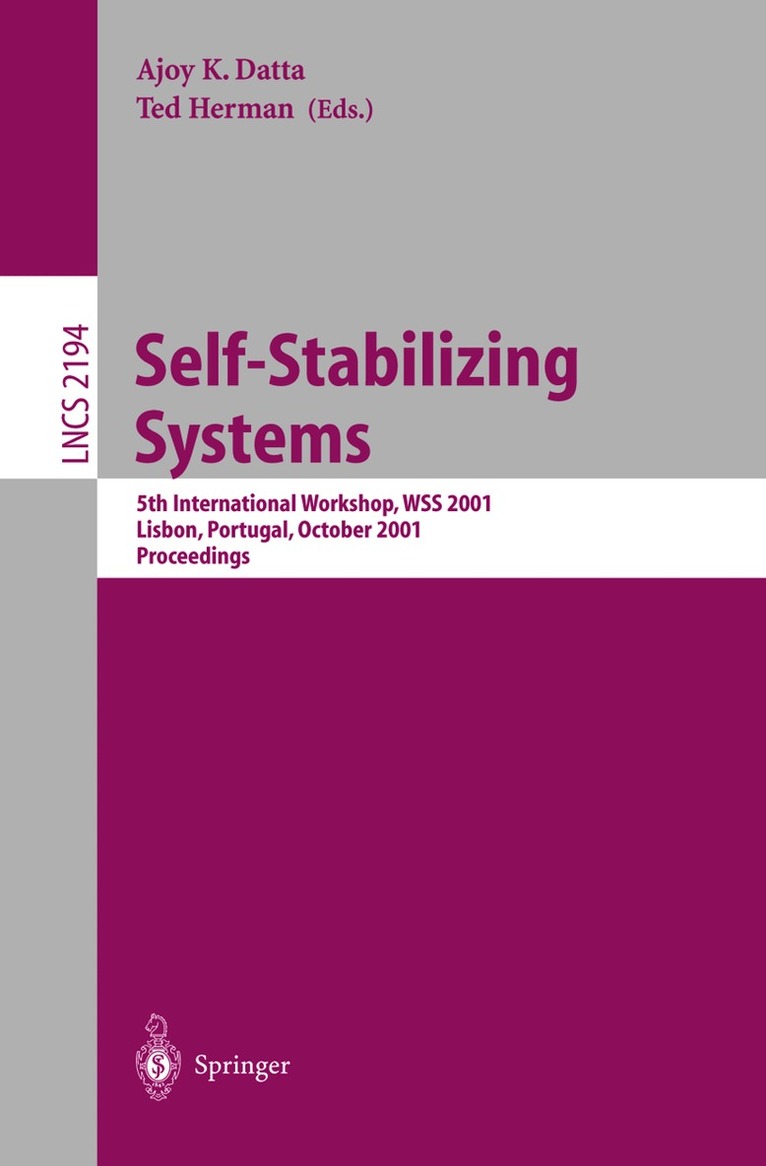
Physicalsystemswhichrightthemselvesafterbeingdisturbedevokeourcuriosity becausewe wantto understand howsuchsystemsareableto reactto unexpected stimuli. Themechanismsareallthe morefascinatingwhensystemsarecomposed of small, simple units, and the ability of the system to self-stabilize emerges out of its components. Faithful computer simulations of such physical systems exhibit the self-stabilizing property, but in the realm of computing, particularly for distributed systems, wehavegreaterambition. We imaginethat all manner of software, ranging from basic communication protocols to high-level applications, could enjoy self-corrective properties. Self-stabilizing software o?ers a unique, non-traditional approach to the c- cial problem of transient fault tolerance. Many successful instances of modern fault-tolerant networks are based on principles of self-stabilization. Surprisingly, the most widely accepted technical de?nition of a self-stabilizing system does not refer to faults: it is the property that the system can be started in any i- tial state, possibly an “illegal state,” and yet the system guarantees to behave properly in ?nite time. This, and similar de?nitions, break many traditional approaches to program design, in which the programmer by habit makes - sumptions about initial conditions. The composition of self-stabilizing systems, initially seen as a daunting challenge, has been transformed into a mana- able task, thanks to an accumulation of discoveries by many investigators. - search on various topics in self-stabilization continues to supply new methods for constructing self-stabilizing systems, determines limits and applicability of the paradigm of self-stabilization, and connects self-stabilization to related areas of fault tolerance anddistributed computing.
E-bok
PDF, Engelska, 2001712 kr
Läs direkt efter köp
Physicalsystemswhichrightthemselvesafterbeingdisturbedevokeourcuriosity becausewe wantto understand howsuchsystemsareableto reactto unexpected stimuli. Themechanismsareallthe morefascinatingwhensystemsarecomposed of small, simple units, and the ability of the system to self-stabilize emerges out of its components. Faithful computer simulations of such physical systems exhibit the self-stabilizing property, but in the realm of computing, particularly for distributed systems, wehavegreaterambition. We imaginethat all manner of software, ranging from basic communication protocols to high-level applications, could enjoy self-corrective properties. Self-stabilizing software o?ers a unique, non-traditional approach to the c- cial problem of transient fault tolerance. Many successful instances of modern fault-tolerant networks are based on principles of self-stabilization. Surprisingly, the most widely accepted technical de?nition of a self-stabilizing system does not refer to faults: it is the property that the system can be started in any i- tial state, possibly an “illegal state,” and yet the system guarantees to behave properly in ?nite time. This, and similar de?nitions, break many traditional approaches to program design, in which the programmer by habit makes - sumptions about initial conditions. The composition of self-stabilizing systems, initially seen as a daunting challenge, has been transformed into a mana- able task, thanks to an accumulation of discoveries by many investigators. - search on various topics in self-stabilization continues to supply new methods for constructing self-stabilizing systems, determines limits and applicability of the paradigm of self-stabilization, and connects self-stabilization to related areas of fault tolerance anddistributed computing.
Häftad, Engelska, 2006
1 116 kr
Skickas inom 10-15 vardagar
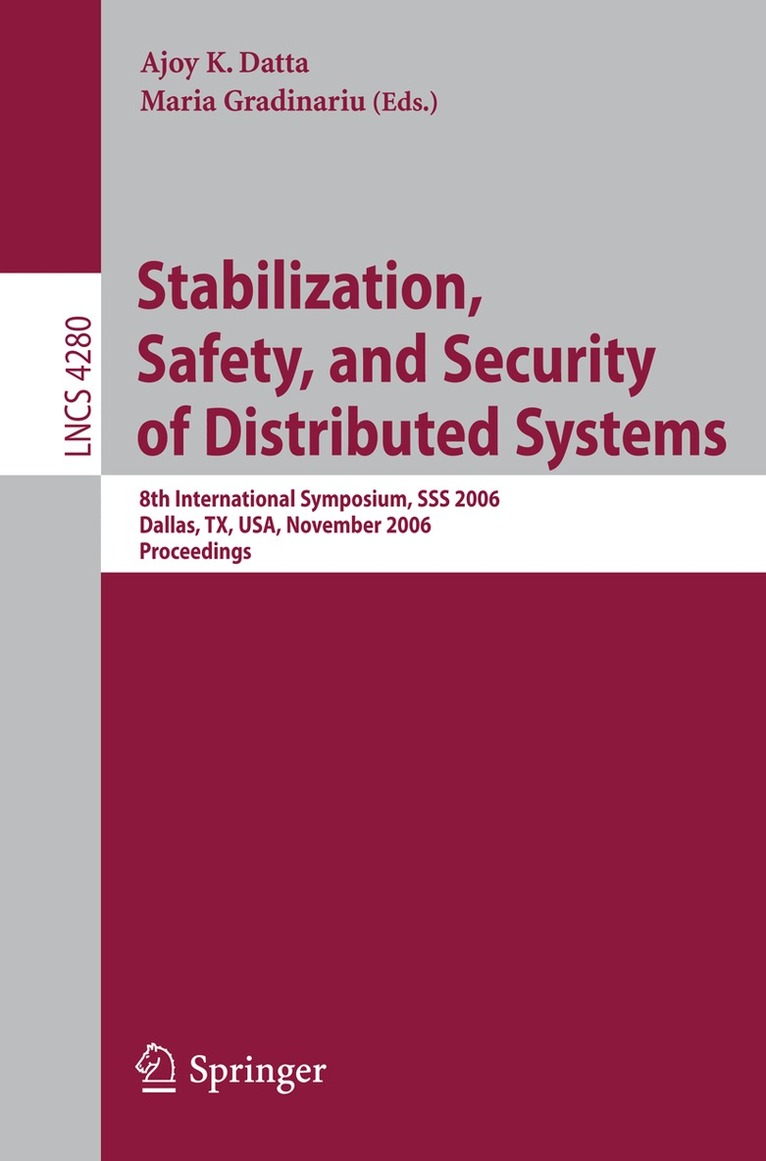
This symposium has been the main forum for presentation of research results in the area of self-* for 17 years. It started as The Workshop on Self-Stabilizing Systems (WSS), and met in 1989 in Austin, 1995 in Las Vegas, 1997 in Santa Barbara, 1999 in Austin, and 2001 in Lisbon. It was then renamed The S- posium on Self-Stabilizing Systems (SSS), and has since met in 2003 in San Francisco, and in 2005 in Barcelona, Spain. This year,we extended the scope of the symposium to cover all safety and - curity related aspects of self-* systems. The title of the symposium was changed to the International Symposium on Stabilization, Safety, and Security of D- tributed Systems (SSS) to re?ect this expansion. The decision by Mohamed Gouda, the General Chair, to expand the scope of the symposium was timely and successful. From 33 papers submitted for SSS 2005, the number of submissions increased to 155. Reviewing this surge of s- missions to select the ?nal set of papers for the symposium was a monumental taskfor the ProgramCommittee. The 61 ProgramCommittee membersdevoted countless hours reading and evaluating the papers. But even this e?ort was not enough; we recruited 143 external reviewers, whose work was also very subst- tial.
E-bok
PDF, Engelska, 20071 420 kr
Läs direkt efter köp
This symposium has been the main forum for presentation of research results in the area of self-* for 17 years. It started as The Workshop on Self-Stabilizing Systems (WSS), and met in 1989 in Austin, 1995 in Las Vegas, 1997 in Santa Barbara, 1999 in Austin, and 2001 in Lisbon. It was then renamed The S- posium on Self-Stabilizing Systems (SSS), and has since met in 2003 in San Francisco, and in 2005 in Barcelona, Spain. This year,we extended the scope of the symposium to cover all safety and - curity related aspects of self-* systems. The title of the symposium was changed to the International Symposium on Stabilization, Safety, and Security of D- tributed Systems (SSS) to re?ect this expansion. The decision by Mohamed Gouda, the General Chair, to expand the scope of the symposium was timely and successful. From 33 papers submitted for SSS 2005, the number of submissions increased to 155. Reviewing this surge of s- missions to select the ?nal set of papers for the symposium was a monumental taskfor the ProgramCommittee. The 61 ProgramCommittee membersdevoted countless hours reading and evaluating the papers. But even this e?ort was not enough; we recruited 143 external reviewers, whose work was also very subst- tial.