Alan Dearle – författare
Visar alla böcker från författaren Alan Dearle. Handla med fri frakt och snabb leverans.
6 produkter
6 produkter
Häftad, Engelska, 2005
560 kr
Skickas inom 10-15 vardagar
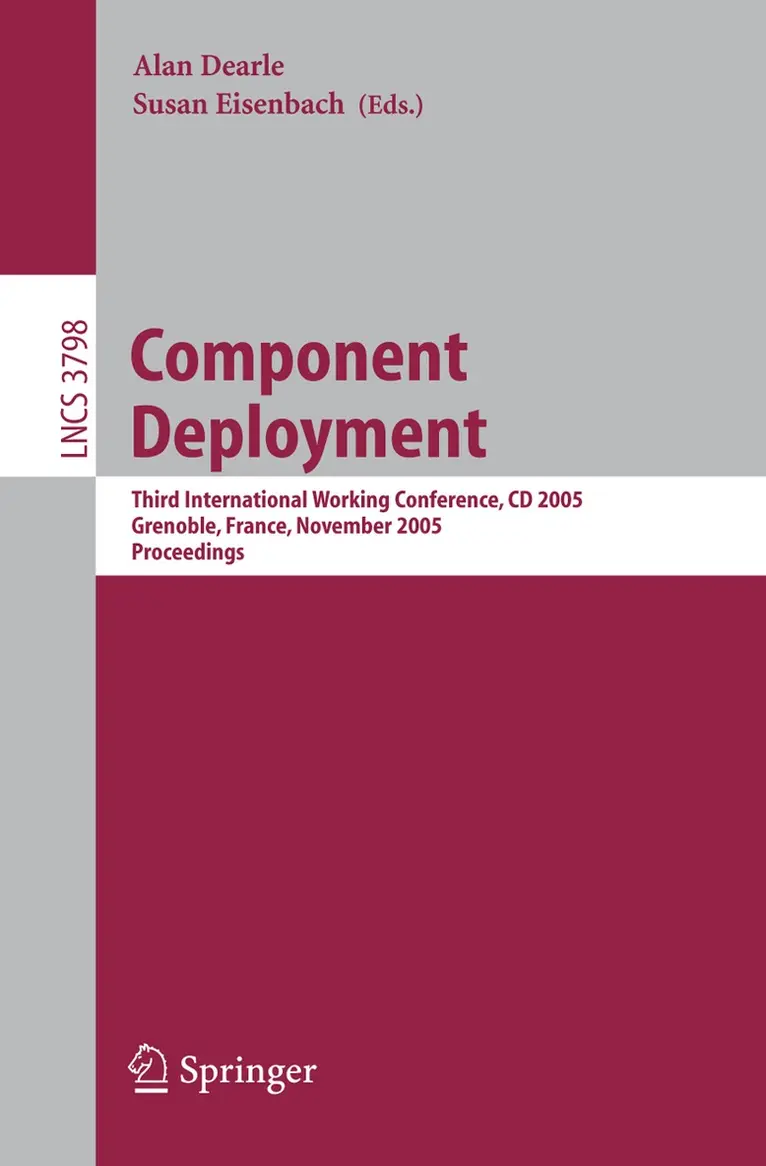
This volume of Lecture Notes in Computer Science contains the proceedings of the rd 3 Working Conference on Component Deployment (CD 2005), which took place from 28 to 29, November 2005 in Grenoble, France, and co-located with Middleware 2005. CD 2005 is the third international conference in the series, the first two being held in Berlin and Edinburgh in 2002 and 2004, respectively. The proceedings of both these conferences were also published by Springer in the Lecture Notes in Computer Science series and may be found in volumes 2370 and 3083. Component deployment addresses the tasks that need to be performed after components have been developed and addresses questions such as: • What do we do with components after they have been built? • How do we deploy them into their execution environment? • How can we evolve them once they have been deployed? CD 2005 brought together researchers and practitioners with the goal of deve- ping a better understanding of how deployment takes place in the wider context. The Program Committee selected 15 papers (12 long papers, three short papers) out of 29 submissions. All submissions were reviewed by at least three members of the Program Committee. Papers were selected based on originality, quality, soundness and relevance to the workshop.
E-bok
PDF, Engelska, 2005734 kr
Läs direkt efter köp
This volume of Lecture Notes in Computer Science contains the proceedings of the rd 3 Working Conference on Component Deployment (CD 2005), which took place from 28 to 29, November 2005 in Grenoble, France, and co-located with Middleware 2005. CD 2005 is the third international conference in the series, the first two being held in Berlin and Edinburgh in 2002 and 2004, respectively. The proceedings of both these conferences were also published by Springer in the Lecture Notes in Computer Science series and may be found in volumes 2370 and 3083. Component deployment addresses the tasks that need to be performed after components have been developed and addresses questions such as: • What do we do with components after they have been built? • How do we deploy them into their execution environment? • How can we evolve them once they have been deployed? CD 2005 brought together researchers and practitioners with the goal of deve- ping a better understanding of how deployment takes place in the wider context. The Program Committee selected 15 papers (12 long papers, three short papers) out of 29 submissions. All submissions were reviewed by at least three members of the Program Committee. Papers were selected based on originality, quality, soundness and relevance to the workshop.
Häftad, Engelska, 2001
560 kr
Skickas inom 10-15 vardagar
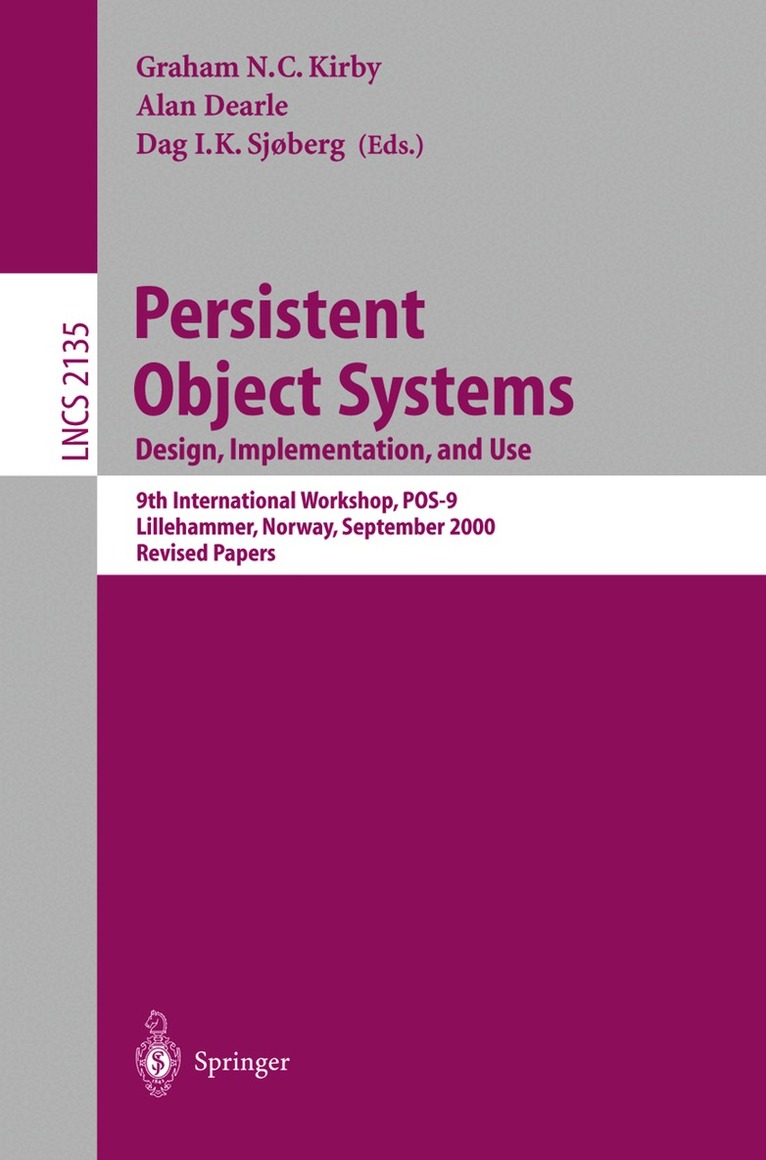
The Ninth International Workshop on Persistent Object Systems (POS 9) took place at the SAS Radisson Hotel in Lillehammer, Norway, from 6th to 8th September 2000. Previous workshops in the series have been held in Scotland (1 and 2), Australia (3), the USA (4), Italy (5), France (6), and the USA (7 and 8). In keeping with those workshops, POS 9 was short but intensive, fitting 28 papers and panel sessions, a boat 1 excursion, and some memorable meals into two and a half days. The participants’ concentration was no doubt helped by the Northern European weather that prevailed for most of the workshop. Continuing a trend experienced over the previous few workshops, POS 9 had difficulty attracting a high number of papers. Of course it is hard to tell whether this is a problem with the field of persistent systems itself, or merely a consequence of the increasing number of workshops, conferences, and journals competing for submissions. In his Epilogue to the proceedings, Ron Morrison makes some interesting suggestions for possible improvements to future POS workshops. Out of a total of 26 submitted papers, 19 were accepted for presentation at the 2 workshop. Breaking down by region, 6 1/2 came from the USA , 1 from Africa, 3 1/2 from Australia, and 8 from Europe. In a new development for POS, an equal number of papers came from England and from Scotland.
E-bok
PDF, Engelska, 2003734 kr
Läs direkt efter köp
The Ninth International Workshop on Persistent Object Systems (POS 9) took place at the SAS Radisson Hotel in Lillehammer, Norway, from 6th to 8th September 2000. Previous workshops in the series have been held in Scotland (1 and 2), Australia (3), the USA (4), Italy (5), France (6), and the USA (7 and 8). In keeping with those workshops, POS 9 was short but intensive, fitting 28 papers and panel sessions, a boat 1 excursion, and some memorable meals into two and a half days. The participants’ concentration was no doubt helped by the Northern European weather that prevailed for most of the workshop. Continuing a trend experienced over the previous few workshops, POS 9 had difficulty attracting a high number of papers. Of course it is hard to tell whether this is a problem with the field of persistent systems itself, or merely a consequence of the increasing number of workshops, conferences, and journals competing for submissions. In his Epilogue to the proceedings, Ron Morrison makes some interesting suggestions for possible improvements to future POS workshops. Out of a total of 26 submitted papers, 19 were accepted for presentation at the 2 workshop. Breaking down by region, 6 1/2 came from the USA , 1 from Africa, 3 1/2 from Australia, and 8 from Europe. In a new development for POS, an equal number of papers came from England and from Scotland.
Häftad, Engelska, 2010
560 kr
Skickas inom 10-15 vardagar
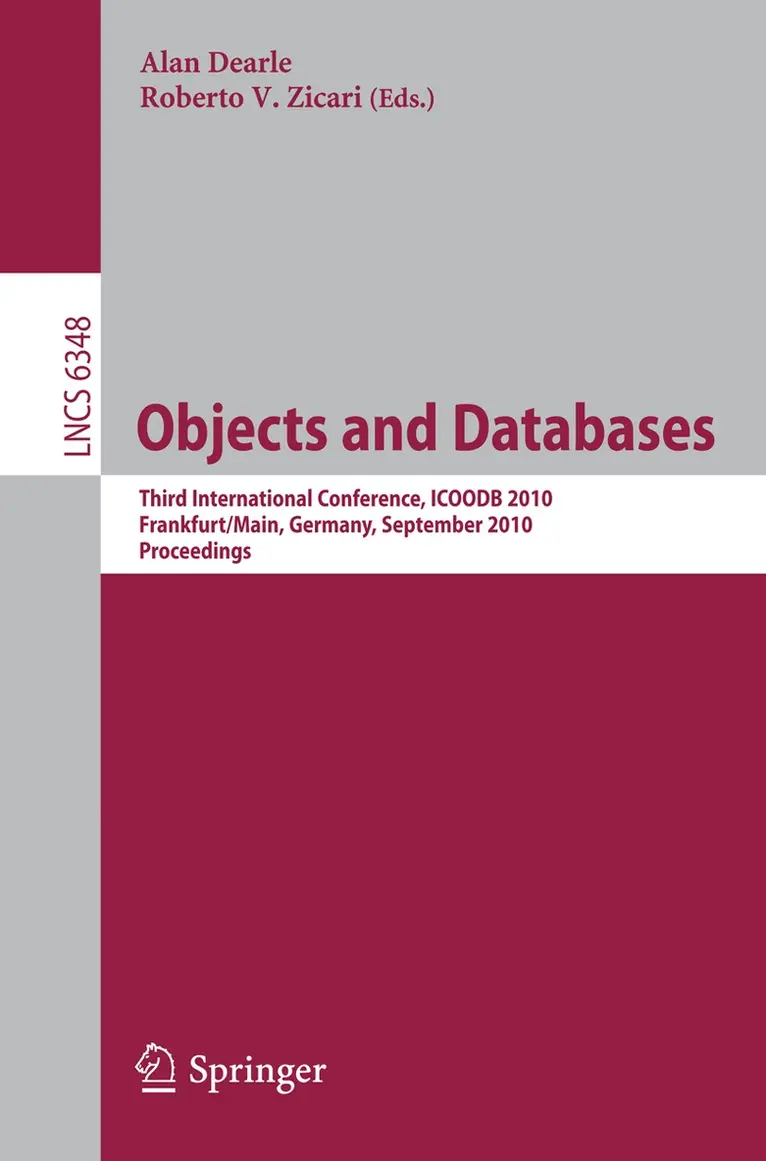
AccordingtoFrancoisBancillonandWonKim[SIGMODRECORD,Vol.19,No. 4, December 1990], object-oriented databases started in around 1983. Twen- seven years later this publication contains the proceedings of the Third Inter- tional Conference on Object-Oriented Databases (ICOODB 2010). Two questions arise from this – why only the third, and what is of interest in the ?eld of object-oriented databases in 2010? The ?rst question is easy – in the 1980s and 1990s there were a number of conferences supporting the c- munity – the International Workshops on Persistent Object Systems started by Malcolm Atkinson and Ron Morrison, the EDBT series, and the International Workshop on Database Programming Languages. These database-oriented c- ferences complimented other OO conferences including OOPSLA and ECOOP, but towards the end of the last century they dwindled in popularity and ev- tually died out. In 2008 the First International Conference on Object Databases was held in Berlin. In 2009 the second ICOODB conference was held at the ETH in Zurich as a scienti?c peer-reviewed conference. What is particular about ICOODB is that the conference series was est- lished to address the needs of both industry and researcherswho had an interest in object databases, in innovative ways to bring objects and databases together and in alternatives/extensions to relational databases. The ?rst conference set the mould for those to follow – a combination of theory and practice with one day focusing on the theory of object databases and the second focusing on their practical use and implementation.
E-bok
PDF, Engelska, 2010734 kr
Läs direkt efter köp
AccordingtoFrancoisBancillonandWonKim[SIGMODRECORD,Vol.19,No. 4, December 1990], object-oriented databases started in around 1983. Twen- seven years later this publication contains the proceedings of the Third Inter- tional Conference on Object-Oriented Databases (ICOODB 2010). Two questions arise from this – why only the third, and what is of interest in the ?eld of object-oriented databases in 2010? The ?rst question is easy – in the 1980s and 1990s there were a number of conferences supporting the c- munity – the International Workshops on Persistent Object Systems started by Malcolm Atkinson and Ron Morrison, the EDBT series, and the International Workshop on Database Programming Languages. These database-oriented c- ferences complimented other OO conferences including OOPSLA and ECOOP, but towards the end of the last century they dwindled in popularity and ev- tually died out. In 2008 the First International Conference on Object Databases was held in Berlin. In 2009 the second ICOODB conference was held at the ETH in Zurich as a scienti?c peer-reviewed conference. What is particular about ICOODB is that the conference series was est- lished to address the needs of both industry and researcherswho had an interest in object databases, in innovative ways to bring objects and databases together and in alternatives/extensions to relational databases. The ?rst conference set the mould for those to follow – a combination of theory and practice with one day focusing on the theory of object databases and the second focusing on their practical use and implementation.