Alec Riley – författare
519 kr
Skickas inom 5-8 vardagar
255 kr
Skickas inom 5-8 vardagar
326 kr
Läs direkt efter köp
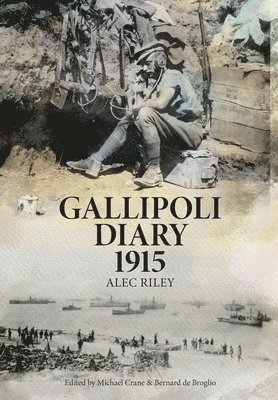
"We had a look around, through periscopes, at the remains of recent fighting. The dead were on top, and we, the living, were below the general ground-level. The usual order of life and death were reversed."
So wrote Alec Riley in his account of an ordinary soldier in an extraordinary conflict, the Gallipoli Campaign of 1915.
A signaller with the 42nd (East Lancashire) Division, Riley was well placed to serve as an eyewitness to the sharp end of the campaign, being with the infantry but not of it. His task, and that of the small unit he served with and whose story he tells, was to maintain communications between the forward trenches and senior commanders in the rear, a conduit for at times unrealistic orders one way, and all-too-real situation reports the other.
During his time on the peninsula, Riley kept meticulous notes, which form the basis of this account. He also took his camera to war, the resulting photos - some of which were used in the British official history of the campaign - flesh out his detailed story of life in and behind the lines.
After four months on the peninsula, suffering from jaundice, septic sores and dysentery, Riley was evacuated sick, destined first for Mudros and then Blighty. He made sure to save his diary and camera.
Although Gallipoli had done for Riley, Riley was not done with Gallipoli. Even while on the peninsula, he and his comrades had looked beyond the war.
"We tried to imagine what the place would be like when the armies had gone. Achi Baba would be green again, the trenches would fall in and flatten; communication-trenches, through which thousands of men had passed, would be long and shallow depressions, and frogs and tortoises the only inhabitants of gully and nullah."
Remarkably, Alec Riley returned to find out, revisiting the peninsula at least twice. In 1930, he spent ten days wandering across the now overgrown fields of battle on a lone pilgrimage, revisiting places he knew intimately 15 years before.
This pilgrimage, and a subsequent second visit, was intended to form the basis of a book, again illustrated with his trusty camera. Sadly, the original manuscript has been lost. But the editors have identified two extracts that appeared in print, which they present alongside a faithful transcript of Riley''s diary and notes.
Also included is an unpublished introduction by General Sir Ian Hamilton, commander of the Mediterranean Expeditionary Force of which Riley had been a small part, and with whom Riley had a decade-long correspondence.
Chapters on the flora, fauna, and geography of the peninsula, along with its history modern and ancient, formed part of Riley''s guide to the battlefields. They provide useful context for today''s visitors to Gallipoli.
The editors of the diary, Michael Crane and Bernard de Broglio, have added copious footnotes and detailed biographical notes on the officers and men who come to life in Riley''s writings, as well as an order of battle and summary of arms for the 42nd Division at Gallipoli. Fourteen maps illustrate the actions, large and small, that Riley describes, alongside 47 black and white photographs showing the battlefield in 1915 and 1930.
Gallipoli Diary 1915 offers the reader a rare perspective on the Gallipoli campaign. Alec Riley saw Helles in war, and returned to explore what remained when the armies had gone.
428 kr
Skickas inom 5-8 vardagar
247 kr
Skickas inom 5-8 vardagar
330 kr
Läs direkt efter köp
"From a ground-floor room at the end of one block shone a light. It came from a canteen. I saw others were busy while I was lowering a pint of shandy. I was so dry that I could not taste it-I could only just feel it. We felt better. Where there was beer there was hope."
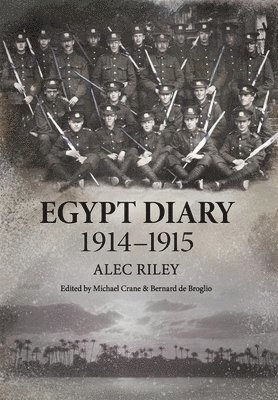
Alec Riley was a signaller in the British Army''s 42nd (East Lancashire) Division. Egypt Diary 1914-1915 tells of the mobilisation of the division at the outbreak of war, and the territorials'' eight-month-long period of training and garrison duty in Egypt prior to being deployed to Gallipoli. It brings to life the strange and exotic sights met by the Lancashire lads, most of whom had previously travelled no further than the annual camps held in North Wales.
Written in Alec Riley''s dry style, the diary relates with wit and humour the many fascinating experiences and events Riley and his comrades encountered. Interactions with Egyptian locals are interspersed with Riley''s acute (and at times subversive) observations of his own officers. Desert marches, exercises and various mundane duties are recorded, as well as measures taken to guard canteens against Australian raiding parties.
The book is lavishly illustrated with contemporary soldiers'' photographs of Egypt and four specially-produced maps. The editors, Michael Crane and Bernard de Broglio, have added extensive footnotes and detailed biographies of almost 40 officers and men who come to life in Riley''s writings.
427 kr
Skickas inom 5-8 vardagar
231 kr
Skickas inom 5-8 vardagar
326 kr
Läs direkt efter köp
"I was after all the experiences I could collect, and wanted to know what a great military hospital was like ... I had to go to one, and decided on the grand style of doing it."
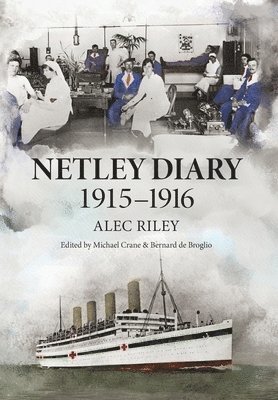
Corporal Alec Riley was a signaller in the British Army''s 42nd (East Lancashire) Division who served at Gallipoli in 1915. Four months on the peninsula left him debilitated, suffering nine septic sores and no less than four diseases - diphtheria, jaundice, enteritis and dysentery.
Riley was evacuated by sea to the Greek island of Lemnos, 50 miles from Cape Helles on the peninsula. Here he survived five weeks in the care of an Australian field hospital before being stretchered onto a hospital ship bound for England. It was during the passage home that Riley decided on ''the grand style of doing it'' and chose the Royal Victoria Hospital, Netley, as his destination.
When it opened in 1863, Netley was the largest military hospital in the world, with more than 1,000 beds. During the First World War, capacity was doubled, and beds filled the corridors. Two temporary hutted hospitals were erected in the grounds behind the main building as the tide of sick and wounded from Gallipoli, the Western Front and other theatres of war rose.
"I have tried," says Riley, "to give some idea of life in one of the many wards, the various patients I met, our habits, amusements, hopes and fears."
The diary chronicles Riley''s last days on Gallipoli, his experiences of No. 1 Australian Stationary Hospital at Mudros, his passage home on the hospital ship Aquitania and his 11 months at Netley and its auxiliary hospitals, Shirley and Shorne Hill.
With dry humour, Riley relates the small mischiefs between the convalescents and the medical staff. He tells of concert parties in the hospital''s theatre, and recalls the songs of the time. He reflects on the efforts of the chaplains, whose efforts to elevate the ''army in blue'' often missed the mark. One spoke on the evils of the rum ration, until a voice shouted "Have you ever been over the top?" Another chose to speak on the good that war does. "An unsavoury subject in a military hospital," thought Riley, "but we were curious to hear what good he thought it did."
Most of all, Riley relates the experiences of a soldier, sick and broken, taking the journey shared by so many away from the front and on the slow road to recovery, a journey in his case that took more than a year.
The book is richly illustrated with rarely seen images and three specially-produced maps.
Included is a concise history of the Royal Victoria Hospital, as well as biographies of the author, his sister and two close comrades at Gallipoli.