Alessandro Somma – författare
Visar alla böcker från författaren Alessandro Somma. Handla med fri frakt och snabb leverans.
7 produkter
7 produkter
Häftad, Engelska, 2026
640 kr
Skickas inom 10-15 vardagar
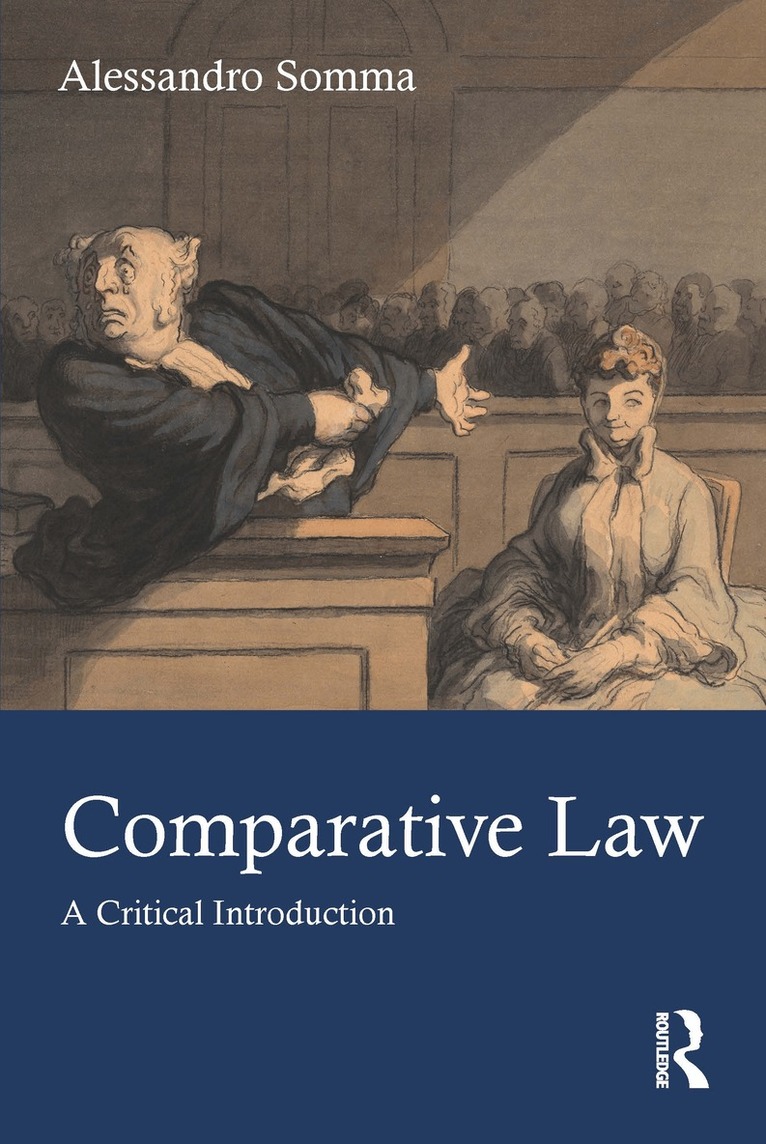
This advanced textbook offers an overview and critical treatment of comparative law, incorporating both traditional and modern approaches to the discipline and an up-to-date survey of the key methodological debates. The fundamental concepts of comparative law are examined through the lens of three main questions: what to compare, why compare, and how to compare.The study of the objects of comparative analysis (what to compare) begins with a critique of legal positivism to address a plurality of legal concepts. The investigation of the aims of comparative law (why compare) considers the most widespread classifications of legal orders and the diverse approaches to the study of legal change. Finally, the methods of comparative law (how to compare) are analysed, taking into account their different functions. Adopting a contextualised, interdisciplinary approach to the subject with a focus on a range of different legal systems, the author brings in examples from politics and economics to the analysis, highlighting the importance of comparative law for the understanding of modern societies.Comparative Law: A Critical Introduction will provide a thought-provoking read for advanced-level students and scholars of comparative law.
Inbunden, Engelska, 2026
2 229 kr
Skickas inom 10-15 vardagar
This advanced textbook offers an overview and critical treatment of comparative law, incorporating both traditional and modern approaches to the discipline and an up-to-date survey of the key methodological debates. The fundamental concepts of comparative law are examined through the lens of three main questions: what to compare, why compare, and how to compare.The study of the objects of comparative analysis (what to compare) begins with a critique of legal positivism to address a plurality of legal concepts. The investigation of the aims of comparative law (why compare) considers the most widespread classifications of legal orders and the diverse approaches to the study of legal change. Finally, the methods of comparative law (how to compare) are analysed, taking into account their different functions. Adopting a contextualised, interdisciplinary approach to the subject with a focus on a range of different legal systems, the author brings in examples from politics and economics to the analysis, highlighting the importance of comparative law for the understanding of modern societies.Comparative Law: A Critical Introduction will provide a thought-provoking read for advanced-level students and scholars of comparative law.
E-bok
PDF, Engelska, 2026702 kr
Läs direkt efter köp
This advanced textbook offers an overview and critical treatment of comparative law, incorporating both traditional and modern approaches to the discipline and an up-to-date survey of the key methodological debates. The fundamental concepts of comparative law are examined through the lens of three main questions: what to compare, why compare, and how to compare.The study of the objects of comparative analysis (what to compare) begins with a critique of legal positivism to address a plurality of legal concepts. The investigation of the aims of comparative law (why compare) considers the most widespread classifications of legal orders and the diverse approaches to the study of legal change. Finally, the methods of comparative law (how to compare) are analysed, taking into account their different functions. Adopting a contextualised, interdisciplinary approach to the subject with a focus on a range of different legal systems, the author brings in examples from politics and economics to the analysis, highlighting the importance of comparative law for the understanding of modern societies.Comparative Law: A Critical Introduction will provide a thought-provoking read for advanced-level students and scholars of comparative law.
E-bok
Engelska, 2026702 kr
Läs direkt efter köp
This advanced textbook offers an overview and critical treatment of comparative law, incorporating both traditional and modern approaches to the discipline and an up-to-date survey of the key methodological debates. The fundamental concepts of comparative law are examined through the lens of three main questions: what to compare, why compare, and how to compare.The study of the objects of comparative analysis (what to compare) begins with a critique of legal positivism to address a plurality of legal concepts. The investigation of the aims of comparative law (why compare) considers the most widespread classifications of legal orders and the diverse approaches to the study of legal change. Finally, the methods of comparative law (how to compare) are analysed, taking into account their different functions. Adopting a contextualised, interdisciplinary approach to the subject with a focus on a range of different legal systems, the author brings in examples from politics and economics to the analysis, highlighting the importance of comparative law for the understanding of modern societies.Comparative Law: A Critical Introduction will provide a thought-provoking read for advanced-level students and scholars of comparative law.
Inbunden, Engelska, 2016
1 669 kr
Skickas inom 7-10 vardagar
Set against the origins and consequences of the global financial crisis, this timely book offers an enriching and revealing narrative of the role that the state plays in regulating markets. Focusing on core areas of private law such as corporate, labour and banking law, the contributors offer a conceptual framework in which to examine the central tenets of the role of private law in today's global economy. In the current climate of ever increasing economic inequality and austerity measures, the authors highlight the urgent need for a comprehensive analysis of the continuing tension between ideas of market liberalism and theories of society. With a focus on both the domestic and transnational dimensions of market governance, the authors offer a crucial insight into the co-existence and interaction between state and market-based economic governance.
E-bok
Engelska, 20091 836 kr
Läs direkt efter köp
This collection of essays reflects both the diversity of the group’s work and the common thread that runs through it. The core claim here is that the DCFR, despite the Commission’s characterization of its proposals as purely technical, cannot escape politics. The intent is to critically identify and evaluate the model of social justice underlying the DCFR.
E-bok
PDF, Engelska, 20091 771 kr
Läs direkt efter köp
Recently, following work supported by the European Commission, the Outline Edition of the Draft Common Frame of Reference (DCFR) concerning European private law was published. However, the Commission’s project has been seriously challenged, right down to its basic perception—that obstacles and disincentives to cross-border transactions caused by excessive national divergence in contract law must be overcome. In particular, the Social Justice Study Group law founded in 2003 has fore fronted critical perspectives based on normative policy. The group focuses on the ‘democratic deficit’ that characterizes the Commission’s approach to European private law. This collection of essays reflects both the diversity of the group’s work and the common thread that runs through it. The core claim here is that the DCFR, despite the Commission’s characterization of its proposals as purely technical, cannot escape politics. The intent is to critically identify and evaluate the model of social justice underlying the DCFR. Although each essay stresses the author’s particular political and cultural views on the topic, the demand for an involvement of democratic institutions and civil society in the construction of a European private law is common to all. Among the critical issues raised are the following: party autonomy versus solidarity; the undermining of the welfare state’s regulatory framework; the use of the competition mechanism as an instrument of State intervention; commutative justice versus distributive justice; contract law and social market economy; how maximum harmonization reduces consumer protection; harmonization as an alibi for reducing a level of protection previously guaranteed; the marginalization of the European Parliament; the absence of general enterprise liability in the DCFR; the importance of weaker-party-friendly orientation in contract law; the implied threat of an artificial European civil society made of producers and consumers; and the lack of public enforcement in the removal of unfair terms in consumer contracts. All the authors are committed to the development of a European identity over the development of the internal market, and to that extent the book may be controversial. As Community initiatives on European private law continue to multiply, this important book takes a significant step toward understanding the participatory procedures that must be taken to protect the multicultural and multilingual society to which European private law is applied, and to clarify in advance the model of social justice on which to build a European contract law.