Alex Ely Kossovsky – författare
Visar alla böcker från författaren Alex Ely Kossovsky. Handla med fri frakt och snabb leverans.
6 produkter
6 produkter
348 kr
Skickas inom 10-15 vardagar
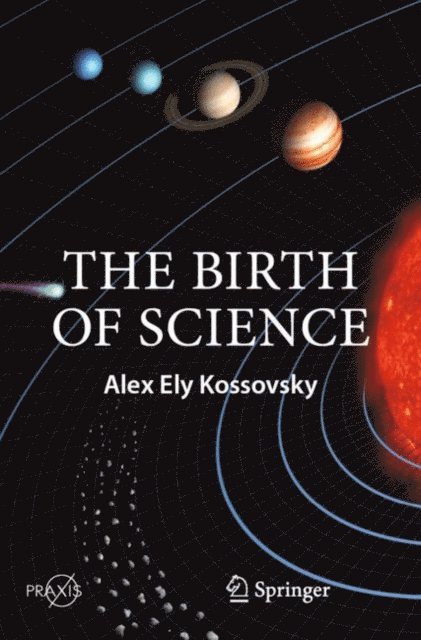
This book reveals the multi-generational process involved in humanity's first major scientific achievement, namely the discovery of modern physics, and examines the personal lives of six of the intellectual giants involved.
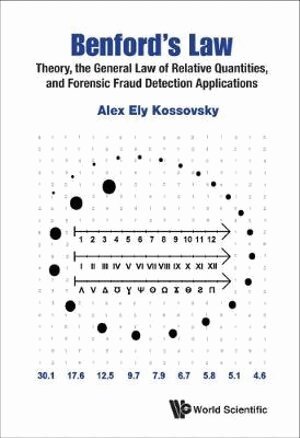
Benford's Law: Theory, The General Law Of Relative Quantities, And Forensic Fraud Detection Applications
Inbunden, Engelska, 2014
3 197 kr
Skickas inom 3-6 vardagar
Contrary to common intuition that all digits should occur randomly with equal chances in real data, empirical examinations consistently show that not all digits are created equal, but rather that low digits such as {1, 2, 3} occur much more frequently than high digits such as {7, 8, 9} in almost all data types, such as those relating to geology, chemistry, astronomy, physics, and engineering, as well as in accounting, financial, econometrics, and demographics data sets. This intriguing digital phenomenon is known as Benford's Law.This book gives a comprehensive and in-depth account of all the theoretical aspects, results, causes and explanations of Benford's Law, with a strong emphasis on the connection to real-life data and the physical manifestation of the law. In addition to such a bird's eye view of the digital phenomenon, the conceptual distinctions between digits, numbers, and quantities are explored; leading to the key finding that the phenomenon is actually quantitative in nature; originating from the fact that in extreme generality, nature creates many small quantities but very few big quantities, corroborating the motto "small is beautiful", and that therefore all this is applicable just as well to data written in the ancient Roman, Mayan, Egyptian, and other digit-less civilizations.Fraudsters are typically not aware of this digital pattern and tend to invent numbers with approximately equal digital frequencies. The digital analyst can easily check reported data for compliance with this digital law, enabling the detection of tax evasion, Ponzi schemes, and other financial scams. The forensic fraud detection section in this book is written in a very concise and reader-friendly style; gathering all known methods and standards in the accounting and auditing industry; summarizing and fusing them into a singular coherent whole; and can be understood without deep knowledge in statistical theory or advanced mathematics. In addition, a digital algorithm is presented, enabling the auditor to detect fraud even when the sophisticated cheater is aware of the law and invents numbers accordingly. The algorithm employs a subtle inner digital pattern within the Benford's pattern itself. This newly discovered pattern is deemed to be nearly universal, being even more prevalent than the Benford phenomenon, as it is found in all random data sets, Benford as well as non-Benford types.
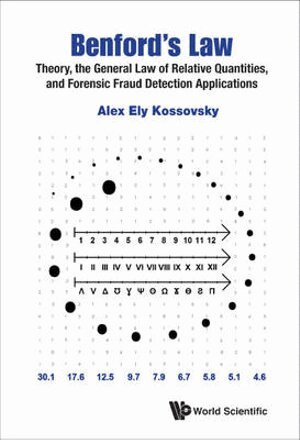
Benford's Law: Theory, The General Law Of Relative Quantities, And Forensic Fraud Detection Applications
Häftad, Engelska, 2014
779 kr
Skickas inom 5-8 vardagar
Contrary to common intuition that all digits should occur randomly with equal chances in real data, empirical examinations consistently show that not all digits are created equal, but rather that low digits such as {1, 2, 3} occur much more frequently than high digits such as {7, 8, 9} in almost all data types, such as those relating to geology, chemistry, astronomy, physics, and engineering, as well as in accounting, financial, econometrics, and demographics data sets. This intriguing digital phenomenon is known as Benford's Law.This book gives a comprehensive and in-depth account of all the theoretical aspects, results, causes and explanations of Benford's Law, with a strong emphasis on the connection to real-life data and the physical manifestation of the law. In addition to such a bird's eye view of the digital phenomenon, the conceptual distinctions between digits, numbers, and quantities are explored; leading to the key finding that the phenomenon is actually quantitative in nature; originating from the fact that in extreme generality, nature creates many small quantities but very few big quantities, corroborating the motto "small is beautiful", and that therefore all this is applicable just as well to data written in the ancient Roman, Mayan, Egyptian, and other digit-less civilizations.Fraudsters are typically not aware of this digital pattern and tend to invent numbers with approximately equal digital frequencies. The digital analyst can easily check reported data for compliance with this digital law, enabling the detection of tax evasion, Ponzi schemes, and other financial scams. The forensic fraud detection section in this book is written in a very concise and reader-friendly style; gathering all known methods and standards in the accounting and auditing industry; summarizing and fusing them into a singular coherent whole; and can be understood without deep knowledge in statistical theory or advanced mathematics. In addition, a digital algorithm is presented, enabling the auditor to detect fraud even when the sophisticated cheater is aware of the law and invents numbers accordingly. The algorithm employs a subtle inner digital pattern within the Benford's pattern itself. This newly discovered pattern is deemed to be nearly universal, being even more prevalent than the Benford phenomenon, as it is found in all random data sets, Benford as well as non-Benford types.
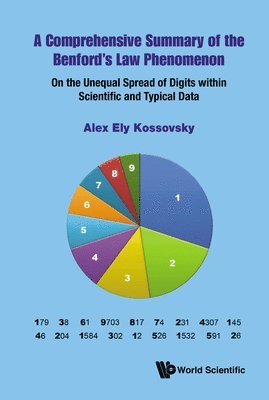
Comprehensive Summary Of The Benford's Law Phenomenon: On The Unequal Spread Of Digits Within Scientific And Typical Data
Inbunden, Engelska, 2025
1 209 kr
Skickas inom 3-6 vardagar
Numbers are written in our digital language system by conveniently and efficiently utilizing the ten digits 0 to 9 in much the same way as sentences and books are written in the English language system by conveniently utilizing the 26 letters A to Z. Surprisingly, and against all common sense or intuition, the spread of these ten digits within numbers of random data is not uniform, but rather highly uneven. Benford's Law predicts that the first digit on the left-most side of numbers is proportioned between all possible digits 1 to 9 approximately according to LOG(1 + 1/digit), so that occurrences of low digits such as {1, 2, 3} in the first position are much more frequent than occurrences of high digits such as {7, 8, 9}. Remarkably, Benford's Law is found to be valid in almost all real life statistics, from data relating to physics, astronomy, chemistry, geology, and biology to data relating to economics, accounting, finance, engineering, and governmental census information. Therefore, Benford's Law stands as the only common thread running through and uniting all scientific disciplines!This book represents an intense and concentrated effort by the author to narrate this digital, numerical, and quantitative story of the Benford's Law phenomenon as briefly and as concisely as possible, while still ensuring a comprehensive coverage of all its aspects, results, causes, explanations, and perspectives. The most recent research results and discoveries in this field are included within this book in such a way as to be comprehensible and engaging to readers of all proficiencies.
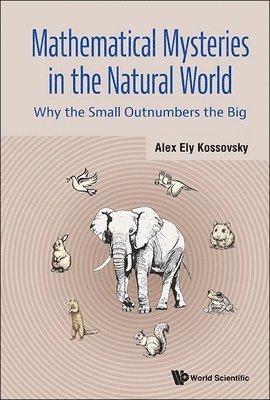
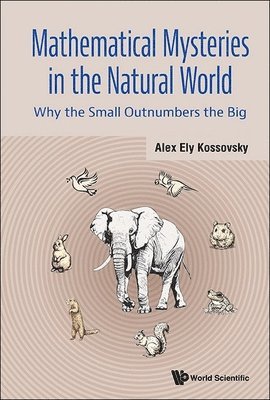
Mathematical Mysteries In The Natural World: Why The Small Outnumbers The Big
Inbunden, Engelska, 2025
1 850 kr
Skickas inom 3-6 vardagar
Why are there more poor people with small bank accounts than rich people with big bank accounts? Why are there more small planets and stars than big ones in the cosmos? And why are there more small rivers than big rivers, and more harmless tremors than devastating earthquakes? Empirical examinations of real-life data overwhelmingly confirm the existence of such uneven size proportions in favor of the small, leaving us only the question: Why?This law of nature carries through a vast list of topics and disciplines, confirming it to be nearly universal. In the biological world there are only approximately two million whales and over three hundred billion birds; in number theory there are more small prime numbers than there are big ones; in census data there are more villages than towns, more towns than cities, and more cities than metropolises; in history there have been more minor conflicts than great wars.In a landmark, first-ever study on the distribution of relative sizes, this book discusses several real-life case studies such as those above in extensive detail, and presents three distinct explanations for the phenomenon. Readers of all disciplines and levels of expertise will find an easily accessible yet original exploration that concludes with a numerical quantification demonstrating precisely by how much the relatively small is more numerous than the relatively big.
824 kr
Skickas inom 3-6 vardagar
Why are there more poor people with small bank accounts than rich people with big bank accounts? Why are there more small planets and stars than big ones in the cosmos? And why are there more small rivers than big rivers, and more harmless tremors than devastating earthquakes? Empirical examinations of real-life data overwhelmingly confirm the existence of such uneven size proportions in favor of the small, leaving us only the question: Why?This law of nature carries through a vast list of topics and disciplines, confirming it to be nearly universal. In the biological world there are only approximately two million whales and over three hundred billion birds; in number theory there are more small prime numbers than there are big ones; in census data there are more villages than towns, more towns than cities, and more cities than metropolises; in history there have been more minor conflicts than great wars.In a landmark, first-ever study on the distribution of relative sizes, this book discusses several real-life case studies such as those above in extensive detail, and presents three distinct explanations for the phenomenon. Readers of all disciplines and levels of expertise will find an easily accessible yet original exploration that concludes with a numerical quantification demonstrating precisely by how much the relatively small is more numerous than the relatively big.