Alex Harvey – författare
Visar alla böcker från författaren Alex Harvey. Handla med fri frakt och snabb leverans.
9 produkter
9 produkter
1 595 kr
Skickas inom 10-15 vardagar
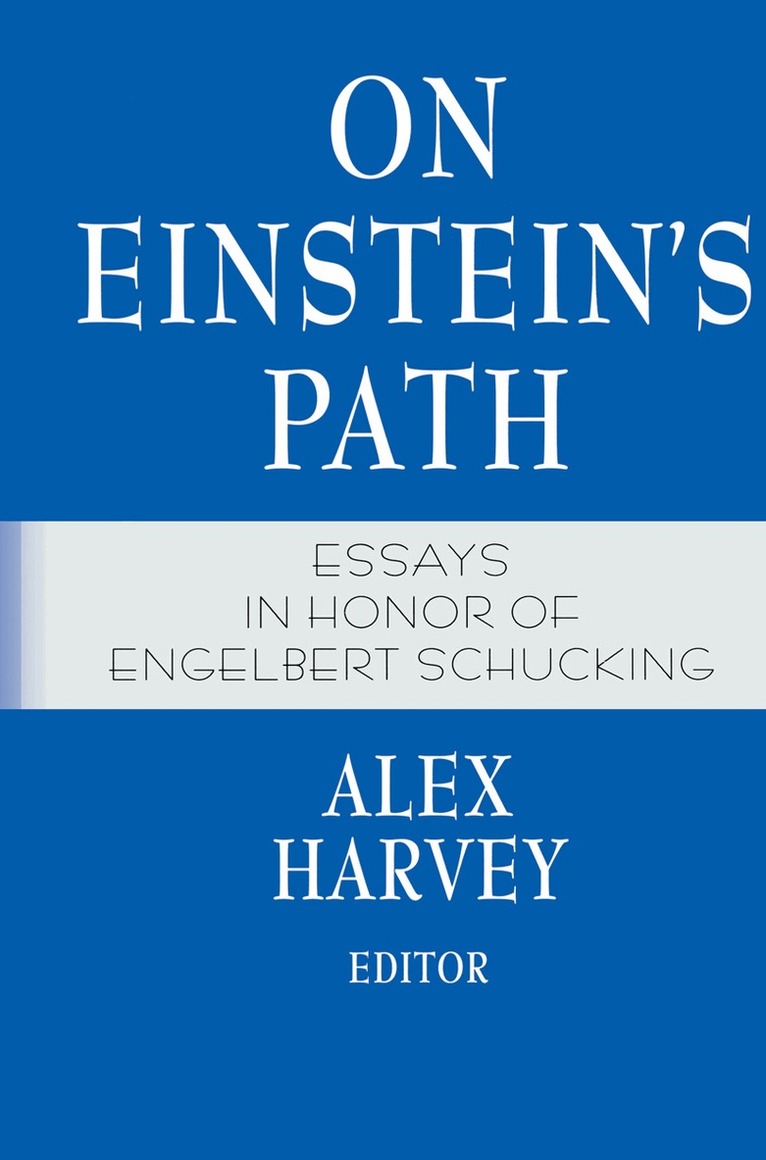
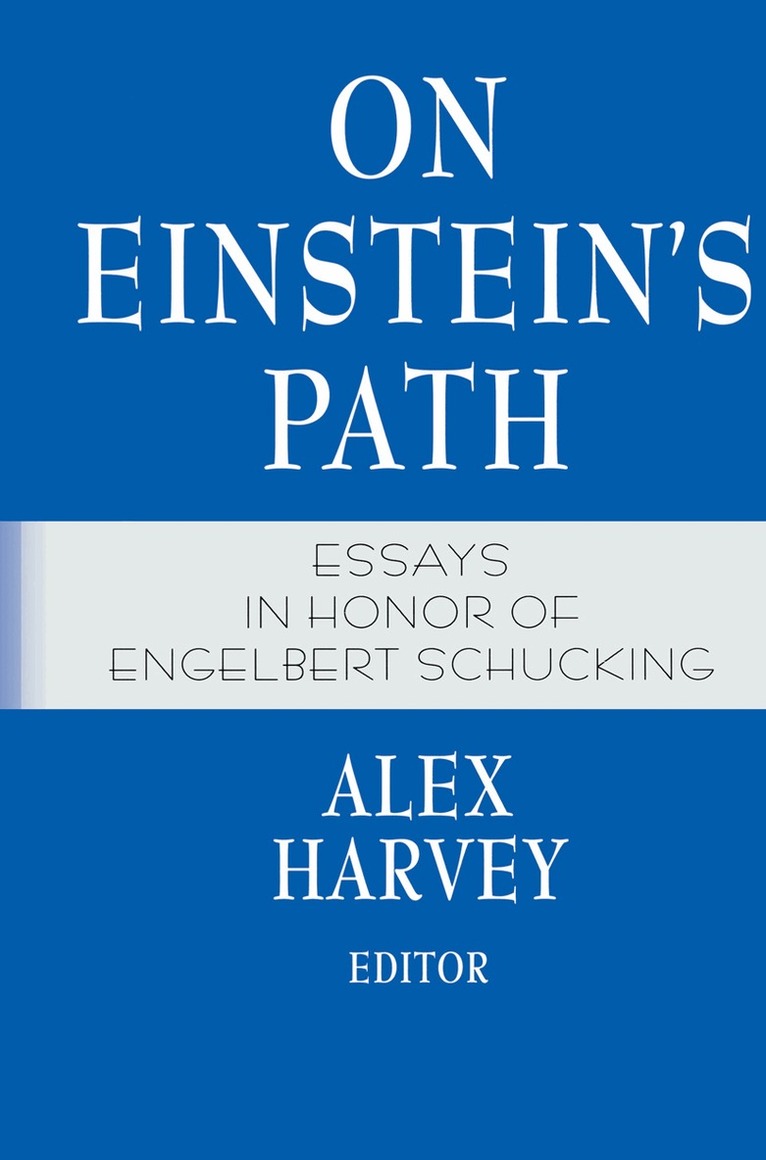
This collection of essays in honor of Engelbert Schucking spans the gamut of research in general relativity and presents a lively and personal account of current work in the field. Contributions include: E.L. Schucking: Jordan, Pauli, Politics, Brecht...and a Variable Gravitational Constant J.L. Anderson: Thomson Scattering in an Expanding Universe A. Ashtekar & T.A. Schilling: Geometrical Formulation of Quantum Mechanics J. Baugh, D.R. Finkelstein, H. Saller, and Zhong Tang: General Covariance is Bose-Einstein Statistics S.L. Bazanski: The Split and Propagation of Light Rays in Relativity L. Bel: How to Define a Unique Vacuum in Cosmology P.G. Bergmann: EIH Theory and Noether's Theorem W.B. Bonnor: The Static Cylinder in General Relativity C.H. Brahns: Gravity and the Tenacious Scalar Field D. Brill: The Cavendish Experiment in General Relativity Y. Choquet-Bruhat: Wave Maps in General Relativity T. Damour: General Relativty and Experiment J. Ehlers: Some Developments in Newtonian Cosmology G.F.R. Ellis & H. van Elst: Deviation of Geodesics in FLRW Spacetime Geometries S. Frittelli & E.T. Newman: Poincar Pseudo-symmetries in Asymptotically Flat Spacetimes E.N.Glass: Taub Numbers and Asymptotic Invariants J.N. Goldberg: Second Class Constraints F.W. Hehl, A. Macias, E.W. Mielke, & Yu.N. Obukhov: On the Structure of the Energy-momentum and the Spin Currents in Dirac's Electron
423 kr
Tillfälligt slut
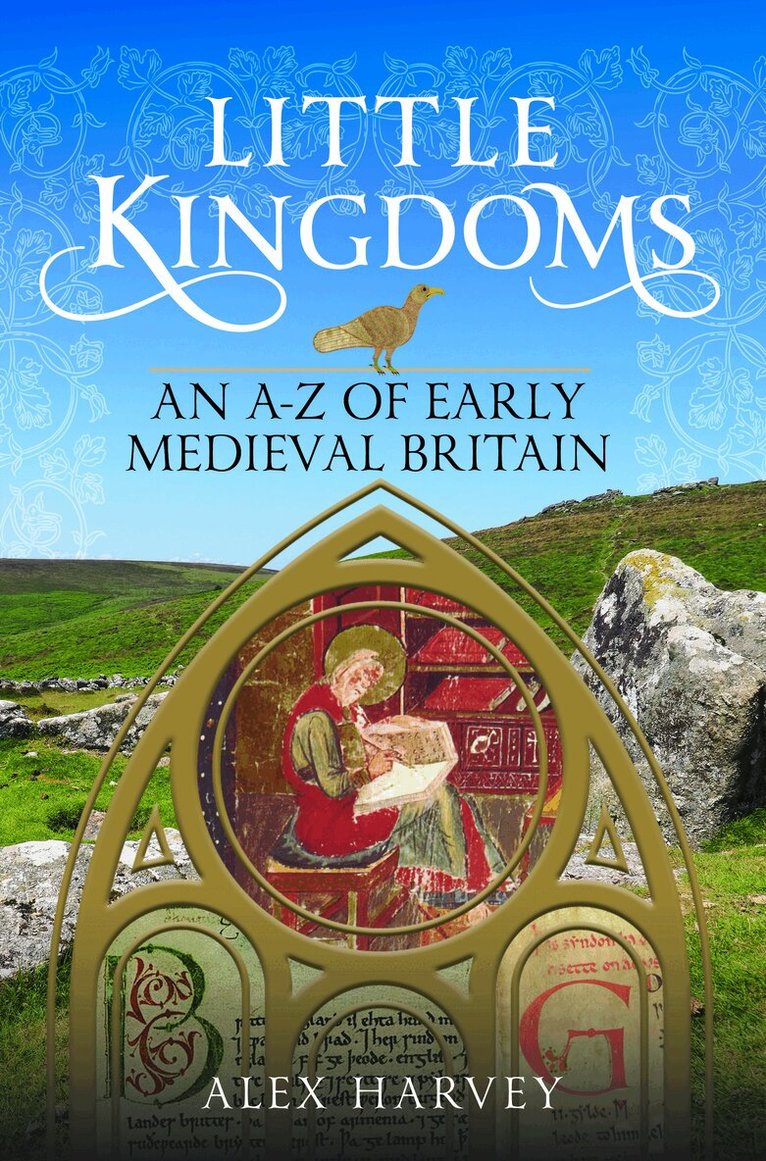
Before England, Wales, and Scotland were created, before Alfred the Great and the Great Viking Army, before even a raid on Lindisfarne, the kingdoms that made up the British Isles were a squabbling, kaleidoscopic mosaic of realities. Some centred their livelihood around rivers, others dug deep to harvest resources from the ground beneath them. There were kingdoms that straddled the sea, others divided by marshes, and some that stuck to rugged mountainsides, or even caves. All these places, remembered now in place-names, artefacts, and obscure chronicles, have become obscured and forgotten, in many cases lost entirely. Little Kingdoms peels back the veil on sixty-two unique realms, listed alphabetically like a travelogue, showcasing the most diverse corners of Early Medieval England, sandwiched in that tantalising gap between the Roman and Viking periods. By using a mixture of disciplines, folklore, and a little imagination, all sixty-two (and many more besides) are brought to life through careful detective work, inventive illustrations, and detailed maps, highlighting the multicultural people of this island and their many, many origins.* Imagine a time when Harrow-on-the-Hill was crowned with a pagan temple, when the commercial heart of London beat not in the City but at the Aldwych, when giant zombies patrolled Strathclyde, and when the Fenlands of Cambridgeshire were a single swamp and the home of eel-wranglers, egret-catchers, and bog-miners. This is the world to which Alex Harvey transports us in this powerfully evocative and clever account of Britain in the centuries after the Roman withdrawal. Made up of more than sixty micro-histories of the places which flourished between the fifth and tenth centuries, his book is both a time machine and an A to Z of a lost age. But it is much more besides. By starting with the little kingdoms, Alex Harvey reverses the standard narrative which interprets Dark Age Britain through the lens of what it was to become. You will never see the Anglo-Saxon world in the same light and you will probably never again describe it as Anglo-Saxon but instead as a multiplicity of overlapping cultures, languages, and myths of origin. - Martyn Rady, Masaryk Professor Emeritus of Central European History at UCL and author of The Middle Kingdoms: A New History of Central Europe * Much of the early medieval period can seem impenetrable - place-names difficult to pin down now, snippets of fact immersed in a soup of myth and legend - and it would take a brave person to try and make sense of it all. Alex Harvey has taken on the challenge and produced a book, in my opinion, like no other, and furthermore a book that is easy to read and digest. - David Johnson, author of New Light on the "Dark Ages" in North Craven* This book is a veritable treasure hoard of information, derived from archaeology and historical chronicles, place-name studies and folklore, Old English poetry and saints’ lives. Alex Harvey dispels the myth that early medieval Britain was a heptarchy, the home of a people easily categorizable by ethnicity or nationality. Instead, Harvey breathes life into a sweeping miscellany of little kingdoms, some familiar and prominent in our early medieval histories, others mysterious and elusive. Whether it’s in reports of strange weather (mole rain) or references to undead islands (a misinterpreted place-name), the reader of Little Kingdoms will find more than a little to explore in a richly complex medieval Britain. - Hana Videen, author of The Deor Hord: An Old English Bestiary* Post-Roman Britain is a land of myth, legend and wonder for many, and a true dark age for others. A place which could easily sit in the Middle Earth of J.R.R. Tolkien, not surprising given it was the inspiration for many of his best-known plot lines. Yet here Alex Harvey skilfully brings this little-known period of British history to vibrant life, showing in striking detail how events then set in place the multiple identities of Britain today. Using true academic rigour, matched with a wonderful ability to tell a story, he introduces readers to kingdoms large and small, some only short-lived but many still recognisable today within the political geography of Britain. In that sense, this is also an important book for our age, when self-identification is at the forefront of the national debate. - Simon Elliott, author of Sea Eagles of Empire* Fun, readable and informative, Alex Harvey’s Little Kingdoms is a celebration of some of the most obscure and odd kingdoms, fiefdoms, territories, and settlements of British history. Infused with enthusiasm and written in a conversational tone, this is the type of pop history I love to read. - Steve Brusatte, professor of palaeontology at the University of Edinburgh, and New York best-selling author of The Rise & Fall of the Dinosaurs* I really liked the decision to structure the book in sixty-two alphabetical entries. It could so easily have been shaped thematically with endless case studies, but that would have made the book less accessible to the general reader and taken the focus off the kingdoms and their stories. And yet, while reading this only as a gazetteer is a delight -with its intriguing pen portraits of long forgotten little realms teased out of clues in charters, old poems and traces in the landscape - it would be a missed opportunity. Read together in sequence the entries allow the reader to watch Alex Harvey use his furious curiosity to puzzle out a much more complete portrait of this fascinating period of history, its people and places. In fact, Little Kingdoms invites different readings: by all means begin with a pick and mix approach, then read it through in alphabetical order while making sure to jump backwards and forwards between the cross references. Harvey is not afraid to ask questions that are impossible to answer, but his attempts not only make for an enjoyable read, but gradually form answers to much bigger questions about the past: about settlement, identity, change and continuity - how these kingdoms emerged and disappeared and why that matters. Process is an important part of the reading experience, the story of how we know what we know about these lost kingdoms is half the pleasure. Little Kingdoms shows what can be achieved with a combination of archaeological expertise, a way with words, an enquiring mind and an imagination fed on manuscripts and long barrows. It is essential reading for anyone interested in the period, in what can be made of the traces that remain, in how to do history well. Essential and absorbing. - Christopher Hadley, author of The Road
265 kr
Tillfälligt slut
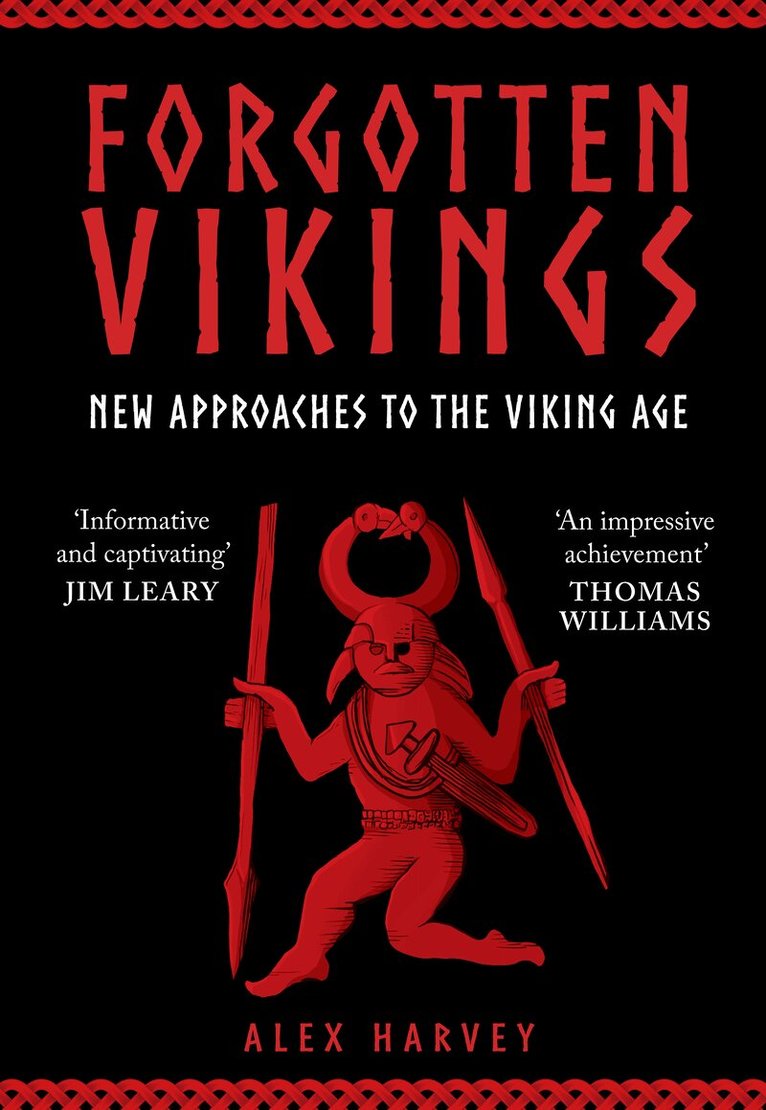
Forgotten Vikings provides a chronological overview of the Viking Age (793–1066) and quite a lot of history either side of these arbitrary dates. Arbitrary? This book aims to explore the phenomenon of ‘the Vikings’ from new angles, forged out of recent academic breakthroughs largely unexplored in popular history books; the Viking Age viewed as a longer, discrete period from the sixth to the fifteenth centuries.Focusing on lesser-known aspects of the period, Alex Harvey taps into more obscure regions of the world these people visited, more obscure characters, and more obscure cultural elements. Examples include the evidence for viking activity on the Azores and Madeira, thirteenth-century Baltic raids, and the presence of viking armies in the Netherlands long before they became a threat to England.Offering unfamiliar perspectives, Forgotten Vikings will change the way you see these often misunderstood people, and unearth a forgotten history.
172 kr
Kommande
The Viking Age was a transformative period of British history. From the eighth to the eleventh centuries, people from over the North Sea raided, invaded, settled, and contributed to the development of the British Isles in various ways. Here the story of the Viking Age and its enduring impact is told through fifty carefully chosen treasures and trinkets; everything from the mundane to the magnificent, from the tiniest trading weight to the most elaborate brooch.In this book the incredible work of the Portable Antiquities Scheme, impossible without countless metal detectorists, is put on display to assess the impact of the Vikings as the narrative moves from first contact to their lasting legacy.
173 kr
Kommande
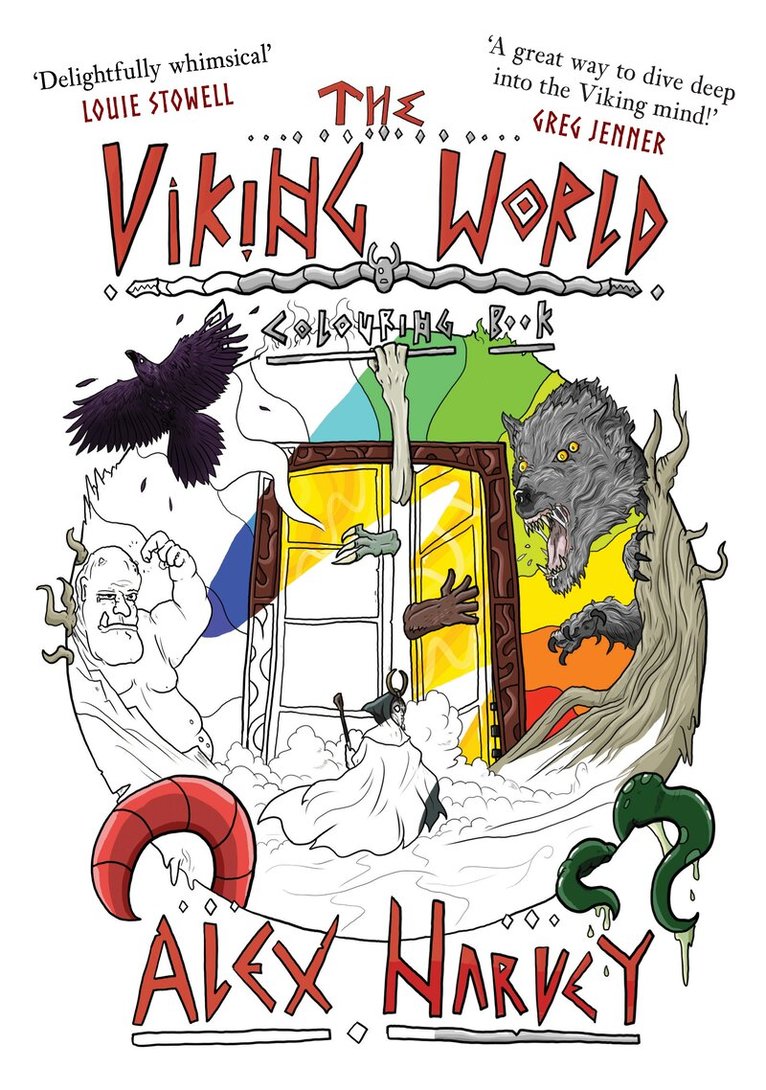
The Vikings continue to fascinate us like few others. Ask anybody about the Vikings and they will think of longboats, shield walls, fierce warriors, runic inscriptions and capricious gods. Their actions helped shape Europe as we know it, but their influence stretched much further out into the known world – and beyond. The enduring popularity of Viking stories in film, literature and video games is testament to the great legacy they have left.In this book, Viking historian Alex Harvey employs his talents as an illustrator to present a selection of historically (and mythologically) accurate annotated outlines for creative colouring.
203 kr
Skickas
Forgotten Vikings provides a chronological overview of the Viking Age (793–1066) and quite a lot of history either side of these arbitrary dates. Arbitrary? This book aims to explore the phenomenon of ‘the Vikings’ from new angles, forged out of recent academic breakthroughs largely unexplored in popular history books; the Viking Age viewed as a longer, discrete period from the sixth to the fifteenth centuries.Focusing on lesser-known aspects of the period, Alex Harvey taps into more obscure regions of the world these people visited, more obscure characters, and more obscure cultural elements. Examples include the evidence for viking activity on the Azores and Madeira, thirteenth-century Baltic raids, and the presence of viking armies in the Netherlands long before they became a threat to England.Offering unfamiliar perspectives, Forgotten Vikings will change the way you see these often misunderstood people, and unearth a forgotten history.
1 595 kr
Skickas inom 10-15 vardagar
Friends and colleagues of Engelbert Schucking came together in a symposium on the 12th and 13th of December 1996 at New York University to celebrate and express to him their respect, admiration, and affection.
217 kr
Skickas inom 5-8 vardagar
141 kr
Tillfälligt slut
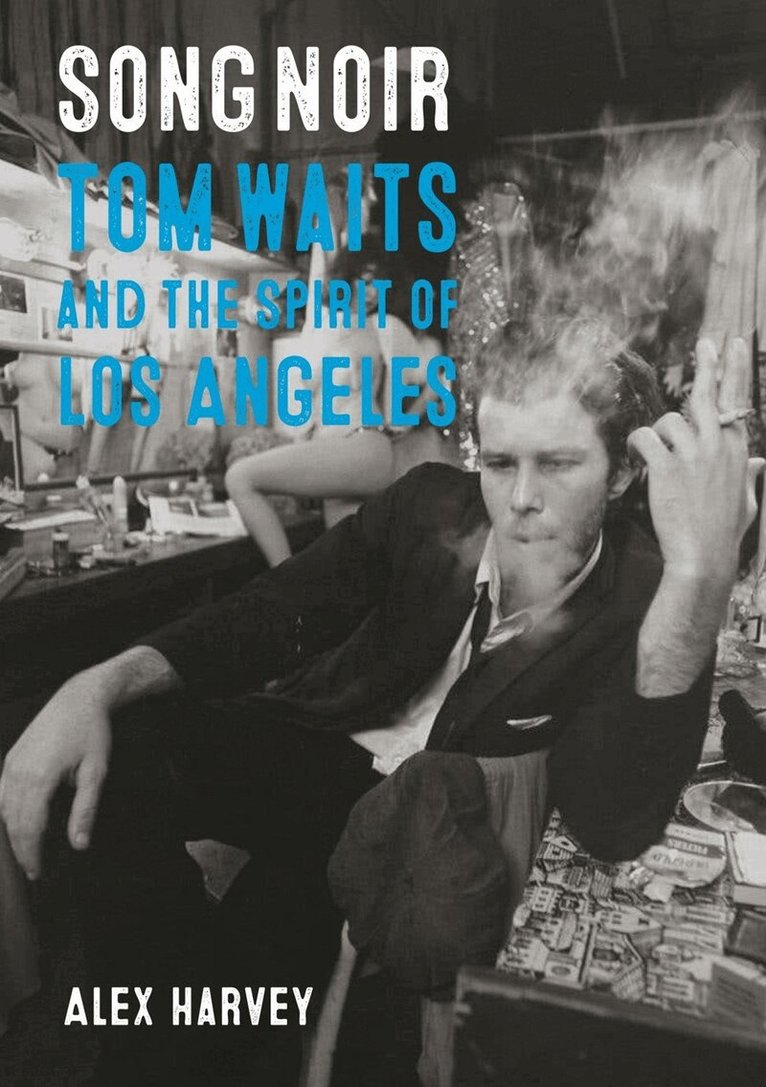
Song Noir examines the formative first decade of Tom Waits’s career, when he lived, wrote and recorded nine albums in Los Angeles; from his soft, folk-inflected debut, Closing Time (1973), to the abrasive, surreal Swordfishtrombones (1983). Starting his song-writing career in the ’70s, Waits absorbed LA's wealth of cultural influences. Combining the spoken idioms of writers like Kerouac and Bukowski with jazz-blues rhythms, he explored the city’s literary and film noir traditions to create hallucinatory dreamscapes.Waits mined a rich seam of the city’s low-life locations and characters, letting the place feed his dark imagination. Mixing the domestic with the mythic, Waits turned quotidian, autobiographical details into something more disturbing and emblematic; a vision of LA as the warped, narcotic heart of his nocturnal explorations.