Alexander Poznyak - Böcker
Visar alla böcker från författaren Alexander Poznyak. Handla med fri frakt och snabb leverans.
6 produkter
6 produkter
536 kr
Skickas inom 10-15 vardagar
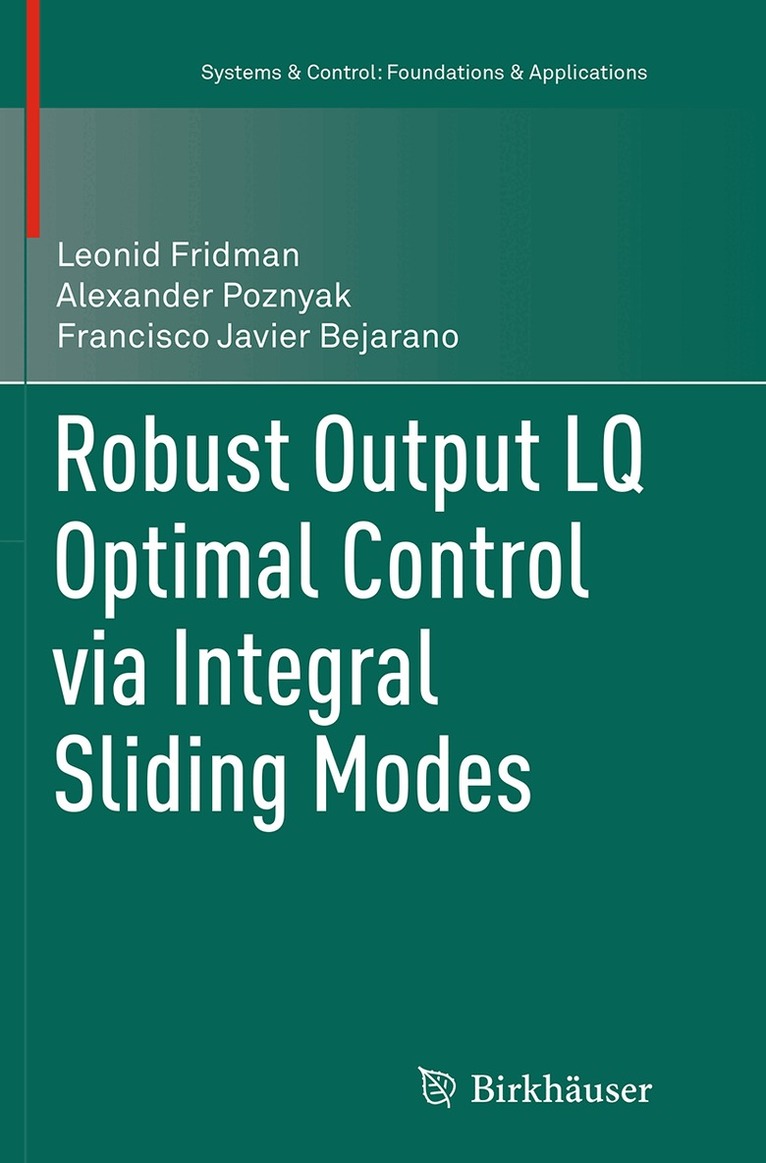
Featuring original research from well-known experts in the field of sliding mode control, this monograph presents new design schemes for implementing LQ control solutions in situations where the output system is the only information provided about the state of the plant. This new design works under the restrictions of matched disturbances without losing its desirable features. On the cutting-edge of optimal control research, Robust Output LQ Optimal Control via Integral Sliding Modes is an excellent resource for both graduate students and professionals involved in linear systems, optimal control, observation of systems with unknown inputs, and automatization.In the theory of optimal control, the linear quadratic (LQ) optimal problem plays an important role due to its physical meaning, and its solution is easily given by an algebraic Riccati equation. This solution turns out to be restrictive, however, because of two assumptions: the system must be free from disturbances and the entire state vector must be known. A new technique, called output integral sliding modes, eliminates the effects of disturbances acting in the same subspace as the control. By using LQ-optimal control together with integral sliding modes, the former is made robust and based on output information only. Thus optimal control theory improves its applicability.
712 kr
Skickas inom 5-8 vardagar
Featuring original research from well-known experts in the field of sliding mode control, this monograph presents new design schemes for implementing LQ control solutions in situations where the output system is the only information provided about the state of the plant. This new design works under the restrictions of matched disturbances without losing its desirable features. On the cutting-edge of optimal control research, Robust Output LQ Optimal Control via Integral Sliding Modes is an excellent resource for both graduate students and professionals involved in linear systems, optimal control, observation of systems with unknown inputs, and automatization.In the theory of optimal control, the linear quadratic (LQ) optimal problem plays an important role due to its physical meaning, and its solution is easily given by an algebraic Riccati equation. This solution turns out to be restrictive, however, because of two assumptions: the system must be free from disturbances and the entire state vector must be known. A new technique, called output integral sliding modes, eliminates the effects of disturbances acting in the same subspace as the control. By using LQ-optimal control together with integral sliding modes, the former is made robust and based on output information only. Thus optimal control theory improves its applicability.
Del 504 - Studies in Systems, Decision and Control
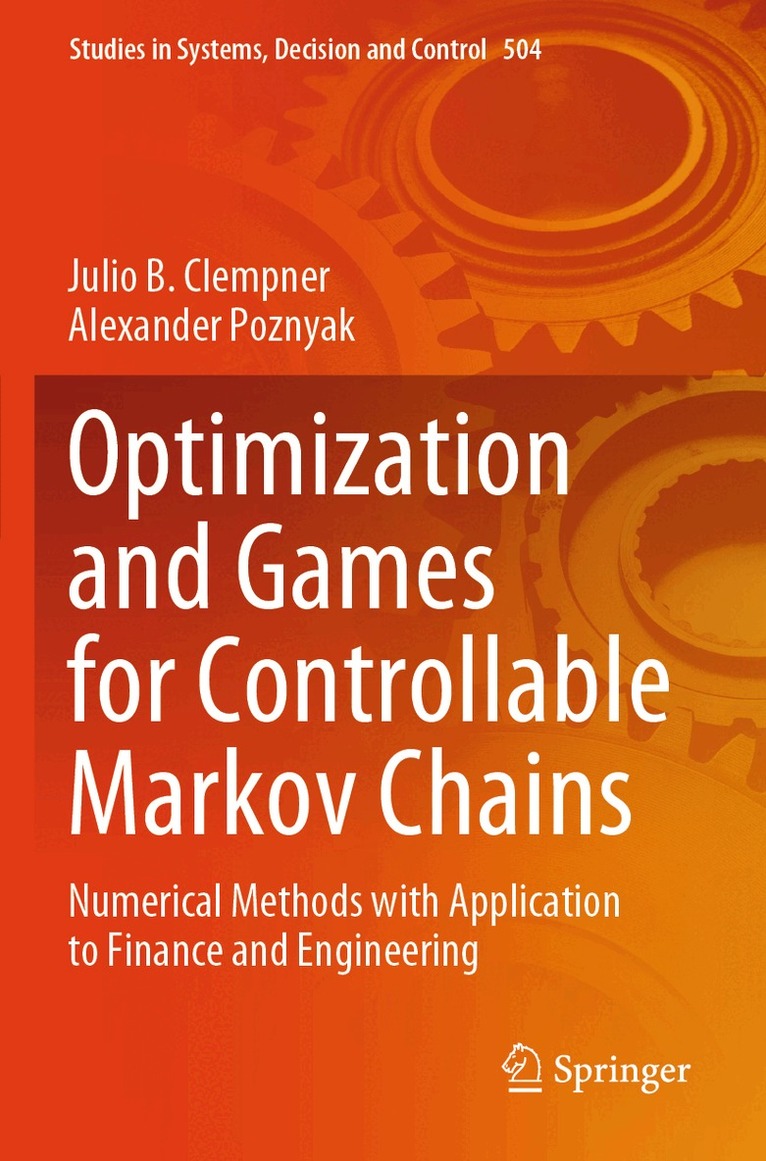
Optimization and Games for Controllable Markov Chains
Numerical Methods with Application to Finance and Engineering
Inbunden, Engelska, 2023
1 698 kr
Skickas inom 7-10 vardagar
This book considers a class of ergodic finite controllable Markov's chains. The main idea behind the method, described in this book, is to develop the original discrete optimization problems (or game models) in the space of randomized formulations, where the variables stand in for the distributions (mixed strategies or preferences) of the original discrete (pure) strategies in the use. The following suppositions are made: a finite state space, a limited action space, continuity of the probabilities and rewards associated with the actions, and a necessity for accessibility. These hypotheses lead to the existence of an optimal policy. The best course of action is always stationary. It is either simple (i.e., nonrandomized stationary) or composed of two nonrandomized policies, which is equivalent to randomly selecting one of two simple policies throughout each epoch by tossing a biased coin. As a bonus, the optimization procedure just has to repeatedly solve the time-average dynamic programming equation, making it theoretically feasible to choose the optimum course of action under the global restriction. In the ergodic cases the state distributions, generated by the corresponding transition equations, exponentially quickly converge to their stationary (final) values. This makes it possible to employ all widely used optimization methods (such as Gradient-like procedures, Extra-proximal method, Lagrange's multipliers, Tikhonov's regularization), including the related numerical techniques. In the book we tackle different problems and theoretical Markov models like controllable and ergodic Markov chains, multi-objective Pareto front solutions, partially observable Markov chains, continuous-time Markov chains, Nash equilibrium and Stackelberg equilibrium, Lyapunov-like function in Markov chains, Best-reply strategy, Bayesian incentive-compatible mechanisms, Bayesian Partially Observable Markov Games, bargaining solutions for Nash and Kalai-Smorodinsky formulations, multi-traffic signal-control synchronization problem, Rubinstein's non-cooperative bargaining solutions, the transfer pricing problem as bargaining.
Del 504 - Studies in Systems, Decision and Control
Optimization and Games for Controllable Markov Chains
Numerical Methods with Application to Finance and Engineering
Häftad, Engelska, 2024
1 698 kr
Skickas inom 10-15 vardagar
This book considers a class of ergodic finite controllable Markov's chains. The main idea behind the method, described in this book, is to develop the original discrete optimization problems (or game models) in the space of randomized formulations, where the variables stand in for the distributions (mixed strategies or preferences) of the original discrete (pure) strategies in the use. The following suppositions are made: a finite state space, a limited action space, continuity of the probabilities and rewards associated with the actions, and a necessity for accessibility. These hypotheses lead to the existence of an optimal policy. The best course of action is always stationary. It is either simple (i.e., nonrandomized stationary) or composed of two nonrandomized policies, which is equivalent to randomly selecting one of two simple policies throughout each epoch by tossing a biased coin. As a bonus, the optimization procedure just has to repeatedly solve the time-average dynamic programming equation, making it theoretically feasible to choose the optimum course of action under the global restriction. In the ergodic cases the state distributions, generated by the corresponding transition equations, exponentially quickly converge to their stationary (final) values. This makes it possible to employ all widely used optimization methods (such as Gradient-like procedures, Extra-proximal method, Lagrange's multipliers, Tikhonov's regularization), including the related numerical techniques. In the book we tackle different problems and theoretical Markov models like controllable and ergodic Markov chains, multi-objective Pareto front solutions, partially observable Markov chains, continuous-time Markov chains, Nash equilibrium and Stackelberg equilibrium, Lyapunov-like function in Markov chains, Best-reply strategy, Bayesian incentive-compatible mechanisms, Bayesian Partially Observable Markov Games, bargaining solutions for Nash and Kalai-Smorodinsky formulations, multi-traffic signal-control synchronization problem, Rubinstein's non-cooperative bargaining solutions, the transfer pricing problem as bargaining.
1 049 kr
Skickas inom 10-15 vardagar
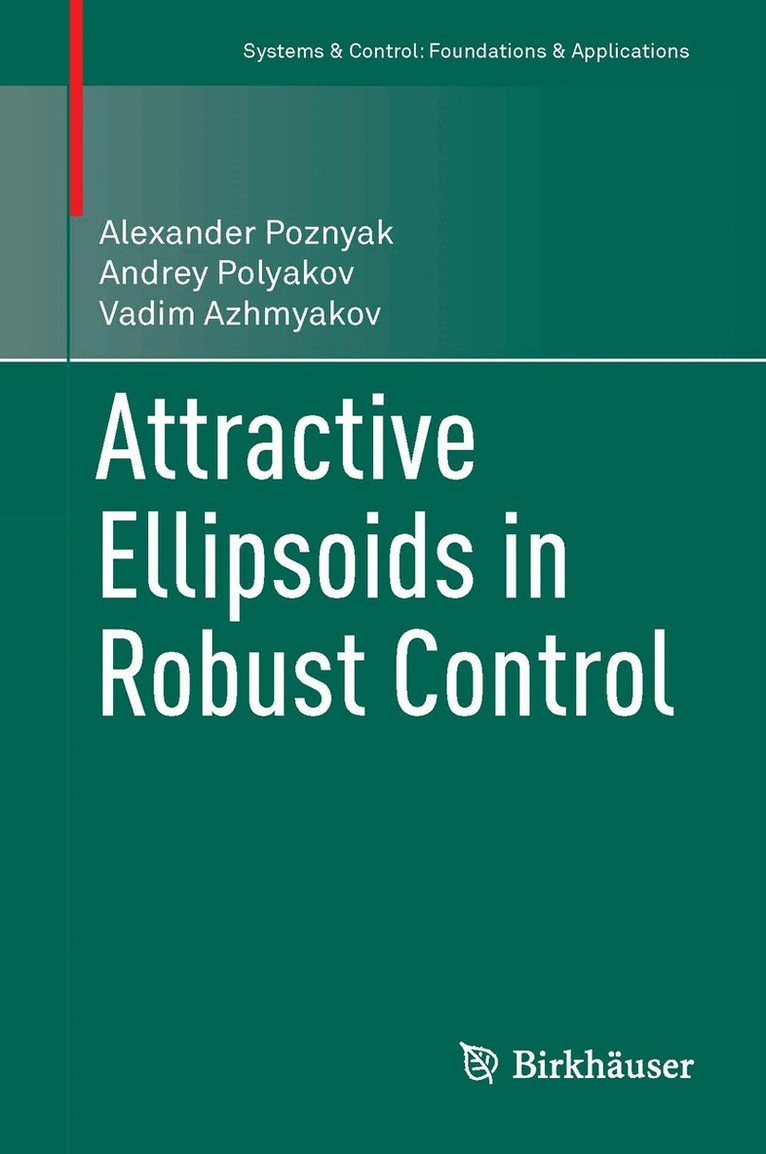
Attractive Ellipsoids in Robust Control
1 049 kr
Skickas inom 10-15 vardagar
This monograph introduces a newly developed robust-control design technique for a wide class of continuous-time dynamical systems called the “attractive ellipsoid method.” Along with a coherent introduction to the proposed control design and related topics, the monograph studies nonlinear affine control systems in the presence of uncertainty and presents a constructive and easily implementable control strategy that guarantees certain stability properties. The authors discuss linear-style feedback control synthesis in the context of the above-mentioned systems. The development and physical implementation of high-performance robust-feedback controllers that work in the absence of complete information is addressed, with numerous examples to illustrate how to apply the attractive ellipsoid method to mechanical and electromechanical systems. While theorems are proved systematically, the emphasis is on understanding and applying the theory to real-world situations. Attractive Ellipsoids in Robust Control will appeal to undergraduate and graduate students with a background in modern systems theory as well as researchers in the fields of control engineering and applied mathematics.