Alfred J. Freddoso - Böcker
Visar alla böcker från författaren Alfred J. Freddoso. Handla med fri frakt och snabb leverans.
5 produkter
5 produkter
1 072 kr
Skickas inom 10-15 vardagar
These original essays offer evidence that a growing number of Anglo-American philosophers are finding in the classical discussion of God's existence and nature fertile sources for the critical reflection on issues in the philosophy of religion.Nelson Pike challenges Aquinas' claim that God is not responsible for evil and shows how the rejection of this claim bears on the proem of evil. Richard Swinburne defends the classical Christian understanding of heaven and hell, arguing that it is both philosophically plausible and compatible with the Christian conception of God's goodness. Philip Quinn proposes a defensible version of the classical assertion that God's conserving a creature in existence is tantamount to his continuously creating that creature.Thomas Flint and Alfred Freddoso present an analysis of omnipotence which they claim to be both philosophically adequate and consonant with the orthodox Christian belief that God is both omnipotent and incapable of sinning. James Ross's main purpose is to dislodge the assumption that God's power is properly and adequately thought of as the power to cause (or bring about or actualize) states of affairs. Clement Dore reinterprets and defends Descartes' often maligned Fifth Meditation argument for God's existence. finally, Mark Jordan explicates the metaphysical foundations of Aquinas' doctrine of divine names.
366 kr
Skickas inom 10-15 vardagar
These original essays offer evidence that a growing number of Anglo-American philosophers are finding in the classical discussion of God's existence and nature fertile sources for the critical reflection on issues in the philosophy of religion.Nelson Pike challenges Aquinas' claim that God is not responsible for evil and shows how the rejection of this claim bears on the proem of evil. Richard Swinburne defends the classical Christian understanding of heaven and hell, arguing that it is both philosophically plausible and compatible with the Christian conception of God's goodness. Philip Quinn proposes a defensible version of the classical assertion that God's conserving a creature in existence is tantamount to his continuously creating that creature.Thomas Flint and Alfred Freddoso present an analysis of omnipotence which they claim to be both philosophically adequate and consonant with the orthodox Christian belief that God is both omnipotent and incapable of sinning. James Ross's main purpose is to dislodge the assumption that God's power is properly and adequately thought of as the power to cause (or bring about or actualize) states of affairs. Clement Dore reinterprets and defends Descartes' often maligned Fifth Meditation argument for God's existence. finally, Mark Jordan explicates the metaphysical foundations of Aquinas' doctrine of divine names.
156 kr
Skickas inom 7-10 vardagar
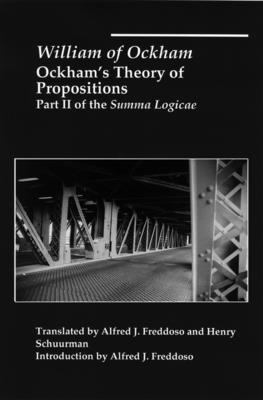
In this work Ockham proposes a theory of simple predication, which he then uses in explicating the truth conditions of progressively more complicated kinds of propositions. His discussion includes what he takes to be the correct semantic treatment of quantified propositions, past tense and future tense propositions, and modal propositions, all of which are receiving much attention from contemporary philosophers. He also illustrates the use of exponential analysis to deal with propositions that prove troublesome in both semantic theory and other disciplines, such as metaphysics, physics, and theology. This type of analysis plays an essential role in his substantive philosophical and theological works, and in many cases then can hardly be understood without a prior acquaintance with this section of the Summa.An introduction by Alfred J. Freddoso clarifies and summarizes Ockham’s theory, discusses certain philosophical problems what it engenders, and proposes new interpretations for parts of it. The essay will be helpful both to those interested in Ockham as a historical figure and to those interested in his substantive systematic contributions to logical history.
149 kr
Skickas inom 7-10 vardagar
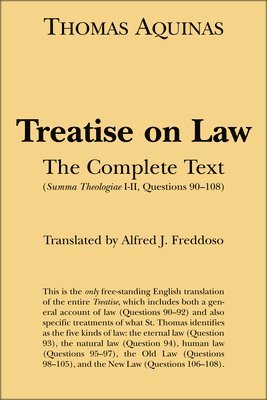
This is a new English translation of St. Thomas Aquinas’s Treatise on Law, found in Questions 90–108 of the First Part of the Second Part of the Summa Theologiae. In fact, it is the only free-standing English translation of the entire Treatise, which includes both a general account of law (Questions 90–92) and also specific treatments of what St. Thomas identifies as the five kinds of law: the eternal law (Question 93), the natural law (Question 94), human law (Questions 95–97), the Old Law (Questions 98–105), and the New Law (Questions 106–108). All other extant editions of Treatise on Law stop with the human law, and are thus approximately one-third the size of the full Treatise.St. Thomas’s account of law is firmly embedded within a general moral theory that begins with a rich conception of human flourishing, i.e., the good for human beings (Questions 1–5). This good consists, first and foremost, in our ultimate and intimate union with the Persons of the Blessed Trinity – a union that in our present state we can grasp intellectively and pursue affectively only with God’s supernatural assistance. It is within this framework that we order our loves and pursue the more proximate goals they open up to us as human beings in this life. Given the appropriate goals, the next question is how we can get from where we are, in the grips of the consequences of Original Sin, to where we want to be. The answer is: by means of (a) human actions that are good, i.e., rightly ordered toward our ultimate end and (b) the habits that these actions either engender or flow from. In analyzing human actions (Questions 6–21) and their relation to the passions (Questions 22–48), St. Thomas gives a general account of what he calls the ‘intrinsic principles’ of human actions and their associated habits – both virtues (Questions 49–70) and vices (Questions 71–89). It is only then that he turns to what he calls the ‘extrinsic principles’ of good human actions, viz., law (Questions 90–108) and grace (Questions 109–114). According to St. Thomas, law, far from supplanting virtue as a basic principle of action, serves as an independent principle of action that complements virtue and is itself capable of being factored into practical deliberation. The reason is that all of God’s precepts, prohibitions, and punishments are aimed at promoting the good of the whole universe and, more particularly, the good for human beings, both individually and within the various forms of social life. Because of this, law serves as both a restraint on bad actions and a spur to good action, i.e., a restraint on actions that take us away from virtue and genuine human flourishing and a spur to actions that promote virtue and flourishing. There are many benefits of having the whole treatise rather than just the first few questions, as has been the standard practice in previous editions of the Treatise on Law. To mention just a few of these benefits, the question on the moral precepts of the Old Law (question 100) helps to illuminate in many different ways the earlier questions on natural law and human law (questions 94–97). Again, the questions on the ceremonial and judicial precepts of the Old Law (questions 101–105) demon-strate in depth the symbiotic relationship that St. Thomas takes to obtain between the Old Testament and the New Testament. The questions on the New Law provide an introduction to the Christian way of life that will be described in incomparable detail in the Second Part of the Second Part, the bulk of which is structured around the treatment of the three theological virtues and the four cardinal virtues.
121 kr
Skickas inom 7-10 vardagar