Allan H. Meltzer – författare
Visar alla böcker från författaren Allan H. Meltzer. Handla med fri frakt och snabb leverans.
10 produkter
10 produkter
Inbunden, Engelska, 2012
244 kr
Skickas inom 5-8 vardagar
The financial crisis caused many genuinely to reconsider the desirability and feasibility of capitalism. In Why Capitalism?, renowned economist Allan Meltzer addresses what he feels are key issues that critics of capitalism routinely fail to adequately recognize . These include the power of incentives and capitalism's adaptability to varying morals, ideals, and cultures. Meltzer argues that while capitalism is not perfect, it is the best option for providing growth and personal freedom. Citing Kant, he stresses that most of the faults and flaws on which critics dwell are human faults and are not systemically inherent to capitalism. Other topics he addresses include the regulated welfare state and how it invites corruption, arbitrary decisions, and circumvention; and irresponsible deficit spending and the unsustainable, unfunded promises by politicians eager to please. Why Capitalism? is a short, powerful book that will raise the level of the current debate among politicians, scholars in the political sciences, and general readers interested in the political issues brought to light by the recent financial crisis, written by one of the strongest voices the public dialogue on the fundamental economic ideas on which the United States economy is based.
Häftad, Engelska, 2014
335 kr
Skickas inom 5-8 vardagar
Allan H. Meltzer's critically acclaimed history of the Federal Reserve is the most ambitious, most intensive, and most revealing investigation of the subject ever conducted. Its first volume, published to widespread critical acclaim, spanned the period from the institution's founding in 1913 to the restoration of its independence in 1951. Book I of the two-part second volume chronicles the evolution and development of the Federal Reserve from the Federal Reserve Accord in 1951 to the first phase of the Great Inflation in the 1960s, revealing the inner workings of the Fed during a period of rapid and extensive change. Book 2 chronicles the evolution and development of the Federal Reserve from the Nixon administration to the mid-1980s, when the Great Inflation ended.
E-bok
Engelska, 2010604 kr
Läs direkt efter köp
Allan H. Meltzer''s monumental history of the Federal Reserve System tells the story of one of America''s most influential but least understood public institutions. This first volume covers the period from the Federal Reserve''s founding in 1913 through the Treasury-Federal Reserve Accord of 1951, which marked the beginning of a larger and greatly changed institution. To understand why the Federal Reserve acted as it did at key points in its history, Meltzer draws on meeting minutes, correspondence, and other internal documents (many made public only during the 1970s) to trace the reasoning behind its policy decisions. He explains, for instance, why the Federal Reserve remained passive throughout most of the economic decline that led to the Great Depression, and how the Board''s actions helped to produce the deep recession of 1937 and 1938. He also highlights the impact on the institution of individuals such as Benjamin Strong, governor of the Federal Reserve Bank of New York in the 1920s, who played a key role in the adoption of a more active monetary policy by the Federal Reserve. Meltzer also examines the influence the Federal Reserve has had on international affairs, from attempts to build a new international financial system in the 1920s to the Bretton Woods Agreement of 1944 that established the International Monetary Fund and the World Bank, and the failure of the London Economic Conference of 1933. Written by one of the world''s leading economists, this magisterial biography of the Federal Reserve and the people who helped shape it will interest economists, central bankers, historians, political scientists, policymakers, and anyone seeking a deep understanding of the institution that controls America''s purse strings. "It was ''an unprecedented orgy of extravagance, a mania for speculation, overextended business in nearly all lines and in every section of the country.'' An Alan Greenspan rumination about the irrational exuberance of the late 1990s? Try the 1920 annual report of the board of governors of the Federal Reserve. . . . To understand why the Fed acted as it did—at these critical moments and many others—would require years of study, poring over letters, the minutes of meetings and internal Fed documents. Such a task would naturally deter most scholars of economic history but not, thank goodness, Allan Meltzer."—Wall Street Journal "A seminal work that anyone interested in the inner workings of the U. S. central bank should read. A work that scholars will mine for years to come."—John M. Berry, Washington Post "An exceptionally clear story about why, as the ideas that actually informed policy evolved, things sometimes went well and sometimes went badly. . . . One can only hope that we do not have to wait too long for the second installment."—David Laidler, Journal of Economic Literature "A thorough narrative history of a high order. Meltzer''s analysis is persuasive and acute. His work will stand for a generation as the benchmark history of the world''s most powerful economic institution. It is an impressive, even awe-inspiring achievement."—Sir Howard Davies, Times Higher Education Supplement
Häftad, Engelska, 2004
327 kr
Skickas inom 5-8 vardagar
Every decision made by the Federal Reserve instantly grabs headlines, yet it is one of the least understood of our public institutions. In this monumental history Allan H. Meltzer, one of the world's leading economists, tells the story of the Federal Reserve and the people who shaped it, from its founding in 1913 through the Treasury-Federal Reserve Accord of 1951. The first of two volumes, and including a foreword by Alan Greenspan, Meltzer's work has been acknowledged as one of the most important studies of an institution with a truly global impact.
Häftad, Engelska, 2014
335 kr
Skickas inom 5-8 vardagar
Allan H. Meltzer's critically acclaimed history of the Federal Reserve is the most ambitious, most intensive, and most revealing investigation of the subject ever conducted. Its first volume, published to widespread critical acclaim, spanned the period from the institution's founding in 1913 to the restoration of its independence in 1951. Book 1 of the two-part second volume chronicles the evolution and development of the Federal Reserve from the Federal Reserve Accord in 1951 to the first phase of the Great Inflation in the 1960s, revealing the inner workings of the Fed during a period of rapid and extensive change. Book 2 chronicles the evolution and development of the Federal Reserve from the Nixon administration to the mid-1980s, when the Great Inflation ended.
Inbunden, Engelska, 1980
858 kr
Skickas inom 10-15 vardagar
The federal income tax exemption for state and local government securities has been a controversial issue for many years. Opponents of the exemption believe that it is inequitable, reduces risk investment by high-bracket taxpayers, and costs an excessive amount to the federal government. Proponents argue that elimination of the tax exemption would make the cost of borrowing money to many state and local governments prohibitive. The purpose of the study was to try to narrow down the differences among experts in taxation and the municipal bond market on the facts and analyses with regard to this matter of public policy.
Häftad, Engelska, 2005
662 kr
Skickas inom 7-10 vardagar
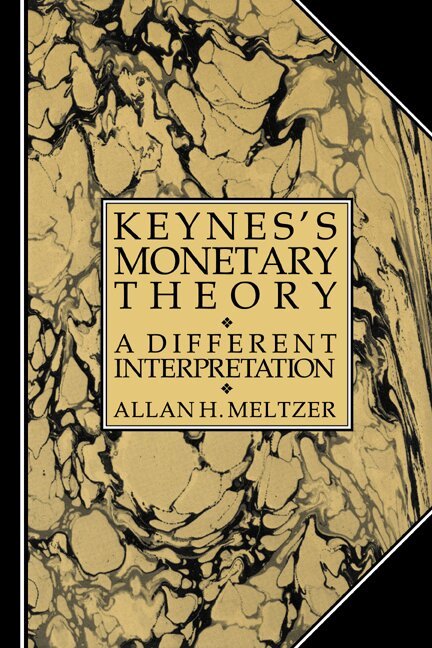
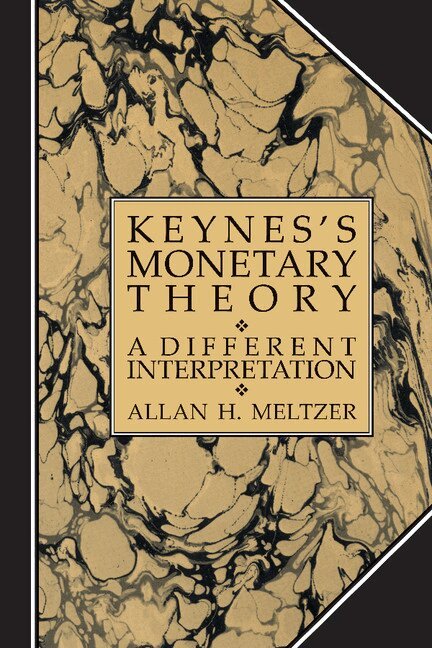
In this rigorous 1989 study of John Maynard Keynes's views on economic theory and policy from 1920-46, Professor Meltzer argues that some of Keynes's main ideas have been ignored or misstated. While attention has focused on short-term countercyclical policies, the main policy implications have been neglected. Keynes placed great emphasis on rules, predictability, and reduction of uncertainty. In keeping with his theoretical work, he opposed discretionary fiscal changes and favored rules to reduce instability and increase the capital stock. These policies are consistent with, and provide evidence for, the interpretation of Keynes's theory developed here.
Inbunden, Engelska, 1989
1 611 kr
Skickas inom 7-10 vardagar
In this rigorous 1989 study of John Maynard Keynes's views on economic theory and policy from 1920-46, Professor Meltzer argues that some of Keynes's main ideas have been ignored or misstated. While attention has focused on short-term countercyclical policies, the main policy implications have been neglected. Keynes placed great emphasis on rules, predictability, and reduction of uncertainty. In keeping with his theoretical work, he opposed discretionary fiscal changes and favored rules to reduce instability and increase the capital stock. These policies are consistent with, and provide evidence for, the interpretation of Keynes's theory developed here.
Häftad, Engelska, 1997
609 kr
Skickas inom 7-10 vardagar
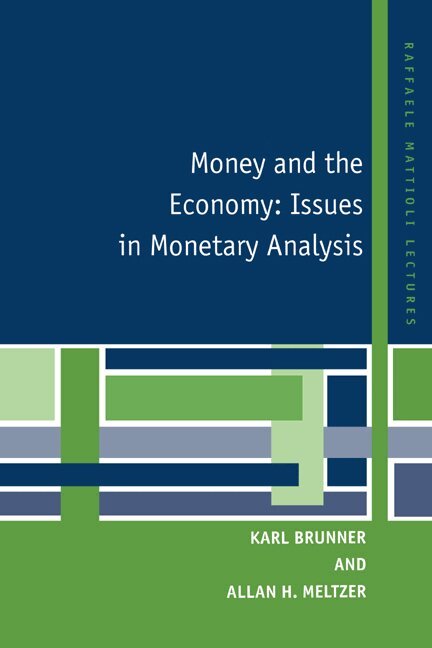
This volume offers a unique perspective on a key issue of monetary economics: the effect of money on output. Karl Brunner and Allan Meltzer address the theoretical aspects of this issue with the purpose of understanding their policy implications. They offer an historical and at times provocative overview on the relationship between money and output, and go on to present their well-known model of a monetary economy, before examining the real sector. Throughout the volume, their views are confronted with competing explanations in order to highlight differences. The monetarist flavour of the volume emerges most clearly in frequent arguments pointing to the relative stability of the private sector.
Inbunden, Engelska, 1995
2 492 kr
Skickas inom 5-8 vardagar
Money and credit are key themes of Allan H. Meltzer's ground-breaking work which is celebrated in this outstanding collection of his essays and papers. Money, Credit and Policy covers the demand for money, the relation of money to output, the role of credit and debt, regulation of financial institutions, the influence of uncertainty and macroeconomic policy. Focusing on the relations between money and credit, and in turn their relationship to output, prices and inflation, this volume includes Meltzer's early work on the demand for money - in which he suggested that the much-discussed instability of the demand for money arises from the use of Keynesian demand equations - as well as his recent contributions on trade, credit and intermediation. Among the many important papers featured in this volume, there is an analysis of why the Federal Reserve of the 1930s persisted in its deflationary policy stance for years, despite its effects, and a discussion of the limits of stabilization policy. The concluding section considers the effects of uncertainty and the reasons for the rise and fall of the dollar during the 1980s, reflecting Meltzer's continuing interest in practical policy issues.