A.N. Parshin – författare
Visar alla böcker från författaren A.N. Parshin. Handla med fri frakt och snabb leverans.
13 produkter
13 produkter
Inbunden, Engelska, 1997
1 509 kr
Skickas inom 10-15 vardagar
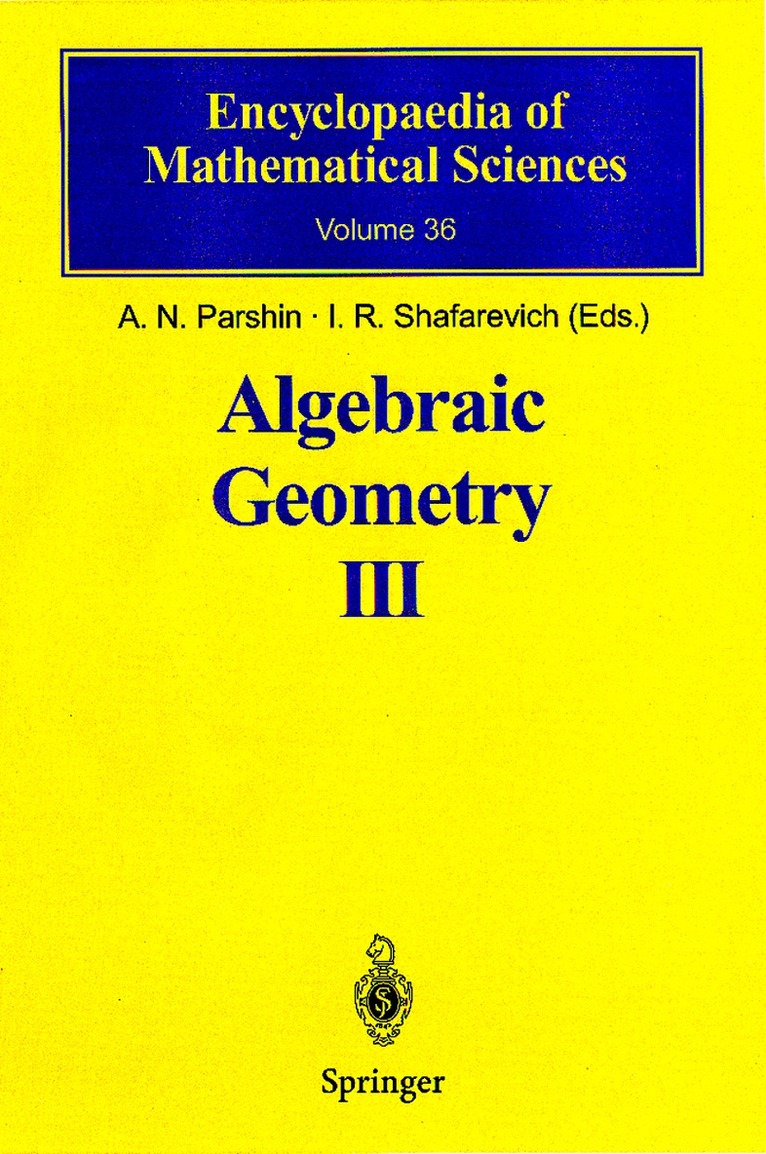
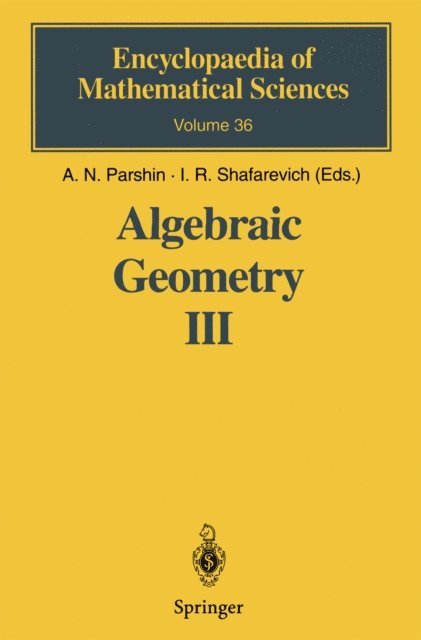
Starting with the end of the seventeenth century, one of the most interesting directions in mathematics (attracting the attention as J. Bernoulli, Euler, Jacobi, Legendre, Abel, among others) has been the study of integrals of the form r dz l Aw(T) = -, TO W where w is an algebraic function of z. Such integrals are now called abelian. Let us examine the simplest instance of an abelian integral, one where w is defined by the polynomial equation (1) where the polynomial on the right hand side has no multiple roots. In this case the function Aw is called an elliptic integral. The value of Aw is determined up to mv + nv , where v and v are complex numbers, and m and n are 1 2 1 2 integers. The set of linear combinations mv+ nv forms a lattice H C C, and 1 2 so to each elliptic integral Aw we can associate the torus C/ H. 2 On the other hand, equation (1) defines a curve in the affine plane C = 2 2 {(z,w)}. Let us complete C2 to the projective plane lP' = lP' (C) by the addition of the "line at infinity", and let us also complete the curve defined 2 by equation (1). The result will be a nonsingular closed curve E C lP' (which can also be viewed as a Riemann surface). Such a curve is called an elliptic curve.
Inbunden, Engelska, 1994
1 509 kr
Skickas inom 10-15 vardagar
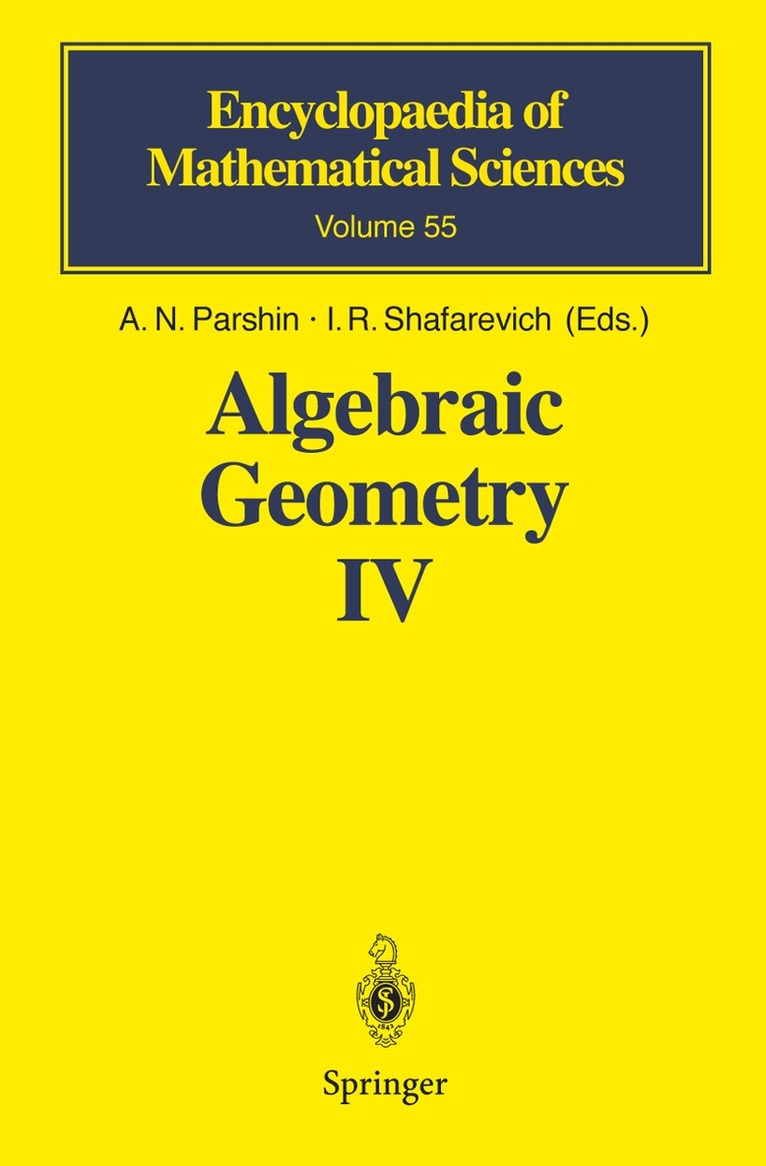
The problems being solved by invariant theory are far-reaching generalizations and extensions of problems on the "reduction to canonical form" of various is almost the same thing, projective geometry. objects of linear algebra or, what Invariant theory has a ISO-year history, which has seen alternating periods of growth and stagnation, and changes in the formulation of problems, methods of solution, and fields of application. In the last two decades invariant theory has experienced a period of growth, stimulated by a previous development of the theory of algebraic groups and commutative algebra. It is now viewed as a branch of the theory of algebraic transformation groups (and under a broader interpretation can be identified with this theory). We will freely use the theory of algebraic groups, an exposition of which can be found, for example, in the first article of the present volume. We will also assume the reader is familiar with the basic concepts and simplest theorems of commutative algebra and algebraic geometry; when deeper results are needed, we will cite them in the text or provide suitable references.
Del 44 - Encyclopaedia of Mathematical Sciences
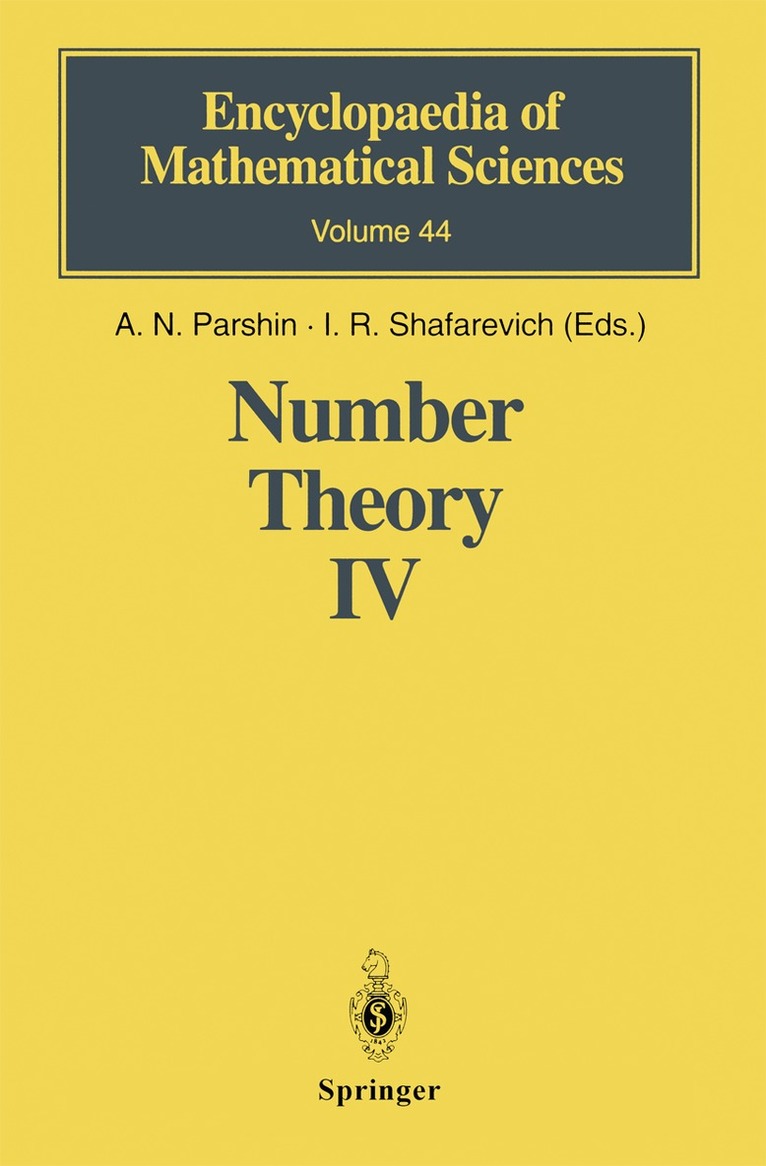
Number Theory IV
Transcendental Numbers
Inbunden, Engelska, 1997
1 616 kr
Skickas inom 10-15 vardagar
This book was written over a period of more than six years. Several months after we finished our work, N.1. Fel'dman (the senior author of the book) died. All additions and corrections entered after his death were made by his coauthor. The assistance of many of our colleagues was invaluable during the writing of the book. They examined parts of the manuscript and suggested many improvements, made useful comments and corrected many errors. I much have pleasure in acknowledging our great indebtedness to them. Special thanks are due to A. B. Shidlovskii, V. G. Chirskii, A.1. Galochkin and O. N. Vasilenko. I would like to express my gratitude to D. Bertrand and J. Wolfart for their help in the final stages of this book. Finally, I wish to thank Neal Koblitz for having translated this text into English. August 1997 Yu. V.Nesterenko Transcendental Numbers N.1. Fel'dman and Yu. V. Nesterenko Translated from the Russian by Neal Koblitz Contents Notation ...................................................... 9 Introduction ................................................... 11 0.1 Preliminary Remarks .................................. 11 0.2 Irrationality of J2 ..................................... 11 0.3 The Number 1C' •••••••••••••••••••••••••••••••••••••••• 13 0.4 Transcendental Numbers ............................... 14 0.5 Approximation of Algebraic Numbers .................... 15 0.6 Transcendence Questions and Other Branches of Number Theory ..................................... 16 0.7 The Basic Problems Studied in Transcendental Number Theory ....................................... 17 0.8 Different Ways of Giving the Numbers ................... 19 0.9 Methods .......................... . . . . . . . . . . . . . . 20 . . . . .
Inbunden, Engelska, 1998
1 509 kr
Skickas inom 10-15 vardagar
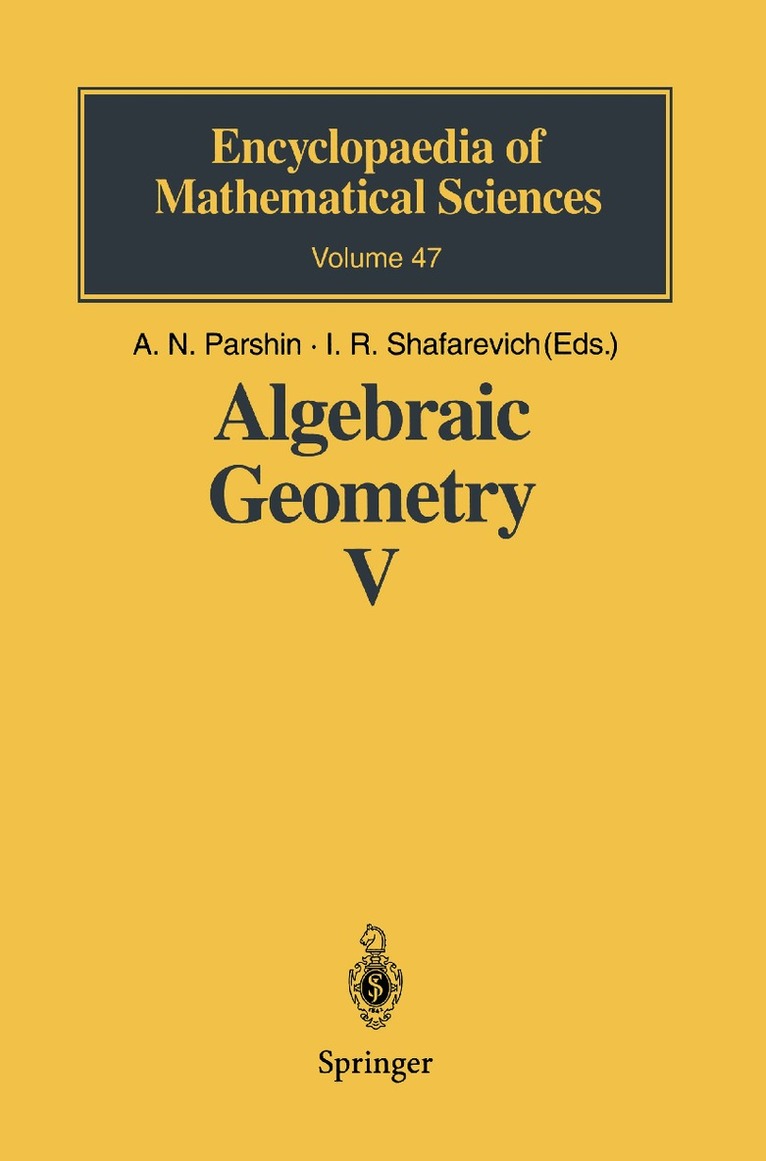
The aim of this survey, written by V.A. Iskovskikh and Yu.G. Prokhorov, is to provide an exposition of the structure theory of Fano varieties, i.e. algebraic vareties with an ample anticanonical divisor. Such varieties naturally appear in the birational classification of varieties of negative Kodaira dimension, and they are very close to rational ones. This EMS volume covers different approaches to the classification of Fano varieties such as the classical Fano-Iskovskikh "double projection" method and its modifications, the vector bundles method due to S. Mukai, and the method of extremal rays. The authors discuss uniruledness and rational connectedness as well as recent progress in rationality problems of Fano varieties. The appendix contains tables of some classes of Fano varieties. This book will be very useful as a reference and research guide for researchers and graduate students in algebraic geometry.
Häftad, Engelska, 1997
758 kr
Skickas inom 10-15 vardagar
From the reviews: "... The author succeeded in an excellent way to describe the various points of view under which Class Field Theory can be seen. ... In any case the author succeeded to write a very readable book on these difficult themes." Monatshefte fuer Mathematik, 1994"... Number theory is not easy and quite technical at several places, as the author is able to show in his technically good exposition. The amount of difficult material well exposed gives a survey of quite a lot of good solid classical number theory... Conclusion: for people not already familiar with this field this book is not so easy to read, but for the specialist in number theory this is a useful description of (classical) algebraic number theory." Medelingen van het wiskundig genootschap, 1995
Del 36 - Encyclopaedia of Mathematical Sciences
Algebraic Geometry III
Complex Algebraic Varieties Algebraic Curves and Their Jacobians
Häftad, Engelska, 2010
1 509 kr
Skickas inom 10-15 vardagar
Starting with the end of the seventeenth century, one of the most interesting directions in mathematics (attracting the attention as J. Bernoulli, Euler, Jacobi, Legendre, Abel, among others) has been the study of integrals of the form r dz l Aw(T) = -, TO W where w is an algebraic function of z. Such integrals are now called abelian. Let us examine the simplest instance of an abelian integral, one where w is defined by the polynomial equation (1) where the polynomial on the right hand side has no multiple roots. In this case the function Aw is called an elliptic integral. The value of Aw is determined up to mv + nv , where v and v are complex numbers, and m and n are 1 2 1 2 integers. The set of linear combinations mv+ nv forms a lattice H C C, and 1 2 so to each elliptic integral Aw we can associate the torus C/ H. 2 On the other hand, equation (1) defines a curve in the affine plane C = 2 2 {(z,w)}. Let us complete C2 to the projective plane lP' = lP' (C) by the addition of the "line at infinity", and let us also complete the curve defined 2 by equation (1). The result will be a nonsingular closed curve E C lP' (which can also be viewed as a Riemann surface). Such a curve is called an elliptic curve.
Del 55 - Encyclopaedia of Mathematical Sciences
Algebraic Geometry IV
Linear Algebraic Groups Invariant Theory
Häftad, Engelska, 2010
1 509 kr
Skickas inom 10-15 vardagar
The problems being solved by invariant theory are far-reaching generalizations and extensions of problems on the "reduction to canonical form" of various is almost the same thing, projective geometry. objects of linear algebra or, what Invariant theory has a ISO-year history, which has seen alternating periods of growth and stagnation, and changes in the formulation of problems, methods of solution, and fields of application. In the last two decades invariant theory has experienced a period of growth, stimulated by a previous development of the theory of algebraic groups and commutative algebra. It is now viewed as a branch of the theory of algebraic transformation groups (and under a broader interpretation can be identified with this theory). We will freely use the theory of algebraic groups, an exposition of which can be found, for example, in the first article of the present volume. We will also assume the reader is familiar with the basic concepts and simplest theorems of commutative algebra and algebraic geometry; when deeper results are needed, we will cite them in the text or provide suitable references.
Del 44 - Encyclopaedia of Mathematical Sciences
Number Theory IV
Transcendental Numbers
Häftad, Engelska, 2010
1 616 kr
Skickas inom 10-15 vardagar
This book was written over a period of more than six years. Several months after we finished our work, N.1. Fel'dman (the senior author of the book) died. All additions and corrections entered after his death were made by his coauthor. The assistance of many of our colleagues was invaluable during the writing of the book. They examined parts of the manuscript and suggested many improvements, made useful comments and corrected many errors. I much have pleasure in acknowledging our great indebtedness to them. Special thanks are due to A. B. Shidlovskii, V. G. Chirskii, A.1. Galochkin and O. N. Vasilenko. I would like to express my gratitude to D. Bertrand and J. Wolfart for their help in the final stages of this book. Finally, I wish to thank Neal Koblitz for having translated this text into English. August 1997 Yu. V.Nesterenko Transcendental Numbers N.1. Fel'dman and Yu. V. Nesterenko Translated from the Russian by Neal Koblitz Contents Notation ...................................................... 9 Introduction ................................................... 11 0.1 Preliminary Remarks .................................. 11 0.2 Irrationality of J2 ..................................... 11 0.3 The Number 1C' •••••••••••••••••••••••••••••••••••••••• 13 0.4 Transcendental Numbers ............................... 14 0.5 Approximation of Algebraic Numbers .................... 15 0.6 Transcendence Questions and Other Branches of Number Theory ..................................... 16 0.7 The Basic Problems Studied in Transcendental Number Theory ....................................... 17 0.8 Different Ways of Giving the Numbers ................... 19 0.9 Methods .......................... . . . . . . . . . . . . . . 20 . . . . .
Del 47 - Encyclopaedia of Mathematical Sciences
Algebraic Geometry V
Fano Varieties
Häftad, Engelska, 2010
1 509 kr
Skickas inom 10-15 vardagar
The aim of this survey, written by V.A. Iskovskikh and Yu.G. Prokhorov, is to provide an exposition of the structure theory of Fano varieties, i.e. algebraic vareties with an ample anticanonical divisor. Such varieties naturally appear in the birational classification of varieties of negative Kodaira dimension, and they are very close to rational ones. This EMS volume covers different approaches to the classification of Fano varieties such as the classical Fano-Iskovskikh "double projection" method and its modifications, the vector bundles method due to S. Mukai, and the method of extremal rays. The authors discuss uniruledness and rational connectedness as well as recent progress in rationality problems of Fano varieties. The appendix contains tables of some classes of Fano varieties. This book will be very useful as a reference and research guide for researchers and graduate students in algebraic geometry.
E-bok
PDF, Engelska, 2012950 kr
Läs direkt efter köp
From the reviews: "... The author succeeded in an excellent way to describe the various points of view under which Class Field Theory can be seen. ... In any case the author succeeded to write a very readable book on these difficult themes." Monatshefte fuer Mathematik, 1994"... Number theory is not easy and quite technical at several places, as the author is able to show in his technically good exposition. The amount of difficult material well exposed gives a survey of quite a lot of good solid classical number theory... Conclusion: for people not already familiar with this field this book is not so easy to read, but for the specialist in number theory this is a useful description of (classical) algebraic number theory." Medelingen van het wiskundig genootschap, 1995
E-bok
PDF, Engelska, 20121 891 kr
Läs direkt efter köp
The problems being solved by invariant theory are far-reaching generalizations and extensions of problems on the "reduction to canonical form" of various is almost the same thing, projective geometry. objects of linear algebra or, what Invariant theory has a ISO-year history, which has seen alternating periods of growth and stagnation, and changes in the formulation of problems, methods of solution, and fields of application. In the last two decades invariant theory has experienced a period of growth, stimulated by a previous development of the theory of algebraic groups and commutative algebra. It is now viewed as a branch of the theory of algebraic transformation groups (and under a broader interpretation can be identified with this theory). We will freely use the theory of algebraic groups, an exposition of which can be found, for example, in the first article of the present volume. We will also assume the reader is familiar with the basic concepts and simplest theorems of commutative algebra and algebraic geometry; when deeper results are needed, we will cite them in the text or provide suitable references.
E-bok
PDF, Engelska, 20132 049 kr
Läs direkt efter köp
This book was written over a period of more than six years. Several months after we finished our work, N.1. Fel''dman (the senior author of the book) died. All additions and corrections entered after his death were made by his coauthor. The assistance of many of our colleagues was invaluable during the writing of the book. They examined parts of the manuscript and suggested many improvements, made useful comments and corrected many errors. I much have pleasure in acknowledging our great indebtedness to them. Special thanks are due to A. B. Shidlovskii, V. G. Chirskii, A.1. Galochkin and O. N. Vasilenko. I would like to express my gratitude to D. Bertrand and J. Wolfart for their help in the final stages of this book. Finally, I wish to thank Neal Koblitz for having translated this text into English. August 1997 Yu. V.Nesterenko Transcendental Numbers N.1. Fel''dman and Yu. V. Nesterenko Translated from the Russian by Neal Koblitz Contents Notation ...................................................... 9 Introduction ................................................... 11 0.1 Preliminary Remarks .................................. 11 0.2 Irrationality of J2 ..................................... 11 0.3 The Number 1C'' •••••••••••••••••••••••••••••••••••••••• 13 0.4 Transcendental Numbers ............................... 14 0.5 Approximation of Algebraic Numbers .................... 15 0.6 Transcendence Questions and Other Branches of Number Theory ..................................... 16 0.7 The Basic Problems Studied in Transcendental Number Theory ....................................... 17 0.8 Different Ways of Giving the Numbers ................... 19 0.9 Methods .......................... . . . . . . . . . . . . . . 20 . . . . .
E-bok
PDF, Engelska, 20131 825 kr
Läs direkt efter köp
Starting with the end of the seventeenth century, one of the most interesting directions in mathematics (attracting the attention as J. Bernoulli, Euler, Jacobi, Legendre, Abel, among others) has been the study of integrals of the form r dz l Aw(T) = -, TO W where w is an algebraic function of z. Such integrals are now called abelian. Let us examine the simplest instance of an abelian integral, one where w is defined by the polynomial equation (1) where the polynomial on the right hand side has no multiple roots. In this case the function Aw is called an elliptic integral. The value of Aw is determined up to mv + nv , where v and v are complex numbers, and m and n are 1 2 1 2 integers. The set of linear combinations mv+ nv forms a lattice H C C, and 1 2 so to each elliptic integral Aw we can associate the torus C/ H. 2 On the other hand, equation (1) defines a curve in the affine plane C = 2 2 {(z,w)}. Let us complete C2 to the projective plane lP'' = lP'' (C) by the addition of the "line at infinity", and let us also complete the curve defined 2 by equation (1). The result will be a nonsingular closed curve E C lP'' (which can also be viewed as a Riemann surface). Such a curve is called an elliptic curve.