and Review Standing Committee on Technology Insight—Gauge, Evaluate – författare
564 kr
Läs direkt efter köp
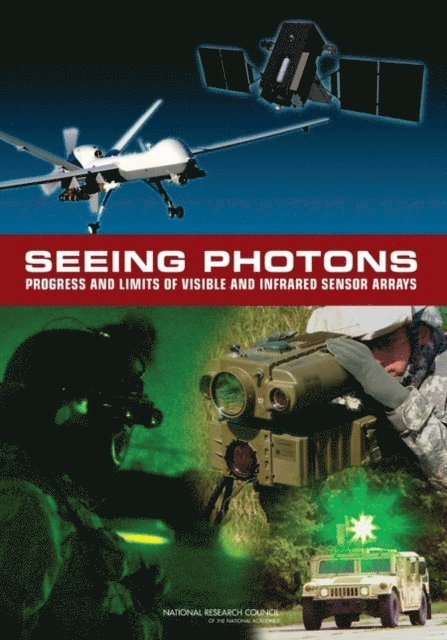
The Department of Defense recently highlighted intelligence, surveillance, and reconnaissance (ISR) capabilities as a top priority for U.S. warfighters. Contributions provided by ISR assets in the operational theaters in Iraq and Afghanistan have been widely documented in press reporting. While the United States continues to increase investments in ISR capabilities, other nations not friendly to the United States will continue to seek countermeasures to U.S. capabilities.The Technology Warning Division of the Defense Intelligence Agency''s (DIA) Defense Warning Office (DWO) has the critical responsibility, in collaborations with other components of the intelligence community (IC), for providing U.S. policymakers insight into technological developments that may impact future U.S. warfighting capabilities. To this end, the IC requested that the National Research Council (NRC) investigate and report on key visible and infrared detector technologies, with potential military utility, that are likely to be developed in the next 10-15 years. This study is the eighth in a series sponsored by the DWO and executed under the auspices of the NRC TIGER (Technology Insight-Gauge, Evaluate, and Review) Standing Committee.
412 kr
Läs direkt efter köp
An increase in global access to goods and knowledge is transforming world-class science and technology (S&T) by bringing it within the capability of an unprecedented number of global parties who must compete for resources, markets, and talent. In particular, globalization has facilitated the success of formal S&T plans in many developing countries, where traditional limitations can now be overcome through the accumulation and global trade of a wide variety of goods, skills, and knowledge. As a result, centers for technological research and development (R&D) are now globally dispersed, setting the stage for greater uncertainty in the political, economic, and security arenas.These changes will have a potentially enormous impact for the U.S. national security policy, which for the past half century was premised on U.S. economic and technological dominance. As the U.S. monopoly on talent and innovation wanes, arms export regulations and restrictions on visas for foreign S&T workers are becoming less useful as security strategies. The acute level of S&T competition among leading countries in the world today suggests that countries that fail to exploit new technologies or that lose the capability for proprietary use of their own new technologies will find their existing industries uncompetitive or obsolete. The increased access to information has transformed the 1950s'' paradigm of "control and isolation" of information for innovation control into the current one of "engagement and partnerships" between innovators for innovation creation. Current and future strategies for S&T development need to be considered in light of these new realities.This book analyzes the S&T strategies of Japan, Brazil, Russia, India, China, and Singapore (JBRICS), six countries that have either undergone or are undergoing remarkable growth in their S&T capabilities for the purpose of identifying unique national features and how they are utilized in the evolving global S&T environment.
807 kr
Läs direkt efter köp
The Department of Defense recently highlighted intelligence, surveillance, and reconnaissance (ISR) capabilities as a top priority for U.S. warfighters. Contributions provided by ISR assets in the operational theaters in Iraq and Afghanistan have been widely documented in press reporting. While the United States continues to increase investments in ISR capabilities, other nations not friendly to the United States will continue to seek countermeasures to U.S. capabilities.The Technology Warning Division of the Defense Intelligence Agency''s (DIA) Defense Warning Office (DWO) has the critical responsibility, in collaborations with other components of the intelligence community (IC), for providing U.S. policymakers insight into technological developments that may impact future U.S. warfighting capabilities. To this end, the IC requested that the National Research Council (NRC) investigate and report on key visible and infrared detector technologies, with potential military utility, that are likely to be developed in the next 10-15 years. This study is the eighth in a series sponsored by the DWO and executed under the auspices of the NRC TIGER (Technology Insight-Gauge, Evaluate, and Review) Standing Committee.
605 kr
Läs direkt efter köp
An increase in global access to goods and knowledge is transforming world-class science and technology (S&T) by bringing it within the capability of an unprecedented number of global parties who must compete for resources, markets, and talent. In particular, globalization has facilitated the success of formal S&T plans in many developing countries, where traditional limitations can now be overcome through the accumulation and global trade of a wide variety of goods, skills, and knowledge. As a result, centers for technological research and development (R&D) are now globally dispersed, setting the stage for greater uncertainty in the political, economic, and security arenas.These changes will have a potentially enormous impact for the U.S. national security policy, which for the past half century was premised on U.S. economic and technological dominance. As the U.S. monopoly on talent and innovation wanes, arms export regulations and restrictions on visas for foreign S&T workers are becoming less useful as security strategies. The acute level of S&T competition among leading countries in the world today suggests that countries that fail to exploit new technologies or that lose the capability for proprietary use of their own new technologies will find their existing industries uncompetitive or obsolete. The increased access to information has transformed the 1950s'' paradigm of "control and isolation" of information for innovation control into the current one of "engagement and partnerships" between innovators for innovation creation. Current and future strategies for S&T development need to be considered in light of these new realities.This book analyzes the S&T strategies of Japan, Brazil, Russia, India, China, and Singapore (JBRICS), six countries that have either undergone or are undergoing remarkable growth in their S&T capabilities for the purpose of identifying unique national features and how they are utilized in the evolving global S&T environment.